Wire Size Calculator - Voltage Drop and Cable Sizing
Use this wire size calculator to find the minimum required cross-sectional area and suggested AWG size to keep voltage drop within safe electrical limits.
Wire Size Calculator
Results
What Is Wire Size Calculator?
A wire size calculator is a specialized educational and engineering planning tool designed to determine the minimum cross-sectional area and gauge of an electrical conductor required to safely and efficiently power an electrical load over a specified distance. Choosing the correct conductor size is one of the most critical aspects of electrical system design, as undersized wires can lead to significant voltage drops, excessive energy waste, and serious fire hazards.
- • Home Renovation Planning: When adding electrical outlets, lighting fixtures, or EV chargers to a property, homeowners and apprentices can determine the necessary AWG copper wire size to comply with voltage drop limits.
- • Off-Grid Solar DC Systems: Low-voltage setups (12V or 24V solar arrays) are highly sensitive to voltage drops. Even minor drops represent massive percentage power losses, making precise cable sizing essential.
- • Industrial Three-Phase Sizing: For industrial installations, electricians size conductors feeding three-phase AC motors using appropriate phase multipliers to optimize cable cross-sections.
- • Long-Distance Cable Runs: In agricultural or outdoor lighting projects where power traverses hundreds of meters, resistance accumulates rapidly. Sizing prevents excessive voltage drops over long distances.
Every electrical wire offers resistance to current flow, determined by material resistivity, length, and area. As current passes through, energy is dissipated as heat, causing voltage to drop. Planning with a wire size calculator ensures systems operate within standard safety margins, minimizing efficiency losses and prolonging equipment life.
Just as managing resistance is key to preventing voltage drop, proper semiconductor design requires accurate current flow calculations, which you can explore with the Transistor Biasing Calculator.
How Wire Size Calculator Works
The calculator computes the resistance limits necessary to keep voltage drop under a specified percentage of source voltage. The core math relies on Ohm’s Law and the formula for conductor resistance.
- A: The minimum required cross-sectional area of the conductor in square meters (converted to square millimeters).
- rho (Resistivity): Specific electrical resistivity at nominal operating temperature. Nominally, 1.72 x 10^-8 Ohm-meters for copper, and 2.82 x 10^-8 Ohm-meters for aluminum.
- L (Distance): One-way distance of the run in meters. The formula accounts for the return path (doubling the distance) in DC and single-phase.
- I (Current): Peak load current in Amperes representing the maximum demand.
- V_drop (Voltage Drop): Maximum acceptable voltage drop in Volts, found by multiplying source voltage by the allowable percentage.
Required conductor area increases proportionally with current load and distance. Doubling the run length requires doubling the cross-sectional area to maintain the same voltage drop. Increasing source voltage while keeping power demand constant decreases required wire size.
The calculator output provides the minimum area in mm² and the closest standard American Wire Gauge (AWG) size. According to <a href="https://www.omnicalculator.com/physics/wire-size" target="_blank" rel="noopener noreferrer">Omni Calculator Wire Size Reference</a>, calculating wire size requires adjusting the single-phase copper cross-sectional area to three-phase and aluminum variants using precise physical resistivity constants.
Copper Single-Phase AC Run (120V Circuit)
Consider a 120V single-phase AC circuit drawing a 15A current load over a distance of 30 meters. The allowable voltage drop limit is set to 3%.
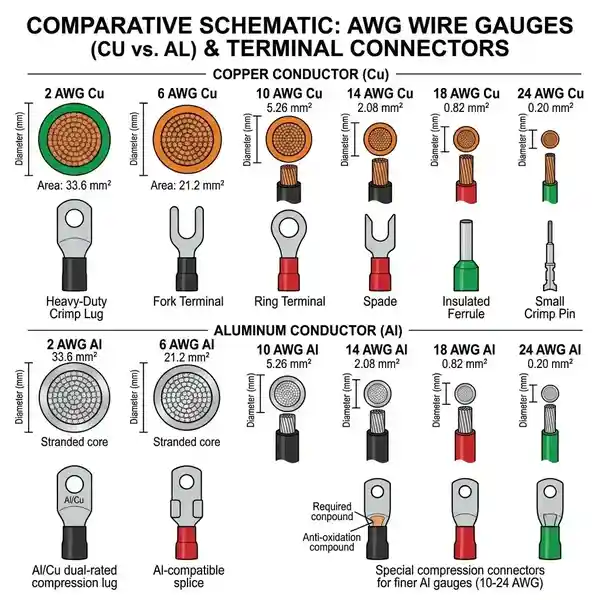
1. Find allowable voltage drop: V_drop = 120V * 0.03 = 3.6 Volts. 2. Apply single-phase formula: A = (2 * 1.72e-8 * 30 * 15) / 3.6 = 0.00001548 / 3.6 = 4.30e-6 m2. 3. Convert to square millimeters: Area = 4.30e-6 * 1,000,000 = 4.30 mm2. 4. Map to AWG: 12 AWG wire has an area of 3.31 mm2 (too small), while 10 AWG wire has an area of 5.26 mm2 (sufficient). Therefore, we suggest 10 AWG.
Minimum Area: 4.30 mm², Suggested AWG: 10 AWG
A standard 12 AWG wire would normally carry 15A over short distances safely. However, because the distance is 30 meters, a larger 10 AWG wire is required to keep the voltage drop below 3.6 Volts (3%).
According to Omni Calculator Wire Size Reference, calculating wire size requires adjusting the single-phase copper cross-sectional area to three-phase and aluminum variants using precise physical resistivity constants.
To see how small changes in conductor resistance can be measured precisely, refer to the Wheatstone Bridge Calculator which demonstrates differential resistance balancing.
Key Concepts Explained
Understanding electrical conduction requires familiarity with several fundamental terms and physics principles that govern wire design.
Material Electrical Resistivity
Resistivity measures how strongly a material opposes current flow. Materials like copper have low resistivity, meaning electrons flow easily, whereas materials like aluminum have higher resistivity, requiring larger physical sizes to achieve the same electrical performance.
Voltage Drop and Power Loss
As current travels through a resistive wire, voltage is dropped along the path. Excessive voltage drop can cause connected appliances and motors to stall, lights to flicker, or digital devices to reset due to under-voltage conditions.
American Wire Gauge (AWG)
AWG is a standardized logarithmic wire gauge system. The gauge numbers represent the drawing steps required. Because of this, larger gauge numbers represent thinner wires, while smaller numbers represent thicker conductors.
Conductor Ampacity Limits
Ampacity is the maximum current a conductor can carry continuously without exceeding its temperature rating. Sizing must satisfy both ampacity safety limits and voltage drop efficiency limits.
When selecting a conductor, designers must balance resistance limits (voltage drop) and thermal limits (ampacity). A wire might have sufficient ampacity to carry a current safely, but over long distances, cumulative resistance yields unacceptable voltage drop, requiring wire upsizing.
The interaction of conductor resistance and load capacitance also plays a role in signal timing, detailed in our RC Filter Calculator.
How to Use This Calculator
Follow these simple steps to determine the correct wire size using the inputs:
- 1 Select System Type: Choose between Direct Current (DC), Single-Phase AC, or Three-Phase AC. This determines whether the calculator uses the single-phase multiplier (2) or the three-phase phase factor (sqrt of 3).
- 2 Choose Material: Select Copper or Aluminum. Copper is standard for branch circuits due to its efficiency, while aluminum is selected for large feeders due to lower material costs.
- 3 Enter Source Voltage: Input supply voltage. Common values include 12V or 24V DC, 120V or 240V single-phase, and 208V, 240V, or 480V three-phase systems.
- 4 Input Load Current: Type maximum continuous current load in Amperes (A). If you only know wattage, divide wattage by supply voltage to find current.
- 5 Specify Distance: Provide one-way distance from power source to load in meters. The calculation automatically accounts for the return path.
- 6 Define Voltage Drop Limit: Input desired percentage limit. A standard engineering recommendation is 3% for branch circuits to ensure proper voltage delivery.
For example, to size a feeder cable for a detached garage drawing 40A at 240V single-phase AC over 50 meters, choose Single-Phase AC, Copper, 240V, 40A, 50 meters, and a 3% drop limit. The calculator reports a voltage drop limit of 7.2V, a minimum required area of 9.56 mm², and suggests using a 6 AWG copper conductor.
Benefits of Using This Calculator
Sizing your conductors correctly offers several critical benefits:
- • Prevents Hazards: Proper wire sizing prevents heat build-up along the cable run, reducing risk of insulation degradation and electrical fires.
- • Ensures Performance: Maintains voltage stability under heavy load, ensuring connected appliances and motors run at peak efficiency.
- • Reduces Energy Waste: Lower resistance minimizes power loss as heat, lowering electrical utility costs and saving energy.
- • Optimizes Cost: Helps select the ideal material (copper vs. aluminum) and size, preventing expensive over-purchasing.
- • Simplifies Checks: Provides quick arithmetic cross-checks for students, installers, and apprentices learning electrical design.
Sizing wire is not just about choosing the absolute largest wire available. Oversized conductors are heavy, difficult to pull through conduit, require larger boxes, and cost more money. Practical engineering is about finding the optimal balance: a conductor that is safe, complies with code, limits voltage drop, and remains cost-effective.
Factors That Affect Your Results
Several physical variables influence resistance and gauge:
Conductor Material Quality
Copper has lower resistivity than aluminum, allowing thinner copper wires to carry the same current as thicker aluminum ones. However, aluminum is lighter and less expensive, leading to trade-offs in structural support and budget.
Ambient Temperature
Electrical resistance increases as conductor temperature rises. In hot environments, wires have higher resistance and lower ampacity, requiring designers to apply temperature derating factors.
Conduit and Bundle Sizing
When multiple current-carrying conductors are grouped in a single conduit, heat cannot dissipate easily. This requires derating conductor ampacity, which may force selection of a larger wire size.
- • This calculator assumes a constant conductor temperature and standard nominal resistivity values. It does not account for severe temperature changes or specific insulation temperature ratings.
- • Calculations are based purely on voltage drop constraints. Real-world installations must verify that the chosen wire satisfies local electrical code thermal ampacity limits.
Electricians must consult official reference sources like the National Electrical Code (NEC) to ensure compliance. Factors such as whether a wire is run underground, through conduit, or exposed to moisture change the required wire type, which is not captured by a simple voltage drop model.
According to the <a href="https://www.nfpa.org/codes-and-standards/all-codes-and-standards/list-of-codes-and-standards/detail?code=70" target="_blank" rel="noopener noreferrer">National Electrical Code (NEC)</a> Section 210.19, maintaining a voltage drop limit of 3% on branch circuits ensures optimal performance and prevents electrical equipment from operating under under-voltage conditions.
According to National Electrical Code (NEC), maintaining a voltage drop limit of 3% on branch circuits ensures optimal performance and prevents electrical equipment from operating under under-voltage conditions.
In cases where high resistance leads to thermal energy waste, calculations from the Water Heating Calculator show how power loss translates directly to heat generation.
Frequently Asked Questions
Q: How do I calculate wire size for motors?
A: Calculating wire size for a motor involves determining the full-load current rating, adding a 25% safety margin for continuous duty per NEC guidelines, then applying the standard voltage drop equation using the material resistivity. This ensures the start-up current does not cause excessive voltage drop.
Q: How do I calculate wire size for 3 phase?
A: To calculate the wire size for a three-phase system, we adjust the formula to account for the phase distribution factor. Instead of multiplying by 2 (for out-and-back wire runs), we multiply by the square root of three (approximately 1.732) to compute the required cross-sectional conductor area.
Q: How do I calculate AWG wire size?
A: AWG, or American Wire Gauge, can be computed mathematically based on the wire diameter or cross-sectional area. The gauge scale is logarithmic, where each step represents a ratio of the diameter. Generally, the required area calculated in mm² is matched to the nearest standard AWG wire size.
Q: How do I calculate wire size for distance?
A: Wire size is directly proportional to distance. When electrical current runs through longer cables, resistance increases, leading to a greater voltage drop. To keep the voltage drop within safe limits, you must increase the cross-sectional area of the wire proportionally as the cable distance increases.
Q: Why does the conductor material affect the required wire size?
A: The material determines the electrical resistivity. Copper has a low resistivity of 1.72e-8 Ohm-meters, making it highly efficient. Aluminum has a higher resistivity of 2.82e-8 Ohm-meters, meaning an aluminum conductor must be physically larger than a copper conductor to carry the same current without overheating.