Books vs Ebooks Calculator - Carbon Footprint comparison
Use this books vs ebooks calculator to compare the environmental impact of physical books versus digital e-readers. Calculate CO2 emissions and trees equivalent.
Books vs Ebooks Calculator
Results
What Is the Books vs Ebooks Calculator?
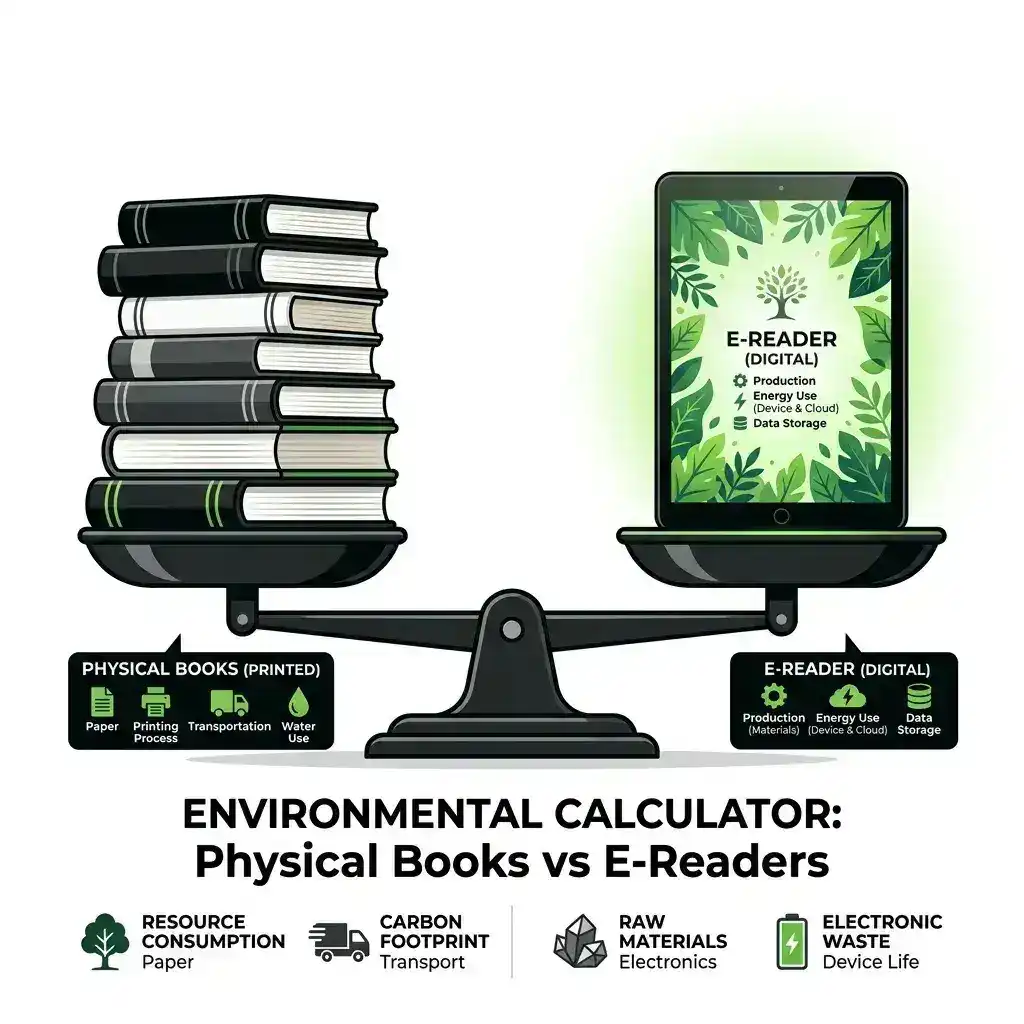
A free books vs ebooks calculator compares the carbon footprint of physical paper books versus digital e-readers based on your reading habits to determine which option is more environmentally friendly. It takes your yearly reading rate and the expected lifespan of your e-reader, then outputs total CO2 emissions, your personal environmental break-even point, and the equivalent count of mature trees saved or needed. Use this tool to evaluate your carbon impact, choose the most sustainable medium, and make eco-friendly decisions for your personal library.
- • Eco-friendly library planning: Assess if buying an e-reader will reduce your greenhouse gas footprint based on your yearly reading rate.
- • Sustainable school buying: Compare school textbook printing carbon costs against purchasing electronic tablets or dedicated e-readers.
- • Gift decision helper: Check if gifting an e-reader to a friend or relative makes environmental sense based on their specific reading frequency.
- • Personal offset tracking: Calculate how many years you must hold onto your current digital reading device to ensure a net positive impact.
Many avid readers assume that going digital is automatically the greenest path. However, manufacturing e-readers demands intensive mineral extraction, silicon refining, and international shipping, creating a massive upfront environmental debt. Physical paper books, on the other hand, require wood pulp harvesting, printing chemical inputs, and heavy cargo transport, which accumulates a steady environmental cost for every single copy.
To find the true environmental winner, we must examine the break-even threshold. The books vs ebooks calculator provides a direct, math-based answer, showing you exactly how many books you must read on a single device before its per-book amortized carbon footprint falls below that of traditional paper publishing.
To see how your overall household emissions stack up beyond your reading desk, our comprehensive carbon footprint calculator tracks household energy, transportation, and waste to give you a complete view of your environmental impact.
How the Books vs Ebooks Calculator Works
This calculator uses lifecycle assessment data to compare the greenhouse gas impact of your reading formats. It calculates total digital emissions, compares them to paper printing equivalents, and translates the difference into tree-absorption years.
- Books: The number of books you read or buy in a single year.
- Lifespan: The number of years you use the e-reader before it is replaced or retired.
- Book_Emissions: The lifecycle carbon emissions of a printed book, default of 7.46 kg CO2 based on Cleantech Group data.
- Device_Lifecycle_Emissions: The full lifecycle emissions of the e-reader, defaulting to 168.0 kg CO2.
The calculations rely on standard baseline numbers derived from environmental research. A landmark study by the Cleantech Group established the average footprint of a printed book at 7.46 kg CO2, while a single Kindle or e-reader represents approximately 168.0 kg CO2 of carbon emissions across its complete lifecycle, from production to disposal.
The calculator also computes the environmental break-even point by dividing the e-reader's total lifecycle footprint by the footprint of a single paper book. This threshold indicates the exact count of books where the digital format becomes cleaner than paper.
Moderate Reader (12 books per year, 4-year e-reader lifespan)
Books = 12 books/yr, Lifespan = 4 years, Book_Emissions = 7.46 kg, Device = 168.0 kg.
Total Books = 12 * 4 = 48 books. Physical Footprint = 48 * 7.46 = 358.1 kg CO2. E-reader Footprint = 168.0 kg CO2. Net Carbon Savings = 358.1 - 168.0 = 190.1 kg CO2 saved. Trees Offset = 190.1 / 21.77 = 8.73 tree-years.
Net Carbon Savings = 190.1 kg CO2; Break-even point = 22.5 books; Trees equivalent = 8.73 tree-years.
Since 48 books is greater than the 22.5 book break-even point, using the e-reader is the more sustainable option.
According to U.S. Environmental Protection Agency, a mature tree absorbs approximately 48 pounds or 21.77 kilograms of CO2 per year
To see how recycling your paper books or old electronics changes your carbon balance, the recycling impact calculator details how waste diversion reduces municipal carbon output.
Key Concepts Behind Paper vs Digital Reading Footprints
Understanding these four core concepts helps clarify why reading volume and device longevity dictate which format is truly more sustainable.
Upfront device manufacturing debt
E-readers require rare-earth mining, metal extraction, and energy-dense battery production, creating a high carbon debt of around 168 kg CO2 before the screen is turned on.
Amortisation of carbon emissions
As you read more digital books, the fixed carbon debt of the e-reader is distributed over a larger volume, driving the carbon cost per book down.
Paper lifecycle factors
Paper books accumulate carbon emissions linearly. Each new copy requires wood harvesting, industrial bleaching, chemical printing, and shipping weight.
Tree sequestration equivalent
Translating kilograms of carbon dioxide into tree-years makes abstract greenhouse gases concrete. It shows how many trees' annual work is offset by your reading format.
These concepts demonstrate why the environmental impact is dynamic rather than static. A paper book's footprint is locked in during production and shipping, whereas an e-reader's relative footprint improves with every book read.
Just like amortising an e-reader's carbon debt, our solar panel ROI calculator demonstrates how the high upfront financial and carbon costs of solar installations pay off over years of clean energy production.
How to Use This Books vs Ebooks Calculator
Follow these simple steps to compare your reading footprint and discover your break-even threshold.
- 1 Enter your annual reading rate: Type the number of books you read or purchase in a typical year.
- 2 Input the e-reader lifespan: Specify how many years you expect to keep and use the same e-reader before replacing it.
- 3 Adjust the printed book footprint (optional): Keep the default 7.46 kg CO2 or adjust it if you buy primarily large hardcovers (higher footprint) or lightweight paperbacks (lower footprint).
- 4 Adjust the e-reader lifecycle footprint (optional): Modify the default 168 kg CO2 if you use a larger tablet (higher footprint) or a highly efficient basic e-reader (lower footprint).
- 5 Read the net carbon results: Review the total books, comparative footprints, net carbon savings, and the equivalent tree-years offset.
If you read 8 books a year and keep your e-reader for 3 years, you will read 24 books total. With standard footprints, your physical footprint is 179.0 kg CO2, while the e-reader is 168.0 kg CO2. The e-reader saves 11.0 kg CO2, equivalent to 0.51 tree-years. Because 24 books exceeds the 22.5 break-even point, the e-reader is slightly greener.
For another classic household energy comparison, the electric vs gas appliance calculator matches the carbon footprints and operating costs of electric versus gas devices.
Benefits of the Books vs Ebooks Calculator
Comparing media footprints helps individuals and schools optimize their purchasing habits for sustainability. Here are the primary benefits:
- • Identify your ecological break-even point: Discover exactly how many books you must read on a digital device to justify its upfront carbon manufacturing cost.
- • Optimise device replacement cycles: Visualize how extending the life of your e-reader from 3 to 6 years dramatically increases your net carbon savings.
- • Inform institutional purchasing: Help schools and libraries decide whether to transition to digital textbook tablets or stick to physical printing.
- • Track carbon offsets with tree equivalents: Understand your carbon footprint in terms of tree absorption, making environmental data easy to comprehend.
- • Compare custom book and device footprints: Model different scenarios, such as comparing a heavy tablet footprint against a lightweight pocket paper book.
By putting precise numbers on your reading habits, this calculator moves the discussion beyond generalities. It shows that light readers are actually more sustainable reading physical paper, while heavy readers achieve substantial gains with digital screens.
Once you have optimised your library footprint, you can use our home energy audit calculator to audit your household heating, cooling, and appliance power consumption to lower your total carbon output.
Factors That Influence Reading Carbon Footprints
The basic break-even point is a good guide, but several real-world variables can alter the actual environmental impact.
Device type and size
A dedicated, low-power e-ink e-reader has a lower manufacturing footprint than a large, multi-use tablet or laptop, which can exceed 300 kg CO2.
Reading material sources
Borrowing books from a public library or buying used paperbacks distributes the printing footprint across multiple readers, dropping your personal footprint per book close to zero.
Paper manufacturing processes
Books printed on recycled paper or sourced from certified sustainable forestry have a lower footprint than those using virgin wood pulp.
Device charging electricity mix
Charging your e-reader using solar power or a renewable grid produces virtually zero operational emissions, whereas charging on a coal-heavy grid accumulates a small carbon cost over time.
- • The calculator focuses primarily on greenhouse gas emissions and does not fully quantify other environmental issues like electronic waste, chemical pollution, or water usage in paper mills.
- • It assumes that digital books completely replace the purchase of new physical books, rather than supplement a mixed reading style.
According to the University of Michigan Center for Sustainable Systems, evaluating environmental impacts of consumer choices requires analyzing full lifecycle manufacturing and lifetime usage patterns.
To see how upgrading other household fixtures to efficient alternatives compares to upgrading your reading style, our led vs incandescent bulb savings calculator compares utility bill and carbon savings from light bulb upgrades.
Frequently Asked Questions
Q: How many books do I need to read on an e-reader to break even environmentally?
A: Using standard baseline figures, the environmental break-even point is approximately 22.5 books. This means you must read at least 23 books on your e-reader to offset the carbon footprint of its manufacturing and lifecycle compared to purchasing new physical books.
Q: What is the carbon footprint of a single printed book?
A: A standard physical paper book has an average carbon footprint of approximately 7.46 kg CO2. This includes wood harvesting, paper mill processing, printing ink chemical production, and cargo transport to retail stores.
Q: What is the lifecycle carbon footprint of an e-reader?
A: A dedicated digital e-reader has a complete lifecycle footprint of about 168.0 kg CO2. The vast majority of this footprint comes from resource-intensive mineral extraction and manufacturing processes, followed by shipping and electrical charging.
Q: Are libraries more eco-friendly than buying e-books?
A: Yes. Borrowing physical books from a public library is the most sustainable reading method. Sharing books among dozens of readers distributes the initial paper manufacturing footprint, dropping the individual impact per reading close to zero.
Q: What environmental factors besides carbon footprint are involved in paper vs. digital books?
A: Beyond CO2, printed books consume significant water and require bleach and ink chemicals. Digital e-readers generate toxic electronic waste at the end of their lives and rely on mined materials like lithium and cobalt.
Q: How does the ecological footprint of a tablet compare to a dedicated e-reader?
A: Multi-purpose tablets have a much higher footprint than e-ink readers. A typical tablet represents over 300 kg CO2 due to high-power processors and screens, meaning you must read far more digital books to reach an ecological break-even point.