Retention Ratio Calculator - Reinvestment and Plowback
Use this retention ratio calculator to compare net income and dividends paid, see retained earnings, and read the plowback ratio.
Retention Ratio Calculator
Results
What Is Retention Ratio Calculator?
A retention ratio calculator shows what share of a company's net income is kept inside the business after dividends are paid. Use it when screening a public company for growth funding, comparing reinvestment policy across peers, or turning an annual report into a quick reinvestment view. The result is a diagnostic ratio, not a buy or sell signal, so it should sit beside ROE, cash flow, debt levels, and the company's stated capital plan.
- • Growth stock screening: Compare retention ratios across companies to identify firms that fund growth from earnings rather than debt or new shares.
- • Dividend review: Check whether a new dividend still leaves enough retained earnings for reinvestment and balance sheet flexibility.
- • Annual report analysis: Translate total dollars of net income and dividends paid into a single reinvestment percentage for a slide.
- • Valuation work: Use the plowback ratio inside the Gordon growth model so sustainable growth matches actual reinvestment policy.
A 65% retention ratio means the company kept 65 cents of every dollar of net income inside the business and paid out 35 cents as dividends. The retained portion may fund new projects, working capital, acquisitions, debt reduction, buybacks, or cash reserves. Retention and payout are complements, so they add up to 100% when net income is positive.
The calculator supports two matching methods. The total-dollar method uses net income and dividends paid. The per-share method uses EPS and dividends per share, which is convenient when screening a single stock. Both arrive at the same retention percentage when they cover the same period, share class, and accounting basis.
For the matching dividend-payout-ratio-calculator view, use the Dividend Payout Ratio Calculator to confirm that the payout percentage and the retention percentage sum to 100% when net income is positive.
How Retention Ratio Calculator Works
The calculator subtracts dividends from earnings to get retained earnings, then divides by earnings to produce the retention ratio and the matching payout ratio.
- Net income: Total profit for the period after expenses, interest, and taxes. In per-share mode this becomes EPS.
- Dividends paid: Common dividends for the same period. In per-share mode this becomes annual dividends per share.
- Retained earnings: Net income minus dividends paid, or EPS minus dividends per share. The dollar amount reinvested for the period.
- Retention ratio: Retained earnings divided by net income, shown as a percentage. Also called the plowback ratio.
- Payout ratio: The matching dividend payout ratio, shown for cross-check. Equals 100% minus the retention ratio when net income is positive.
Internal growth equals the retention ratio multiplied by return on equity. The form takes a return on equity input, so the Internal Growth Capacity result shows that product directly. Retained earnings is shown separately because the dollar amount is what funds new investment.
The calculator reports a negative retention ratio without throwing an error, because a negative result is informative on its own. It means the company is distributing more than it earned in the period, which is not automatically a problem if reserves, asset sales, or financing cover the gap, but it deserves a closer look.
Worked example: Company Alpha
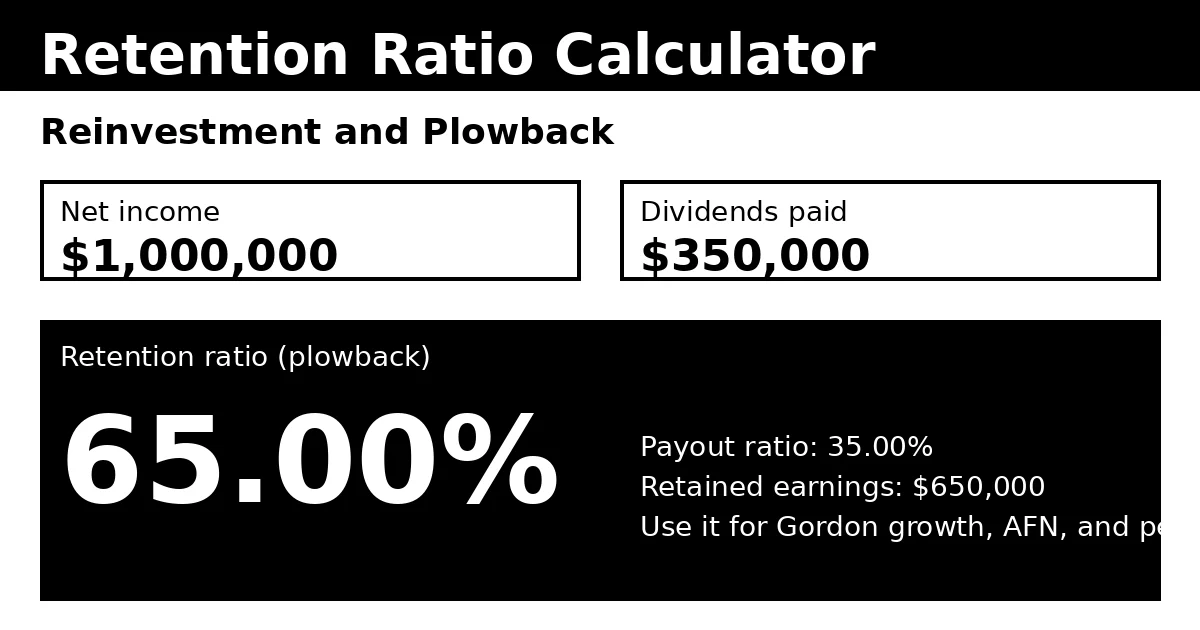
Net income = $1,000,000. Dividends paid = $350,000.
Retained earnings = $1,000,000 - $350,000 = $650,000. Retention ratio = $650,000 / $1,000,000 x 100 = 65.00%. Payout ratio = 100% - 65.00% = 35.00%.
The retention ratio is 65.00%.
Company Alpha is reinvesting roughly two thirds of its profit back into the business, with the remaining one third distributed to shareholders.
Worked example: per-share check
EPS = $5.00. Dividends per share = $2.00.
Retained earnings per share = $5.00 - $2.00 = $3.00. Retention ratio = $3.00 / $5.00 x 100 = 60.00%. Payout ratio = $2.00 / $5.00 x 100 = 40.00%.
The retention ratio is 60.00%.
On a per-share basis, 60% of earnings stay inside the firm and 40% are paid out, which matches the same logic as the total-dollar method.
According to Corporate Finance Institute, the dividend payout ratio formula can be expressed as dividends per share divided by earnings per share, or as dividends divided by net income
When the retention ratio is fed into a Gordon growth model, the Dividend Discount Model Calculator shows how the plowback rate and return on equity combine into a sustainable growth rate.
Key Concepts Explained
These four concepts frame how a retention ratio is read and where it can mislead.
Plowback ratio
Another name for the retention ratio. The two terms refer to the same formula: retained earnings divided by net income.
Complement to payout
Retention and payout ratios sum to 100% when net income is positive. Knowing one gives the other without recalculating.
Internal growth funding
The retained dollar amount, not just the percentage, is what funds new investment. Two firms with the same percentage can reinvest very different absolute amounts.
Retention in valuation
Inside the Gordon growth model, growth equals retention times return on equity. High retention supports growth only if ROE is also strong.
The retention ratio is sometimes confused with dividend yield, but the two answer different questions. Yield compares annual dividends with the share price. Retention compares dividends with earnings, which makes it a coverage and policy metric rather than an income metric.
A retention ratio is only as reliable as the earnings number behind it. One-time gains, asset sales, impairments, tax effects, and restructuring charges can swing net income for a single period. Multi-year averages and cash flow cross-checks usually tell a cleaner reinvestment story.
Because additional funds needed depends on how much of net income is kept inside the firm, the AFN Calculator is a natural next step when the retention ratio shows limited reinvestment room.
How to Use This Calculator
Use the retention ratio calculator with one method at a time and keep the period consistent from start to finish.
- 1 Pick a method: Choose total dollars for a company-level review, or per share when screening a stock with EPS and dividends per share.
- 2 Enter earnings: Use net income for the same fiscal year, trailing twelve months, or quarter set that matches the dividend figure.
- 3 Enter dividends: Use total common dividends paid or annual dividends per share. Treat special dividends separately unless your review intentionally includes them.
- 4 Read the retention ratio: Compare the percentage with the reinvestment plan, ROE, industry norms, and the share of profit needed to fund debt or working capital.
- 5 Cross-check with payout: The matching payout ratio should equal 100% minus the retention ratio. If it does not, double-check that the inputs cover the same period and share class.
- 6 Read the growth capacity: Enter the return on equity to populate Internal Growth Capacity, which is the retention ratio times that return on equity.
For a board memo, enter $10 million of net income, $3.5 million of dividends paid, and 12% return on equity. The retention ratio is 65%, payout ratio is 35%, retained earnings are $6.5 million, and Internal Growth Capacity is 7.8%.
Before you check the retention ratio, the Dividend Calculator helps estimate the annual dividend cash flow from shares, payout frequency, and dividend per share.
Benefits of Using This Calculator
The value is not just the percentage; it is the discipline of matching dividends with earnings and turning that into a reinvestment view.
- • Connects policy with growth: Turns dividend policy and earnings into the same ratio, which makes the reinvestment story easier to explain and audit.
- • Surfaces the funding gap: When retention is low, retained earnings may not cover capex or acquisitions, which is a useful flag for capital planning.
- • Supports peer review: A consistent calculation method makes retention ratios comparable across companies and across years.
- • Feeds valuation models: Provides the plowback rate for the Gordon growth model, so growth assumptions match actual policy.
- • Pairs well with ROE: Retention times ROE approximates internal growth, so the same inputs work for both reinvestment review and valuation work.
- • Catches unusual periods: Negative or above-100% results are visible at a glance, which makes it easier to spot one-time gains, special dividends, or losses masking distributions.
For growth investors, the retention ratio helps distinguish a company that funds expansion from earnings from one that relies on debt or share issuance. For income investors, a low retention ratio can signal that distributions are sustainable, while a high ratio can point to future dividend growth once reinvestment slows.
The ratio is most useful as a trend line. Compare several years of retention ratios, because a single year can be distorted by asset sales, impairments, tax effects, restructuring charges, or commodity cycles.
When the retention ratio is being checked on a per-share basis, the EPS Calculator helps verify that the EPS and dividends per share figures come from the same period and share class before the ratio is trusted.
Factors That Affect Your Results
A retention ratio can move for reasons that have little to do with a board's long-term reinvestment preference.
Earnings volatility
Cyclical profits can make a stable retention ratio look risky in weak years and conservative in strong years, even when the dividend is unchanged.
Special dividends
One-time payouts can make the retention ratio look unusually low if included with regular dividends and annualised.
Share repurchases
Buybacks return cash to shareholders without changing the retention ratio, so the headline number can understate total capital returned.
Preferred dividends
Preferred dividend claims affect the income available to common shareholders and should not be mixed with common dividends.
Capital needs
Companies with heavy reinvestment, debt maturities, or acquisition plans may need a higher retention ratio than slower-growth peers.
- • The calculator uses accounting earnings, not free cash flow. A company can report strong earnings while cash generation is weaker, or weak earnings while cash generation is stronger.
- • The result does not value a stock or recommend a capital plan. It is an informational reinvestment ratio that should sit beside ROE, cash flow, debt, and industry context.
For public-company review, read the financial statements and dividend notes behind the numbers. If net income includes unusual items, consider whether adjusted earnings or operating cash flow should be part of a separate review.
This calculator is for informational analysis only. Investment decisions should also consider valuation, balance sheet strength, cash flow, taxes, risk tolerance, and whether the reinvestment plan fits the company's long-term strategy.
According to Investor.gov, a dividend is a portion of a company's profit paid to shareholders, and special dividends are unscheduled one-time payments outside the regular dividend schedule.
When the retention ratio does not match the dollar change in the equity account, the Retained Earnings Calculator helps trace the difference between net income, dividends, and the period-end retained earnings balance.
Frequently Asked Questions
Q: What is the retention ratio formula?
A: Retention ratio equals retained earnings divided by net income. Retained earnings is net income minus dividends paid, so the formula can also be written as (net income - dividends paid) divided by net income, or 1 minus the dividend payout ratio.
Q: What is a good retention ratio?
A: There is no universal good retention ratio. A high-growth technology company may keep 80 to 100 percent of earnings to fund expansion, while a mature utility may retain only 20 to 30 percent. Compare the ratio with the company's reinvestment plan, ROE, and industry before judging it.
Q: Can the retention ratio be negative?
A: Yes. A negative retention ratio means dividends paid exceeded net income for the period, so the dividend is being funded from reserves, asset sales, or new financing rather than from current profit. That can be a temporary situation but deserves review.
Q: How is retention ratio different from payout ratio?
A: The retention ratio is the share of earnings kept inside the business. The payout ratio is the share distributed to shareholders as dividends. When net income is positive, the two ratios add up to 100 percent, so knowing one gives you the other.
Q: How does retention ratio affect company growth?
A: In the Gordon growth model, internal growth equals the retention ratio times return on equity. A high retention ratio supports growth only if the reinvested capital earns an ROE above the cost of capital. Otherwise, the same dividend policy could create value at a lower retention level.
Q: What are the limitations of the retention ratio?
A: The ratio uses accounting earnings, which can be distorted by one-time gains, impairments, or tax effects. It does not show how the retained dollars are actually deployed, and it ignores share repurchases that also return capital. Combine it with ROE, cash flow, and a read of the reinvestment plan.