Apgar Score Calculator - Newborn Total At 1 And 5 Minutes
apgar score calculator that sums the 1952 Apgar five-category 0 to 2 scoring for color, pulse, grimace, activity, and respiration at 1 and 5 minutes into a 0 to 10 total with the Reassuring band by timepoint.
Apgar Score Calculator
Results
What This Calculator Does
An apgar score calculator turns the 1952 Virginia Apgar five-category assessment of a newborn into a 0 to 10 total at 1 and 5 minutes after birth, paired with the published Reassuring to Low band by timepoint.
- • Delivery room assessment: score the newborn at 1 and 5 minutes, read both totals, and document the band for each timepoint.
- • Resuscitation response tracking: compare the 1-minute and 5-minute totals to confirm a positive response, with the follow-up schedule flagged when the 5-minute total is below 7.
- • Newborn handoff: hand off the five category scores, the two totals, and the bands to the next clinician.
The apgar score is the most widely used newborn assessment, summing Appearance, Pulse, Grimace, Activity, and Respiration on a 0 to 2 scale to a 0 to 10 total at 1 and 5 minutes. The calculator is a planning tool. Individual mortality and neurologic outcome cannot be predicted from apgar score alone, and any total below 7 at 5 minutes needs the 10, 15, and 20 minute reassessments.
The 1-minute Apgar sits next to the same due date workflow that the Pregnancy Due Date Calculator estimates from the last menstrual period, and both tools use the same dating logic to anchor a newborn assessment.
How This Calculator Works
The calculator works in two passes. It scores each of the five Apgar categories on the 1952 0 to 2 scale for the 1-minute and 5-minute assessments, sums the five categories to a 0 to 10 total at each timepoint, and maps each total to the Reassuring, Moderately abnormal, or Low band.
- Appearance: skin color: blue or pale (0), pink body with blue extremities (1), or pink all over (2).
- Pulse: heart rate: absent (0), under 100 bpm (1), or at or above 100 bpm (2).
- Grimace: reflex irritability to a suction catheter or foot slap: no response (0), grimace (1), or cry or pull (2).
- Activity: muscle tone: limp (0), some flexion (1), or active motion with flexion (2).
- Respiration: breathing effort: absent (0), slow or irregular (1), or good cry (2).
Each category is scored on the 0 to 2 scale at 1 and 5 minutes, the five contributions are summed to a 0 to 10 total at each timepoint, and the total is mapped to the Reassuring, Moderately abnormal, or Low band. When the 5-minute total is below 7, the form flags the 10, 15, and 20 minute follow-up per the AAP and ACOG 2015 Committee Opinion.
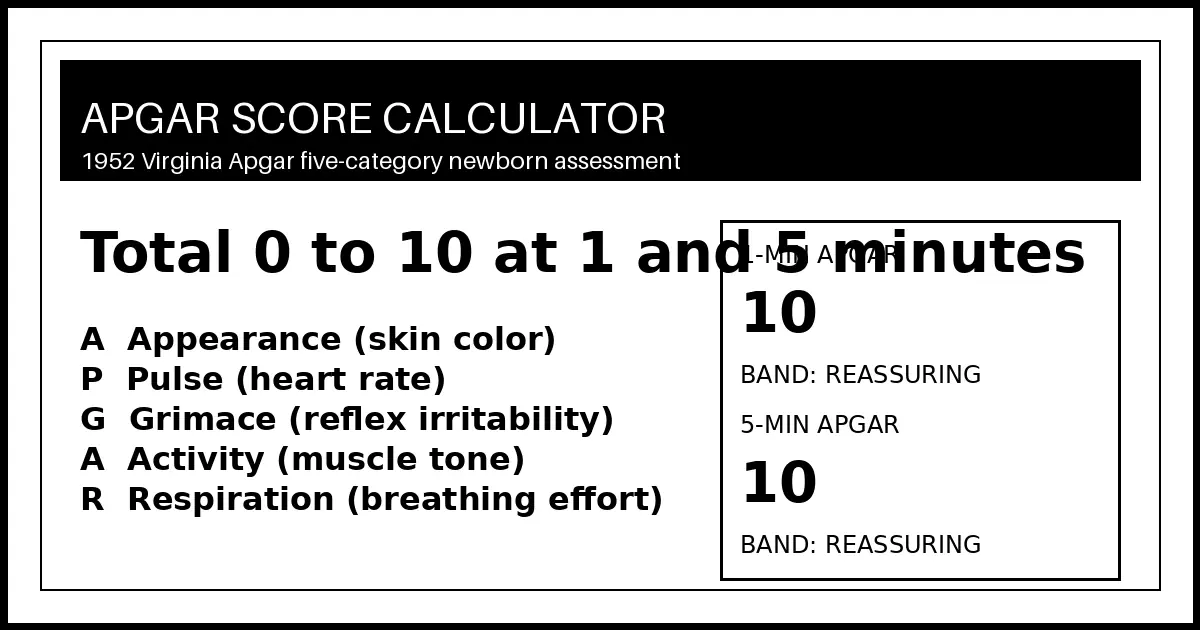
Healthy newborn (Appearance 2, Pulse 2, Grimace 2, Activity 2, Respiration 2 at both timepoints, total 10 at 1 and 5 minutes)
1 min: 2, 2, 2, 2, 2 5 min: 2, 2, 2, 2, 2. Both totals land in the 7-10 Reassuring band, so no follow-up is needed.
1-minute Apgar 10 (Reassuring) and 5-minute Apgar 10 (Reassuring).
According to Apgar V, Anesth Analg 1953, the apgar score is the sum of five categories (Appearance, Pulse, Grimace, Activity, Respiration) each scored 0, 1, or 2, for a total range of 0 to 10.
According to Wikipedia - APGAR score, the five category scores are summed to a 0 to 10 total, with 7 to 10 Reassuring, 4 to 6 Moderately abnormal, and 0 to 3 Low.
A depressed Apgar at term often prompts a check of the gestational age, and the Gestational Age Calculator returns the same completed weeks plus days from the same dating data the delivery team already collected.
Key Concepts Explained
Four concepts drive the result. Naming them keeps the Apgar total from being read as a single number.
Five Apgar Categories
the 1952 Apgar scale scores Appearance, Pulse, Grimace, Activity, and Respiration on a 0 to 2 scale. Each contributes 0, 1, or 2 points, and the ceiling total is 10.
1-Minute and 5-Minute Timepoints
the 1-minute Apgar describes how the newborn tolerated birth, and the 5-minute Apgar describes how the newborn is responding to the new environment and any resuscitation. Both are reported per the AAP and ACOG 2015 Committee Opinion.
Reassuring to Low Band
7 to 10 is Reassuring, 4 to 6 is Moderately abnormal, and 0 to 3 is Low. A 5-minute total below 7 triggers the 10, 15, and 20 minute reassessment schedule.
Resuscitation Response
a 5-minute total higher than the 1-minute total is a positive response to resuscitation per the 1952 Apgar follow-up paper. The form returns Improved, Worsened, or No change.
The 1952 Apgar activity row leans on the muscle tone that a small-for-gestational-age newborn may not have, and the Birthweight Percentile Calculator returns the same percentile for the birthweight at the same gestational age.
How to Use This Calculator
The form works from the published 1952 Apgar table. Each of the five categories is scored 0, 1, or 2 at 1 and 5 minutes after birth, and the form returns both totals and the published interpretation band.
- 1 Score the 1-minute Apgar: pick Appearance, Pulse, Grimace, Activity, and Respiration at 1 minute from the 0, 1, or 2 option for each row.
- 2 Score the 5-minute Apgar: repeat the same five categories at 5 minutes using the same 0, 1, or 2 options per row.
- 3 Read both totals and bands: the form returns the 1-minute and 5-minute totals (0 to 10) with the published Reassuring, Moderately abnormal, or Low band for each timepoint.
- 4 Check the follow-up schedule: when the 5-minute total is below 7, the form flags the AAP and ACOG 2015 reassessment schedule of 10, 15, and 20 minutes after birth.
A newborn with Appearance 2, Pulse 2, Grimace 2, Activity 2, Respiration 2 at 1 minute and the same five 2s at 5 minutes returns a 1-minute Apgar of 10 and a 5-minute Apgar of 10, both Reassuring, and no follow-up is needed because the 5-minute total is at or above 7.
Benefits of Using This Calculator
Calculating the apgar score from the five published categories at 1 and 5 minutes has several practical benefits over running the 1952 table by hand.
- • Two timepoints, one form: scores all five 1952 categories at 1 and 5 minutes, sums them to two 0 to 10 totals, and returns the published Reassuring band for each timepoint.
- • Resuscitation response built in: returns the change from 1-minute to 5-minute as Improved, Worsened, or No change, matching the 1952 Apgar follow-up interpretation.
- • Follow-up schedule flag: flags the 10, 15, and 20 minute reassessment schedule whenever the 5-minute apgar score is below 7, matching the AAP and ACOG 2015 Committee Opinion.
The same form works for a delivery room documentation entry and for a teaching reference that walks through the 1952 Apgar scoring table without re-deriving the 0 to 2 scale by hand.
A low Apgar can flag a growth-restricted newborn, and the Fetal Weight Percentile Calculator returns the same fetal weight percentile from the late-pregnancy ultrasound so the delivery team can correlate the 1-minute total with fetal growth.
Factors That Affect Your Results
Several factors shape the apgar total. The most important ones sit inside the entered form.
Acrocyanosis
pink body with blue hands and feet is a common finding at 1 minute and scores 1 for Appearance. A 5-minute total of 9 with acrocyanosis only is still in the Reassuring band.
5-Minute Threshold
a 5-minute total of 7 is the threshold above which no 10, 15, or 20 minute reassessment is needed per the AAP and ACOG 2015 Committee Opinion. A 5-minute total of 5 or less triggers an umbilical artery blood gas test.
Subjective Scoring
the 1952 Apgar scale leans on clinician judgement for the Grimace, Activity, and Respiration rows. A second observer should confirm the row when the 5-minute total is below 7.
- • The AAP and ACOG 2015 Committee Opinion notes that a low Apgar alone does not diagnose asphyxia, and the score should not be used to predict individual mortality or neurologic outcome.
- • Confounders such as gestational age, maternal medications, congenital anomalies, and resuscitation at birth can change the total without changing the underlying condition.
According to AAP and ACOG APGAR Committee Opinion 2015, the apgar score is reported at 1 and 5 minutes after birth and is repeated at 10, 15, and 20 minutes when the 5-minute total is below 7.
When a newborn with a low Apgar is started on empiric antibiotics, the Amoxicillin Pediatric Dosage Calculator returns the dose in milligrams per kilogram for the same first day of life.
Frequently Asked Questions
Q: What is a normal APGAR score?
A: A normal APGAR total is 7 to 10 at 1 and 5 minutes after birth, which the 1952 Apgar scale labels Reassuring. A total of 4 to 6 is Moderately abnormal, and 0 to 3 is Low. Acrocyanosis (blue hands and feet with a pink body) is common at 1 minute and is scored 1 for Appearance.
Q: How is the APGAR score calculated?
A: The APGAR score is the sum of five category scores, each scored 0, 1, or 2. Appearance is the skin color, Pulse is the heart rate, Grimace is the reflex irritability in response to a suction catheter or foot slap, Activity is the muscle tone, and Respiration is the breathing effort. The five categories are summed to a 0 to 10 total, and the total is reported at 1 and 5 minutes after birth.
Q: What does APGAR stand for?
A: APGAR is a backronym that uses the surname of Dr. Virginia Apgar to make the five categories easier to memorize. A stands for Appearance (skin color), P stands for Pulse (heart rate), G stands for Grimace (reflex irritability), A stands for Activity (muscle tone), and R stands for Respiration (breathing effort). A separate mnemonic is 'How Ready Is This Child?' for Heart rate, Respiratory effort, Irritability, Tone, and Color.
Q: When is the APGAR score taken?
A: The APGAR score is reported at 1 and 5 minutes after birth for every newborn. When the 5-minute score is below 7, the American Academy of Pediatrics and the American College of Obstetricians and Gynecologists recommend repeating the score at 10, 15, and 20 minutes after birth to track the response to resuscitation.
Q: What is the maximum APGAR score?
A: The maximum APGAR score is 10, with each of the five categories scoring 2. The minimum score is 0, with all five categories scoring 0. Acrocyanosis (pink body with blue hands and feet) scores 1 for Appearance and is the most common reason a healthy newborn scores 9 instead of 10 at 1 minute.
Q: What does a low APGAR score mean?
A: A 5-minute APGAR of 0 to 3 is Low and is the published trigger for the AAP and ACOG follow-up schedule of 10, 15, and 20 minute reassessments. A 5-minute score of 5 or less is an indication to obtain umbilical artery blood for an arterial blood gas test. A low APGAR alone does not diagnose asphyxia, and the AAP and ACOG Committee Opinion notes that APGAR should not be used to predict individual mortality or neurologic outcome.