Feet to Meters Calculator
Convert a foot measurement into meters, centimeters, millimeters, inches, yards, and a reverse meter-to-foot check.
Feet to Meters Calculator
Results
What This Calculator Does
The feet to meters calculator changes foot measurements into meters, centimeters, millimeters, inches, yards, and a reverse meter check. It is designed for source values already measured in feet, such as height records, room dimensions, field notes, equipment clearances, drawings, and construction measurements that need a metric length.
The main result reports meters because metric records usually use meters for ordinary lengths before moving to centimeters or millimeters for smaller detail. Supporting rows keep the original feet, centimeter and millimeter equivalents, inch and yard context, a reverse check from meters back to feet, and the exact factor visible. That layout makes the conversion easy to audit instead of reducing it to one rounded number.
The calculator is a unit converter, not a building-code, medical, sports, surveying, or engineering approval tool. A length can be translated accurately without deciding whether that length satisfies a clearance rule, design tolerance, athletic standard, or safety requirement. Those interpretations depend on standards and measurements outside the unit relationship.
The reverse-check field is included for review. When a document already lists meters beside feet, the metric value can be entered to see its foot equivalent. That helps detect copied values, early rounding, or a mismatched unit label before a spreadsheet, drawing, or specification repeats the number.
Keeping all rows tied to the same source value reduces the chance that a rounded copy becomes the new measurement as records move between forms, drawings, and spreadsheets.
For a wider table across metric and customary lengths, the Length Converter covers feet, meters, inches, yards, miles, kilometers, centimeters, and millimeters in one place.
How the Calculator Works
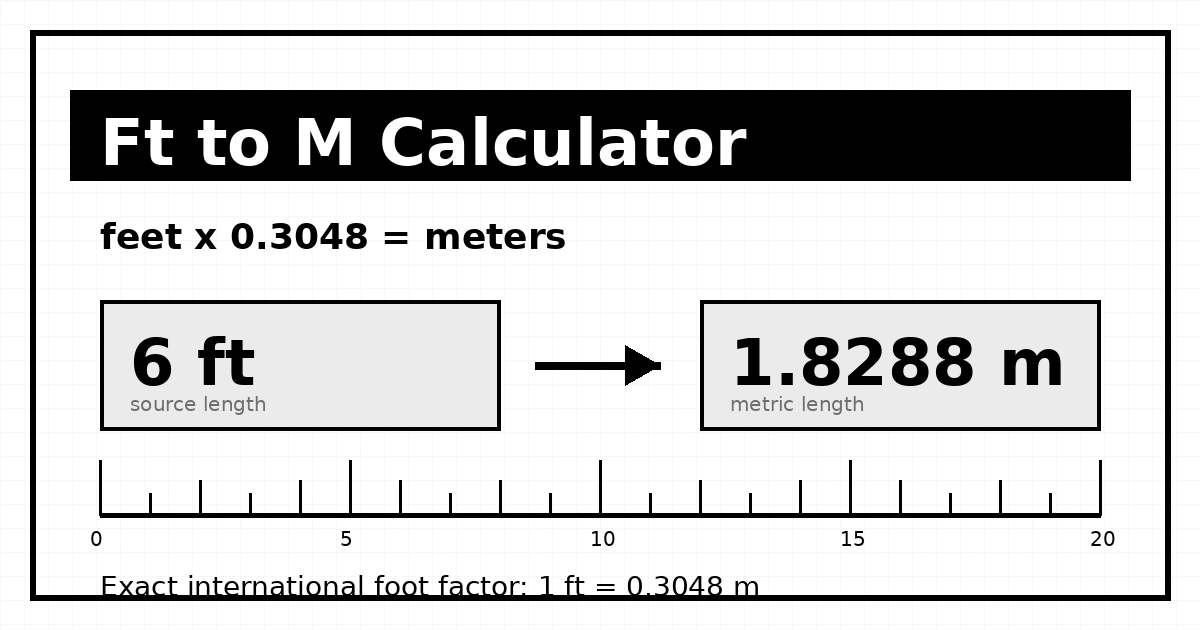
The conversion starts with the exact relationship between the international foot and the meter. One foot equals exactly 0.3048 meter. The calculator multiplies the entered foot value by that factor, then rounds only the displayed output according to the selected precision.
NIST Handbook 44 Appendix C lists the international foot as 0.3048 meter exactly in its length conversion table. That exact factor supports the main feet-to-meter calculation and the reciprocal meter-to-foot check.
Centimeters are calculated from meters by multiplying by 100. Millimeters are calculated from meters by multiplying by 1,000. Inches are calculated from feet by multiplying by 12. Yards are calculated by dividing feet by 3. The optional reverse check divides meters by 0.3048, which is equivalent to multiplying meters by about 3.280839895.
A 6 ft example shows the sequence. Multiplying 6 by 0.3048 gives 1.8288 m, 182.88 cm, 1,828.8 mm, and 72 in.
The calculator does not round each intermediate row before calculating the next row. Meters, centimeters, millimeters, inches, and yards all come from the same unrounded source value. That keeps the displayed rows internally consistent even when the selected precision hides some digits.
When a measurement combines whole feet with leftover inches, the Feet and Inches Calculator can normalize the mixed notation before a meter conversion is reviewed.
Key Concepts Explained
Feet-to-meter conversion is direct arithmetic, but the unit basis matters. Feet, inches, and yards belong to customary and imperial length notation. Meters, centimeters, and millimeters belong to the International System of Units. The calculator keeps both families visible so the source unit and destination unit remain clear.
The BIPM metre page identifies the metre as the SI base unit of length. The meter result is therefore the natural primary output when a foot measurement is being prepared for metric records, technical notes, international forms, or scientific context.
Foot
The source unit for the main conversion. The calculator uses the international foot, not a legacy survey-foot value or a historical local foot.
Meter
The primary metric output. Meters are common in drawings, science, international product dimensions, room measurements, and many engineering notes.
Centimeter
A smaller metric unit equal to one-hundredth of a meter. Centimeters are useful when ordinary objects need more readable metric detail.
Millimeter
A finer metric unit equal to one-thousandth of a meter. Millimeters are often used for tolerances, hardware, material thickness, and small clearances.
A common error is treating a rounded mental shortcut as the fixed definition. Multiplying feet by 0.3 is convenient for a quick estimate, but it is not the same as multiplying by 0.3048. The difference is small for one casual reading and more visible across long runs, repeated dimensions, or area and volume calculations built from converted lengths.
For height records that start with inches instead of feet, the Height in Inches Calculator gives a separate way to organize customary height notation.
Current Unit Rules and Values
The unit values in this converter are stable definitions rather than yearly rates. One international foot equals exactly 0.3048 meter. One meter equals about 3.280839895 international feet. One foot contains exactly 12 inches, and one yard contains exactly 3 feet.
Because these are definitions, the calculator does not adjust results by country, date, material, person, building type, or project purpose. Context can change how a converted length is interpreted, but it does not change the arithmetic that translates feet into meters. A foot source value and a meter source value should describe the same length after conversion when both are measured accurately.
NIST's U.S. survey foot notice explains that the U.S. survey foot was superseded for most applications beginning January 1, 2023, while the international foot equals 0.3048 meter exactly. This calculator uses that international-foot basis.
The practical issue is usually source precision. A tape marked to the nearest foot cannot support the same detail as a laser measure or a drawing dimensioned to millimeters. The calculator can display more decimals, but those decimals should not be treated as more reliable than the original measurement.
For measurements already expressed in metric and customary height units, the Height Converter handles common height formats without making the foot value the only source.
How to Use This Calculator
The form needs a foot value and a display precision. The optional meter field is a separate reverse check for documents that already contain a metric length.
Enter Feet
Type the measured foot value. Decimal entries are appropriate when the source measurement includes tenths, hundredths, or calculated feet.
Choose Precision
Select how many decimal places appear in meter and foot-related rows. The internal factor remains unchanged.
Read Meters and Centimeters
Meters give the main metric result, while centimeters and millimeters provide smaller-unit context for detailed records.
Check Reverse Value
Enter a meter value only when a source document needs comparison back to feet.
The result should be copied with its unit label. A value such as 1.83 is ambiguous without m or ft. Labels prevent later readers from treating a meter result as the original foot value.
When a conversion feeds another calculation, the original measurement should stay beside the result. That keeps the chain traceable through the fixed meter factor.
For architectural or craft measurements that include inch fractions, the Inches to Fraction Calculator can help document fractional-inch notation before related length conversions are compared.
Benefits and When to Use It
A foot-to-meter conversion is most useful when a length crosses from customary notation into metric notation. The calculator keeps that handoff clear by showing the primary meter result, centimeter and millimeter detail, the original feet, common customary companions, and a reverse-check option in one compact panel.
- •Record consistency: one foot source can support meters, centimeters, millimeters, inches, and yards without separate worksheets.
- •Label checks: the reverse field helps identify whether a copied meter value matches the customary source.
- •Appropriate rounding: display precision can match the report while the exact factor remains unchanged.
- •Context separation: the output translates units without making code, design, surveying, or safety judgments.
The converter is useful for classroom examples, product dimensions, room measurements, clearance notes, material lengths, sports marks, travel records, and drawing reviews. In each case, the source number should still come from the authoritative record or measuring device.
It is less suitable when the problem is not simply length conversion. Area, volume, slope, structural design, land surveying, and tolerance analysis all use additional variables. The meter output may be one input into those decisions, but it is not the whole decision.
It also supports review work after a conversion has already happened elsewhere. If a report lists both 20 ft and 6.10 m, the reverse check can show whether those values are consistent within the expected rounding. That kind of check is often faster than tracing the original spreadsheet formula.
When the source direction starts with metric distance, the Kilometers to Miles Calculator provides a metric-to-customary comparison for longer travel-scale lengths.
Factors That Affect Results
The conversion factor does not change, but the useful precision of the output depends on the source value and on how the converted number will be used. Most apparent differences between conversion tools come from rounding, abbreviations, or use of a shortcut factor.
Source Precision
A foot value rounded to a whole number cannot justify a highly precise meter result, even though the calculator can display more decimals.
Display Rounding
Rounding should happen after conversion. Early rounding can shift totals when many converted rows are added together.
Unit Basis
The calculator uses the international foot. It does not use a legacy U.S. survey foot, local historical foot, or project-specific scale factor.
For practical records, the source measurement method often matters more than the unit conversion. A tape measure, laser distance meter, architectural drawing, GPS-derived value, and survey record can produce different source readings before any conversion begins. The meter result inherits that measurement quality.
The display precision should match the job. Whole meters may be enough for a rough room description, centimeters may suit furniture or product dimensions, and millimeters may suit hardware or fabrication notes. Extra decimals are only useful when the source measurement supports them.
For lengths that later become floor area, the Area Calculator handles two-dimensional calculations after the underlying length units have been reviewed.
Real-World Examples
A 1 ft source value converts to 0.3048 m, which is normally displayed as 0.30 m at two decimals. That same value is 30.48 cm, 304.8 mm, and 12 in. This small example is a useful check because every larger foot result scales from it.
A 6 ft source value converts to 1.83 m at two decimals. It also converts to 182.88 cm, 1,828.8 mm, and 72 in. In yard notation, it reads 2 yd because 6 feet divided by 3 equals 2 yards.
A 20 ft source value converts to 6.096 m before display rounding. If a document rounds that to 6.10 m and later converts back, the reverse result becomes about 20.0131 ft. That is not a formula error; it is the effect of rounding the metric value before preserving the original foot source.
A room length listed as 12.5 ft converts to 3.81 m at two decimals and 381.00 cm. If a drawing asks for millimeters, the same source is 3,810 mm. The appropriate copied value depends on the field, so the unit label should be included whenever the record allows it.
A clearance listed as 8.25 ft converts to 2.5146 m before display rounding. At two decimals that becomes 2.51 m, while a whole-centimeter record would show 251 cm. Both are rounded displays of the same source, so the original foot value should remain available when precision matters.
For project measurements, converted meters help reconcile unit systems, but code compliance, tolerance, slope, and fit depend on additional facts.
Frequently Asked Questions
How does the ft to m calculator convert feet to meters?
The calculator multiplies feet by 0.3048. That exact factor comes from the international foot definition, so every meter, centimeter, millimeter, and reverse-foot result traces back to the same length relationship.
What is 1 ft in meters?
One foot equals exactly 0.3048 meter. Rounded displays often show 0.30 m, but the calculator keeps 0.3048 internally before applying the selected number of decimal places.
How many meters are in 6 feet?
Six feet equals 1.8288 meters. At two decimal places that displays as 1.83 m, while the centimeter row displays 182.88 cm from the same unrounded conversion.
Can meters be converted back to feet?
Yes. The optional meter check divides meters by 0.3048, which is equivalent to multiplying meters by about 3.280839895 feet per meter.
Should feet be rounded before converting to meters?
Measured feet should normally remain as recorded until after conversion. Rounding the source first can shift meter totals when many dimensions are converted or when converted lengths feed area or volume calculations.
Does this calculator use the U.S. survey foot?
No. The calculator uses the international foot, where 1 ft equals exactly 0.3048 m. Legacy survey-foot records should be reviewed separately before conversion.