Lbs to g Converter - Convert Pounds to Grams
Lbs to g converter changes pound amounts into grams, kilograms, and ounces while showing the exact factor, reverse check, and rounding note.
Lbs to g Converter
Results
What This Calculator Does
The lbs to g converter changes a mass entered in pounds into grams with the standard avoirdupois relationship used for everyday U.S. customary mass. The core output is a gram value, and the result panel also shows kilograms, ounces, the reverse pound check, and the exact factor that drives the calculation.
This page is intentionally narrow. It is for pound-to-gram conversion only, so it avoids mixing density-based volume conversions, nutrition estimates, or force units into a simple mass task. That separation matters because pounds, grams, kilograms, and ounces are mass units, while pound-force describes force under acceleration.
The calculator works well for package weights, lab notes, product records, ingredient labels, craft material quantities, and other cases where a value written in pounds must be recorded in grams. For broader mass-unit movement across kilograms, ounces, stones, tons, and smaller metric units, the weight converter covers a wider unit set.
The result is mathematical, not regulatory advice. When a gram value affects a label, shipping declaration, medicine record, or compliance document, the final rounding rule should come from the governing process for that document.
How the Calculator Works
The calculation multiplies pounds by the gram equivalent of one avoirdupois pound. The NIST Handbook 44 current edition provides the Appendix C unit tables used in U.S. legal metrology, and those tables list mass relationships for pounds, kilograms, grams, and related units.
A one-pound entry therefore returns 453.59237 grams before display rounding. A two-pound entry returns 907.18474 grams. A quarter-pound entry returns 113.3980925 grams. The calculator stores the full factor in the formula and then formats the visible value according to the selected decimal setting.
The reverse check divides the displayed gram basis by 453.59237 to confirm the original pound input. For closely related kilogram reporting, the lbs to kg converter presents the same pound standard with kilogram-first output.
Scientific notation is included for unusually large or very small entries. It changes presentation only; it does not change the multiplication factor, intermediate value, or reverse check.
Key Concepts Explained
The pound used here is the avoirdupois pound, the common pound for body weight, parcel weight, groceries, and most general-purpose mass records in the United States. It is different from troy and apothecaries systems, which appear in specialized contexts such as precious metals or historical pharmacy measures.
A gram is a metric mass unit equal to one-thousandth of a kilogram. The NIST SI units mass page identifies the kilogram as the SI unit for mass, which makes gram reporting part of the metric mass system rather than a separate custom unit.
Reverse conversion often belongs in a different workflow. When a gram amount must be interpreted as pounds for a U.S. record, the kg to lbs converter is useful after grams are grouped into kilograms.
Real-World Examples
A package listed at 3.2 lb converts to 1,451.495584 g before rounding. At two decimal places, the same package appears as 1,451.50 g. A shipping or inventory system may prefer kilograms for larger parcels, but grams can be better when small differences matter.
A half-pound ingredient quantity converts to 226.796185 g. Recipe records often round that to 227 g because kitchen scales rarely need more detail for typical home cooking. For ingredient-specific volume questions, the grams to cups converter is a better fit because cups depend on ingredient density.
A 0.125 lb sample converts to 56.69904625 g. That value is small enough that a gram-based record is easier to scan than a fractional pound. If the same sample is part of a food-energy estimate, the grams to calories calculator handles the separate nutrition calculation.
A 14 lb object converts to 6,350.29318 g. That is also 224 oz, and it equals one stone in the imperial stone system. The gram result is still produced by the same pound factor; the stone relationship is only an additional way to recognize the original amount.
Official Factor and Rounding
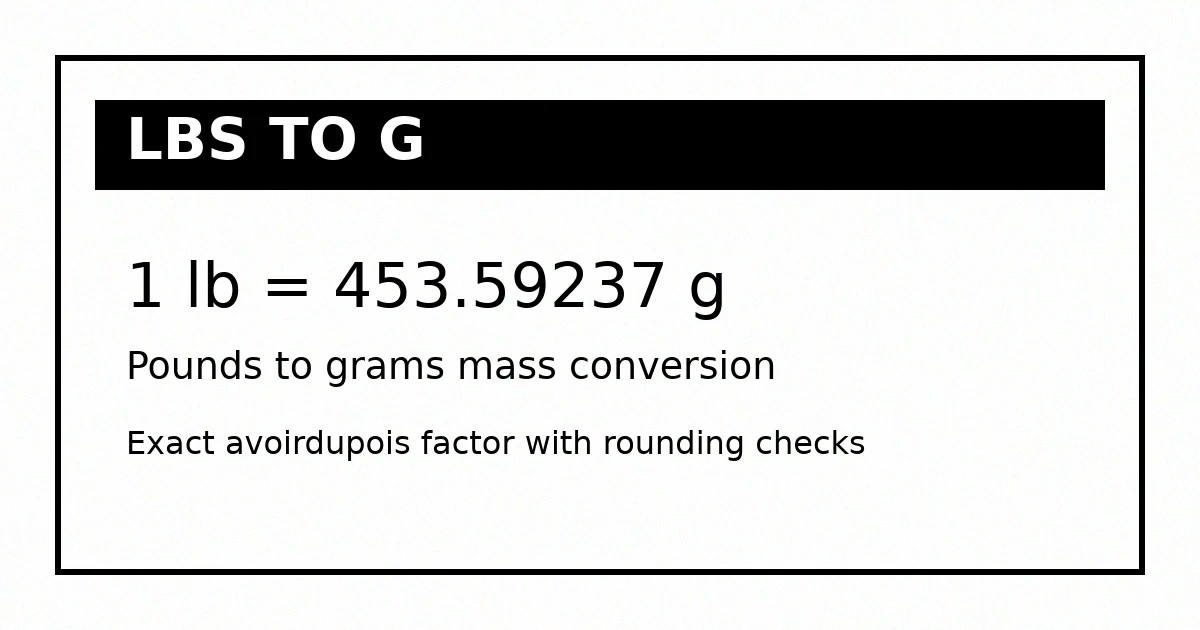
The exact mass relationship behind the calculator is one avoirdupois pound equals 0.45359237 kilogram, which is 453.59237 grams. NIST unit conversion guidance points users to Handbook 44 Appendix C for conversion factors used in legal metrology, trade, and commerce activities through its NIST unit conversion page.
Rounding should match the purpose of the result. Ingredient records often round to whole grams. Lab or calibration notes may keep three or more decimal places. Software imports may store the unrounded value and display a shorter value in the interface.
The decimal-place selector changes only the main gram display. The kilogram row keeps six decimals, the ounce row keeps practical decimal detail, and the reverse-check row confirms the original pound input. This keeps the result readable without hiding the exact factor used.
Rounding should not be chained across multiple conversions. A record converted from pounds to grams and then from rounded grams back to pounds can drift slightly. For clean audit trails, the original value, original unit, factor, and rounded display rule should be retained together.
Interpreting Results
The gram result is usually the value that belongs in a metric record, but the supporting rows are useful for review. Kilograms put larger weights into a compact metric form, ounces connect the pound entry to a smaller customary unit, and the reverse check confirms that the gram value still represents the original pound amount.
A result such as 453.59 g does not mean the calculator ignored the remaining decimal places. It means the display setting asked for two decimals. The underlying factor remains 453.59237, and the exact unrounded product can be reproduced by increasing decimal places or by repeating the multiplication in another tool.
Context determines whether whole grams or decimal grams are easier to defend. Parcel descriptions, recipe cards, and inventory notes often read better as whole grams. Calibration notes, small samples, and data imports may need more places because a few tenths of a gram can matter at that scale.
Larger body-weight or produce-weight records are sometimes written in stones and pounds before they are converted to grams. In that case, the lbs to stone converter can clarify the customary-unit form before a separate gram record is prepared.
How to Use This Calculator
Enter the pound amount as a whole number or decimal, such as 1, 2.5, or 0.125.
Select the number of decimal places needed for the main gram result.
Keep standard display for ordinary records or scientific notation for very large or very small values.
Review grams, kilograms, ounces, reverse check, and the factor row before copying a value into another record.
A zero input is valid and returns zero grams. Negative mass entries are blocked because most everyday conversion records describe physical quantities rather than signed mathematical differences.
The reset button restores a one-pound input, two-decimal gram display, and standard notation. That default demonstrates the base conversion immediately: 1 lb equals 453.59 g when rounded to two decimal places.
Benefits and When to Use It
A dedicated pounds-to-grams page reduces the chance of choosing the wrong unit family. A general converter can be helpful, but a focused page makes the formula, factor, and result interpretation easier to inspect.
Packaging records: pound weights can be translated into gram values for labels, listings, and cross-border notes.
Kitchen prep: bulk ingredients sold by the pound can be measured on gram scales with a clear rounding rule.
Classroom work: the exact factor gives a transparent example of unit conversion by multiplication.
Data cleanup: mixed pound and gram records can be standardized before sorting or comparison.
The page is most useful when the starting number is already a mass in pounds. It should not be used to convert cups, gallons, liters, or fluid ounces to grams without a density value, because volume-to-mass conversion depends on the material.
The narrow scope also makes review faster. A person checking the record can see the starting pounds, the official factor, the resulting grams, and the reverse calculation without sorting through unrelated units. That is helpful when several people touch the same record, such as a warehouse listing, a shared recipe file, or a classroom worksheet.
Factors That Affect Results
The conversion factor is fixed, so the mathematical result depends only on the pound input. Differences in final records usually come from rounding, source-unit quality, and whether the starting value was truly pounds of mass.
When precision is important, the original pound entry should remain attached to the converted gram value. That practice makes later review easier because the conversion can be repeated from the source number rather than from a rounded result.
The result can also be affected by how the source value was captured. A retail label may round to the nearest tenth of a pound, while a bench scale may record several decimal places. The calculator converts the number provided; it cannot recover precision that was not present in the original measurement.
Common Mistakes to Avoid
The most common mistake is treating a rounded shortcut as the official factor. Multiplying by 454 can be acceptable for a mental estimate, but it adds about 0.40763 g of error per pound. That may look small for one pound, yet it grows across large inventory batches or repeated calculations.
Another mistake is converting a volume straight to grams without density. A cup of flour, a cup of sugar, and a cup of water do not have the same mass. A pounds-to-grams calculation starts with mass, so it cannot resolve ingredient density, liquid concentration, or packed-volume differences by itself.
Mixed notation can also create errors. A note that says 3 lb 8 oz is not the same as 3.8 lb. It is 3.5 lb because 8 oz equals half a pound. The pound amount should be normalized before multiplying by 453.59237.
Finally, precision should not imply measurement certainty. A scale that reports pounds to one decimal place cannot support a gram result with laboratory-grade meaning, even though the arithmetic can display many decimals. The conversion can be exact while the original measurement remains approximate.
It is also worth checking whether the source record uses a plural abbreviation consistently. The symbols lb and lbs are commonly understood in everyday writing, but formal records often prefer lb as the unit symbol. The calculator accepts the everyday wording in its title while showing the mathematical relationship in plain unit labels.
Frequently Asked Questions
Q: How many grams are in one pound?
A: One avoirdupois pound equals exactly 453.59237 grams. The calculator multiplies the pound value by 453.59237 to produce the gram result.
Q: What formula does the lbs to g converter use?
A: The formula is grams = pounds x 453.59237. The reverse check divides grams by 453.59237 to return the original pound amount.
Q: Does the calculator handle decimal pounds?
A: Yes. Decimal pound entries such as 0.25 lb, 2.5 lb, or 12.75 lb are supported because the conversion factor is multiplied by the exact entered value.
Q: Why is the gram result often rounded?
A: The exact calculation can produce many decimal places. The displayed result keeps practical decimal precision while the detailed rows show the exact conversion factor and related units.
Q: Is pound a mass unit or a force unit?
A: This calculator treats pound as the avoirdupois pound of mass. Pound-force is a different force unit and is not part of the pounds-to-grams calculation.
Q: Can grams be converted back to pounds?
A: Yes. A gram value can be divided by 453.59237 to return pounds, and the reverse-check row shows that relationship for the current result.