MPa Conversion Calculator - Convert Pressure and Stress
Convert megapascals into common pressure and stress units with exact pascal-based factors, rounded results, and reverse reference values.
MPa Conversion Calculator
Results
What This Calculator Does
MPa conversion calculator results translate a pressure or stress value from megapascals into pascals, kilopascals, bar, pounds per square inch, standard atmospheres, torr, and newtons per square millimeter. The tool is designed for situations where a specification gives strength, fluid pressure, or test pressure in MPa while another drawing, data sheet, lab note, or regional standard expects a different unit.
A megapascal is a large pascal multiple. The mega prefix means one million, so 1 MPa equals 1,000,000 Pa. That scale explains why MPa appears in engineering stress and high-pressure work instead of ordinary room-pressure descriptions. A material yield strength of 250 MPa, for example, is easier to read than 250,000,000 Pa.
The calculator keeps the conversion narrow on purpose. It does not estimate force, area, temperature effects, material safety factors, or fluid behavior. It converts the unit label while preserving the same physical pressure or stress quantity. For cases where pressure must be paired with load, the Force Converter can keep force units separate before a pressure equation is prepared.
The most common result for North American equipment data is psi. European and international hydraulic references often use bar or MPa. Scientific and metrology references often return to pascals. Keeping all of those outputs beside one input reduces transcription errors when values move between product sheets, material tables, inspection records, and calculation notes.
The page is also helpful when a value must be reviewed in two different professional contexts. A quality-control record may store the source value in MPa because the test machine reports stress that way, while a maintenance note may need psi for a gauge comparison. A single conversion table keeps those equivalent readings tied to the same source value instead of scattering separate calculations across a spreadsheet.
How the Calculator Works
The calculation uses the pascal as the bridge unit. First, the MPa value is multiplied by 1,000,000 to produce pascals. Then that pascal amount is divided by the pascal factor for each target unit. For bar, the target factor is 100,000 Pa. For psi, the target factor is approximately 6,894.757293 Pa. For a standard atmosphere, the target factor is exactly 101,325 Pa.
According to NIST pressure and gas flow conversion tables, common pressure units can be related through pascal factors, including psi, atm, and torr. The same factor method also supports reverse checking. A displayed psi result multiplied by the psi pascal factor returns the original pascal value, apart from rounding.
For example, 5 MPa becomes 5,000,000 Pa. Dividing by 6,894.757293 gives about 725.1887 psi. Dividing by 100,000 gives exactly 50 bar. Dividing by 101,325 gives about 49.3462 atm. For calculations where pressure is combined with surface size, the Area Converter can normalize square meters, square inches, and related area units before pressure is turned into force.
Rounding is display-only. The underlying factors remain fixed, while the decimal-place selector changes how many digits appear in the result panel. That makes the page useful for both quick shop-floor checks and more exact documentation, provided the source measurement itself supports the chosen precision.
The pascal bridge also prevents a common mistake: chaining rounded conversions. Converting MPa to bar, rounding the bar result, and then converting that rounded number to psi can introduce avoidable error. This calculator derives every target unit directly from the same pascal value, so the displayed outputs remain internally consistent even when some rows are rounded for readability.
Key Concepts Explained
Pressure is force divided by area. Mechanical stress uses the same dimensional idea, so MPa can describe both fluid pressure and stress in a solid. The physical interpretation depends on the surrounding problem: a hydraulic line may be rated in MPa as internal pressure, while a steel grade may list yield strength in MPa as stress.
The pascal is the coherent SI pressure unit. The NIST Guide to the SI Chapter 4 lists pressure and stress with the special SI unit name pascal, symbol Pa, and the expression N/m². Because one square millimeter is one millionth of a square meter, 1 N/mm² equals 1,000,000 N/m², or 1 MPa.
Several pressure units reflect different historical or practical contexts. Bar is close to atmospheric pressure and remains common in fluid power and industrial gauges. Psi fits inch-pound equipment and tire-pressure markings. Torr and millimeters of mercury come from manometer practice. Standard atmospheres provide a reference pressure, not a location-specific weather reading.
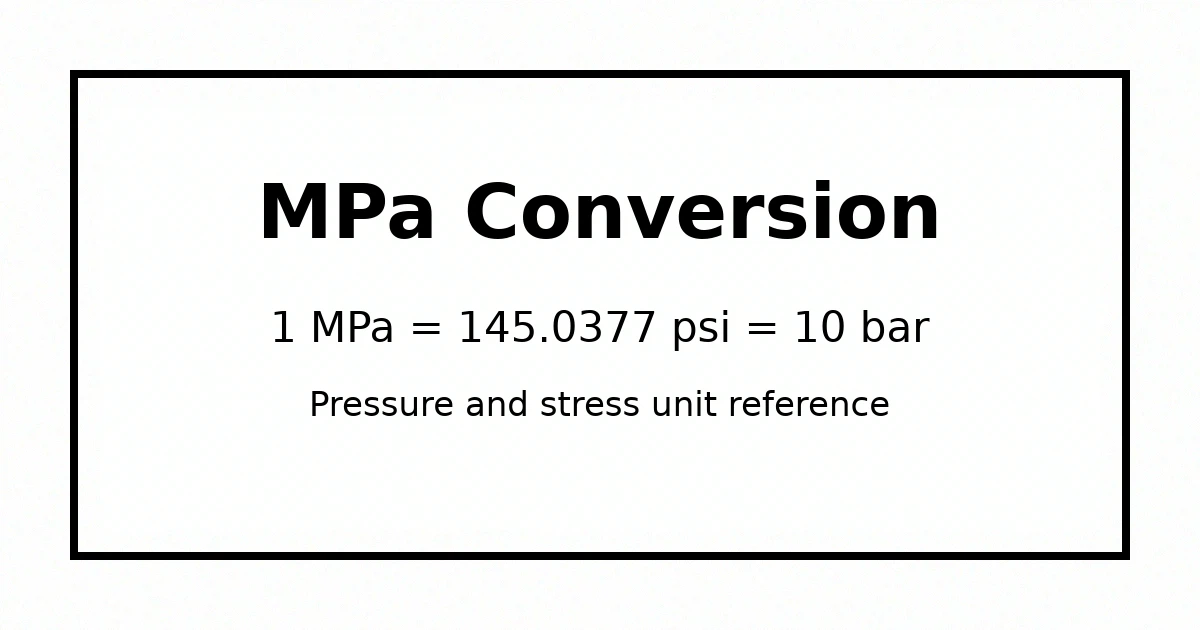
That variety is why a single MPa value can look very different after conversion. The value 1 MPa is 10 bar, about 145 psi, about 9.87 atm, and about 7,500.62 Torr. For torque specifications that combine pressure-related equipment with rotational loads, the Torque Converter can handle moment units without mixing them into the MPa calculation.
Capitalization matters in formal unit writing. MPa uses an uppercase M for the mega prefix and an uppercase P because pascal is named after Blaise Pascal, while the spelled-out unit name remains lowercase in ordinary prose. The calculator focuses on numeric conversion, but consistent symbols make reports easier to review and reduce confusion between m, M, Pa, and related metric prefixes.
How to Use This Calculator
The input field accepts a nonnegative MPa value. A value may represent pressure, tensile stress, compressive stress, or another pressure-equivalent quantity, provided the source value is already expressed in megapascals. Decimal inputs are allowed because many specifications use values such as 0.7 MPa, 2.5 MPa, or 34.5 MPa.
After entry, the result panel reports psi as the primary output because MPa-to-psi conversion is a frequent cross-system need. The secondary rows show bar, Pa, kPa, atm, Torr, and N/mm². The N/mm² line is especially useful for material-strength tables, where older references may use N/mm² while modern documentation uses MPa for the same magnitude.
The decimal selector controls displayed precision. Two decimals suit rough communication, four decimals suit most engineering notes, and six decimals can help when a converted value is later copied into another calculation. Extra displayed digits should not imply that the original measurement was more accurate than the instrument or data sheet stated.
When a pressure value is only one part of a broader dimensional conversion, the Length Converter can keep millimeters, meters, inches, and feet consistent before an area or stress formula is assembled.
A practical workflow is to record the original MPa value first, then copy the needed target unit into the receiving document. Keeping the original alongside the converted result makes later review simpler because the source measurement remains visible. If a team later changes the reporting unit from psi to bar, the MPa value can be converted again without relying on a previously rounded intermediate result.
Benefits and When to Use It
MPa conversion is useful whenever a high-pressure or stress value crosses system boundaries. Hydraulic components may list pressure in MPa and bar, while service notes may request psi. Civil, mechanical, and materials references may publish compressive strength, tensile strength, or modulus-related stress values in MPa, while a legacy report uses psi or ksi.
The calculator also helps with audit trails. Showing multiple equivalent units beside one input makes it easier to spot a misplaced decimal, especially when values are copied from drawings or product labels. A value of 0.5 MPa should be 5 bar, not 50 bar. A value of 10 MPa should be about 1,450 psi, not 145 psi.
According to the NIST Guide to the SI Appendix B, standard atmosphere is defined as 1.01325E+05 Pa and bar is defined as 1.00000E+05 Pa. Those official factors support the calculator's bar and atm results.
For density-sensitive pressure work, such as fluid columns or material property checks, the Density Calculator can keep mass and volume relationships separate from pressure-unit conversion.
The calculator is not a substitute for a design code, pressure-vessel rating, material certification, or calibration procedure. It is best treated as a unit-normalization step before those domain-specific checks begin. That distinction is important because a correctly converted pressure can still be unsuitable for a particular component, test condition, or safety margin.
Factors That Affect Results
The conversion factors themselves do not change with location, temperature, or application. One MPa is always one million pascals. What can change is the meaning of the measured pressure. Gauge pressure is measured relative to local atmospheric pressure, absolute pressure is measured relative to vacuum, and differential pressure compares two points. Unit conversion preserves whichever reference the original value used.
Measurement uncertainty also matters. A pressure gauge marked only to the nearest 0.1 MPa cannot justify a final psi value with six meaningful decimal places. The calculator can display extra digits for downstream arithmetic, but practical reporting should usually follow the precision of the source instrument, calibration certificate, or specification.
Another factor is whether the MPa value represents pressure or stress. Stress values may be compared with material allowables, design factors, or test standards. Pressure values may be compared with vessel ratings, pump curves, regulator settings, or tire and cylinder labels. The numerical conversion is identical, but the engineering decision around the result is not.
For energy or power systems where pressure is part of a larger physical calculation, the Power Converter can keep watt, horsepower, and related unit changes separate from the pressure side of the work.
Unit context should be preserved when values move between drawings and software. A pressure noted as MPa(g), MPa(a), or MPa differential should not lose that reference during conversion. The calculator changes MPa into another unit, but it does not infer whether the zero reference is atmospheric pressure, vacuum, or another measurement point.
The target unit can also affect readability. Very large pascal values may obscure the scale of a result, while very small atmosphere or torr differences may overstate practical precision. MPa, bar, and psi often remain the most readable options for mechanical equipment because their numeric ranges stay compact around typical industrial pressures.
Real-World Examples
A hydraulic system rated at 21 MPa converts to 210 bar and about 3,045.79 psi. That comparison is useful when a pump plate lists MPa, a hose catalog lists bar, and a service gauge reads psi. The converted numbers describe the same pressure, but each unit fits a different documentation habit.
A concrete compressive strength of 30 MPa equals 30 N/mm² and about 4,351.13 psi. That comparison is common when metric design references meet U.S. construction terminology. The conversion does not determine whether a mix design is suitable; it simply places the same stress level into the unit expected by the receiving document.
A small pneumatic test pressure of 0.8 MPa converts to 8 bar, 800 kPa, and about 116.03 psi. The kPa result is often more readable than pascals, while the psi result may match a gauge face. The same source value can therefore support a metric checklist, an imperial gauge reading, and a formal SI calculation note.
For percentage comparisons between an allowable pressure and a measured pressure, the Percentage Difference Calculator can compare two already-normalized values after both have been converted into the same unit.
A laboratory vacuum or gas-handling note may use much smaller pressure ranges, but MPa can still appear in equipment limits or cylinder ratings. In that setting, the torr and atm rows provide orientation while the pascal and kilopascal rows preserve SI traceability. The converted value should still be interpreted with the instrument range and calibration method used for the original reading.
Frequently Asked Questions
Q: How many pascals are in one MPa?
One MPa equals 1,000,000 pascals. The mega prefix means one million, so a megapascal is one million units of the SI pressure unit, the pascal.
Q: How is MPa converted to psi?
MPa is converted to psi by multiplying the MPa value by 145.0377377. The calculator first converts MPa to pascals, then divides by the pascal value of one pound per square inch.
Q: Is MPa the same as N/mm²?
Yes. One MPa is equal to one newton per square millimeter because 1 N/mm² equals 1,000,000 N/m², and one pascal is one newton per square meter.
Q: When is MPa more practical than Pa or kPa?
MPa is more practical when pressures or stresses are large enough that pascal or kilopascal numbers become hard to read. Hydraulic pressure, material strength, and engineering stress values are common examples.
Q: Does this calculator handle gauge and absolute pressure differently?
No. The conversion factors are the same for gauge, absolute, and differential pressure as long as the same pressure reference is kept before and after conversion.