Pyramid Volume Calculator - Square, Rectangular, or Base Area
Use this pyramid volume calculator to compute the inside space of a square, rectangular, or known-base pyramid, with base area and the (1/3) base * height step.
Pyramid Volume Calculator
Results
What Is Pyramid Volume Calculator?
A pyramid volume calculator finds the inside space of any pyramid with a known perpendicular height from the base area and vertical height. Enter a square base side, a rectangular base length and width, or a base area you already know, and the tool returns the volume in cubic units along with the base area it used. Use it for school geometry problems, stockpile and pile estimates, and hopper capacity takeoffs.
- • Classroom geometry: Check homework and lesson problems on the V = (1/3) * B * h rule, including the square and rectangular special cases.
- • Sand, gravel, and aggregate piles: Estimate the volume of a square or rectangular base stockpile when you know the base footprint and the height of the cone of material.
- • Hopper and bin capacity: Size a square or rectangular hopper or funnel by working from the base opening and the height of the bin.
- • Cross-check other volume tools: Run the same shape through a different input method (square vs. base area) to confirm the answer matches across methods.
A pyramid is a three-dimensional solid with a flat polygonal base and triangular faces that meet at a single point called the apex. The perpendicular distance from the base plane to the apex is the height, and the volume depends on the base area and that perpendicular height, not on the slant height of a triangular face. The same V = (1/3) * B * h rule applies whether the apex sits above the centroid of the base (a right pyramid) or offset (an oblique pyramid).
For a pyramid with a six-sided base, the Volume Hexagonal Pyramid Calculator runs the same (1/3) * B * h step on a regular hexagon footprint.
How Pyramid Volume Calculator Works
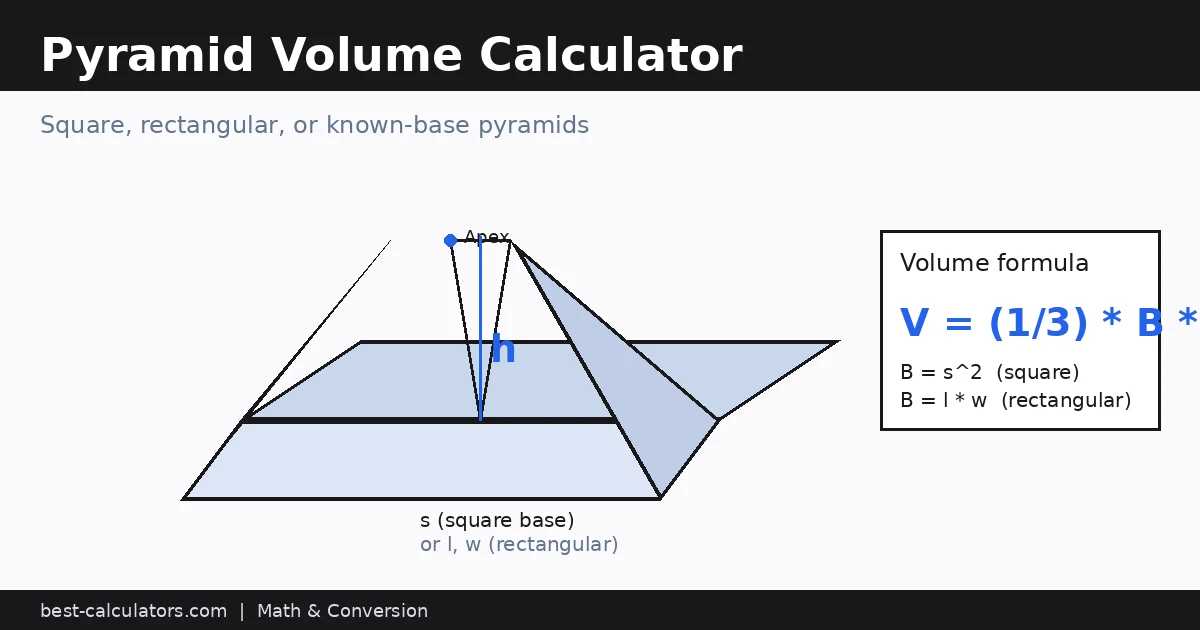
The calculator uses the universal pyramid volume formula, V = (1/3) * B * h, where B is the base area and h is the perpendicular height from the apex to the base plane. For a square base of side s, B = s^2 and V = (1/3) * s^2 * h. For a rectangular base of length l and width w, B = l * w and V = (1/3) * l * w * h. The 1/3 factor holds for every pyramid, right or oblique, when h is the perpendicular height, regardless of base side count.
- s: side length of the square base, used to compute B = s^2
- l, w: length and width of the rectangular base, used to compute B = l * w
- B: pre-calculated base area for the base-area method
- h: perpendicular height from the apex to the base plane, the same h in all three methods
- V: resulting volume in cubic length units, equal to (1/3) * B * h
The factor 1/3 comes from the geometric fact that three congruent right pyramids of equal base and height fit exactly into a right prism of the same base and height, the classic proof that the pyramid volume is one third of the prism volume B * h. Cavalieri's principle extends the same one-third factor to any pyramid with a known perpendicular height, including right and oblique pyramids with any flat polygonal base.
Example with square base side 6 and height 10
Pick Square Base, enter side = 6 and height = 10.
B = 6^2 = 36.00. V = (1/3) * 36.00 * 10 = 120.00. Base area 36.00, volume 120.00.
Volume = 120.00 cubic units. Base area = 36.00 square units.
The same physical pyramid should give the same volume under the base-area method (B = 36, h = 10).
Example with rectangular base length 8, width 5, and height 9
Pick Rectangular Base, enter length = 8, width = 5, height = 9.
B = 8 * 5 = 40.00. V = (1/3) * 40.00 * 9 = 120.00. Base area 40.00, volume 120.00.
Volume = 120.00 cubic units. Base area = 40.00 square units.
The base-area method (B = 40, h = 9) reaches the same answer.
According to Wolfram MathWorld, the volume of a pyramid is one third of the base area times the perpendicular height, V = (1/3) * B * h, regardless of base shape or position of the apex relative to the base.
A cone is a pyramid with a circular base, and the Cone Volume Calculator runs the same (1/3) * B * h rule on a pi * r^2 footprint.
Key Concepts Explained
These terms decide whether the formula you are using actually matches the shape you are measuring.
Base Area (B)
The total flat surface area of the polygon at the bottom of the pyramid. For a square base of side s, B = s^2. For a rectangular base of length l and width w, B = l * w. The base area is what the volume formula multiplies by h and divides by three.
Vertical Height (h)
The perpendicular distance from the base plane to the apex. The vertical height is not the slant height of a triangular face.
Apex and the Perpendicular Height
The apex is the single point where the triangular faces meet. The V = (1/3) * B * h rule works for any pyramid as long as h is the perpendicular drop from the apex to the base plane, regardless of where the apex sits above the base.
Slant Height vs Vertical Height
The slant height of a face runs from the apex to the midpoint of a base edge. The slant height is always longer than the vertical height, so using it where the formula needs the vertical height overstates the volume.
A common error is to use the slant height of a face in place of the vertical height. The slant height is the line along the surface of a triangular face from the apex to the midpoint of a base edge, while the vertical height is the straight line from the base center to the apex.
For a mixed collection of three-dimensional shapes, the Volume Calculator keeps the (1/3) * B * h, pi * r^2 * h, and (4/3) * pi * r^3 rules in one place.
How to Use This Calculator
Pick the input method that matches the measurements you already have, then read the result rows in order.
- 1 Pick the calculation method: Choose Square Base for a single base side, Rectangular Base for length and width, or Known Base Area when you already have the footprint area.
- 2 Enter the base dimension: For the square method enter side, for the rectangular method enter length and width, and for the base-area method enter the base area in square units.
- 3 Enter the vertical height: Type the perpendicular distance from the base center to the apex, not the slant height of a triangular face.
- 4 Read the base area: Use the Base Area row to confirm the footprint the calculator used, especially when the base came from the square or rectangular input.
- 5 Read the volume: Use the Volume row for material counts, fill estimates, or any answer that needs the three-dimensional size of the pyramid.
A contractor has a 6 ft square base stockpile rising 10 ft at the center. The square method with side 6 and height 10 gives 120.00 cubic feet of loose sand before compaction.
Once the volume is in cubic feet or cubic meters, the Volume Converter can move the result into the unit the material list or invoice uses.
Benefits of Using This Calculator
A pyramid volume calculator that supports all three common base inputs and shows the base area alongside the volume makes the answer easier to use and to double-check.
- • Three input methods: Square side, rectangular length and width, and a known base area are all accepted, so the user does not have to derive a missing dimension first.
- • Base area always shown: The base area used in the formula is displayed as a separate result row, so the user can confirm the calculator used the right footprint.
- • Universal (1/3) B * h step: The same (1/3) * B * h step is used for every input method, so the result is consistent across square, rectangular, and base-area entries.
- • Decimal friendly: Decimal side, length, width, base area, and height values work for measured drawings, scaled plans, and metric or imperial units.
- • Unit consistency: The result is in cubic units that match the length unit entered, and the base area is in square units of the same length unit.
A textbook problem usually gives a side or a length and width, while a real object is often measured by its footprint and a tape drop from the apex, which leads to the base-area method. Showing the base area in the result panel lets the user check the formula step without re-typing the values.
For an irregular or polygonal base that the inputs do not cover, the Area Calculator can compute the footprint that the base-area method then uses.
Factors That Affect Your Results
A pyramid volume calculator is a small piece of math, but a few measurement choices decide whether the result matches the real shape.
Vertical vs slant height
The formula needs the perpendicular height from base to apex, not the slant height of a triangular face. Using the slant height overstates the volume.
Perpendicular height required
The V = (1/3) * B * h rule applies to any pyramid with a known perpendicular height, right or oblique. For an oblique pyramid, h is still the perpendicular drop from the apex to the base plane, and the formula is unchanged.
Unit consistency
Every length input must use the same unit, and the resulting volume is in cubic units of that length. Mixing inches and feet, or feet and meters, gives an answer off by a factor of 12 or 3.281.
- • The calculator does not solve for a missing dimension when only the volume is known, because the same volume can come from many different base and height combinations.
- • Real stockpiles, hoppers, and bins are rarely perfect right pyramids, so the result is a geometric estimate rather than a survey-grade measurement.
- • Rounded output can differ by a few hundredths from a hand calculation that rounds after each step. The internal computation keeps full precision before the display rounds.
A pyramid with a known base area is the most general case, because the 1/3 factor is independent of the number of base sides.
According to Wolfram MathWorld, the volume of a square pyramid with base side s and height h is V = (1/3) * s^2 * h.
According to Wikipedia, the volume of a pyramid is one third of the product of the base's area and the height, V = (1/3) * B * h, where the height is the perpendicular distance from the apex to its orthogonal projection on the base.
Frequently Asked Questions
Q: What is the formula for the volume of a pyramid?
A: The volume of a pyramid is V = (1/3) * B * h, where B is the base area and h is the perpendicular height from the apex to the base plane. For a square base of side s the formula becomes V = (1/3) * s^2 * h, and for a rectangular base of length l and width w it becomes V = (1/3) * l * w * h. The rule works for any pyramid with a known perpendicular height, right or oblique.
Q: How do you find the volume of a square pyramid?
A: Square the base side length to get the base area, then multiply by the vertical height and divide by three. For a base side of 6 units and a height of 10 units, the base area is 36 and the volume is (1/3) * 36 * 10 = 120 cubic units. The vertical height must be the perpendicular drop from the apex to the base, not the slant height of a face.
Q: How do you find the volume of a rectangular pyramid?
A: Multiply the base length by the base width to get the base area, then multiply by the vertical height and divide by three. For a base of 8 by 5 units and a height of 9 units, the base area is 40 and the volume is (1/3) * 40 * 9 = 120 cubic units. The same answer is reached with the base-area method using B = 40 and h = 9.
Q: Why is the volume of a pyramid one third base area times height?
A: Three congruent right pyramids of equal base and height fit exactly into a right prism of the same base and height, the classic geometric proof that the pyramid volume is one third of the prism volume B * h. Cavalieri's principle extends the same factor to any pyramid with a known perpendicular height, so the pyramid volume is (1/3) * B * h regardless of base shape or apex position.
Q: What units should I use for the pyramid volume result?
A: Use one length unit for every input, such as inches, feet, centimeters, or meters. The calculator returns the base area in square units of that length and the volume in cubic units of that length. Mixing units, such as feet for the base and inches for the height, will give an answer that is off by a power of 12.
Q: How does the volume of a pyramid compare to the volume of a cone or prism?
A: A cone and a pyramid share the same (1/3) * B * h rule, with the cone base area pi * r^2 instead of a polygon area. A prism of the same base and height has three times the volume of the pyramid, because the prism is three congruent pyramids stacked base to apex. A cylinder follows the prism rule with pi * r^2 as the base area.