Vector Magnitude Calculator: 2D & 3D Vector Norm Tool
Use this vector magnitude calculator to compute the magnitude of 2D and 3D vectors with exact Euclidean norms, normalized unit vector components, and full mathematical steps.
Vector Cartesian Components
Magnitude & Direction Outputs
Normalized Unit Vector (û)
What is Vector Magnitude?
A vector magnitude calculator evaluates the scalar length, geometric size, or Euclidean norm of a directed line segment defined across two-dimensional or three-dimensional coordinate spaces. In classical mathematics, linear algebra, and mechanics, a vector represents a fundamental entity possessing both numerical magnitude and directional orientation. While direction specifies the trajectory or line of action along which a quantity acts, magnitude measures the pure, non-directional intensity or geometric distance between the origin and the terminal point.
In Cartesian coordinates, vectors are expressed as ordered tuples such as (x, y) in the Euclidean plane or (x, y, z) in spatial three-dimensional geometry. The magnitude is denoted in standard mathematical notation by placing vertical bars around the vector variable, written as |v| or ||v||. Because spatial length represents a physical distance, vector magnitude is always a non-negative real scalar quantity. Even when individual coordinate components are negative, squaring each term during the calculation ensures that the resulting sum of squares is non-negative, yielding a positive or zero principal square root.
Primary Practical & Scientific Applications:
- Classical Mechanics & Force Analysis: Calculating the resultant net force acting on structural joints by summing component load vectors and determining total load magnitude in newtons.
- Kinematics & Aerospace Trajectories: Computing absolute ground speed and true airspeed by evaluating orthogonal velocity components across horizontal and vertical flight axes.
- Computer Graphics & Video Game Physics: Normalizing directional vectors to calculate surface lighting reflections, ray-tracing intersection distances, and collision boundaries.
- Robotics & Automated Spatial Kinematics: Calculating end-effector reach, mechanical actuator displacement, and torque distributions in articulated robotic arms.
When analyzing complete spatial behavior alongside magnitude, our companion Vector Direction Calculator determines angular trajectories, while our Unit Vector Calculator extracts normalized directional unit arrows.
How to Calculate Vector Magnitude
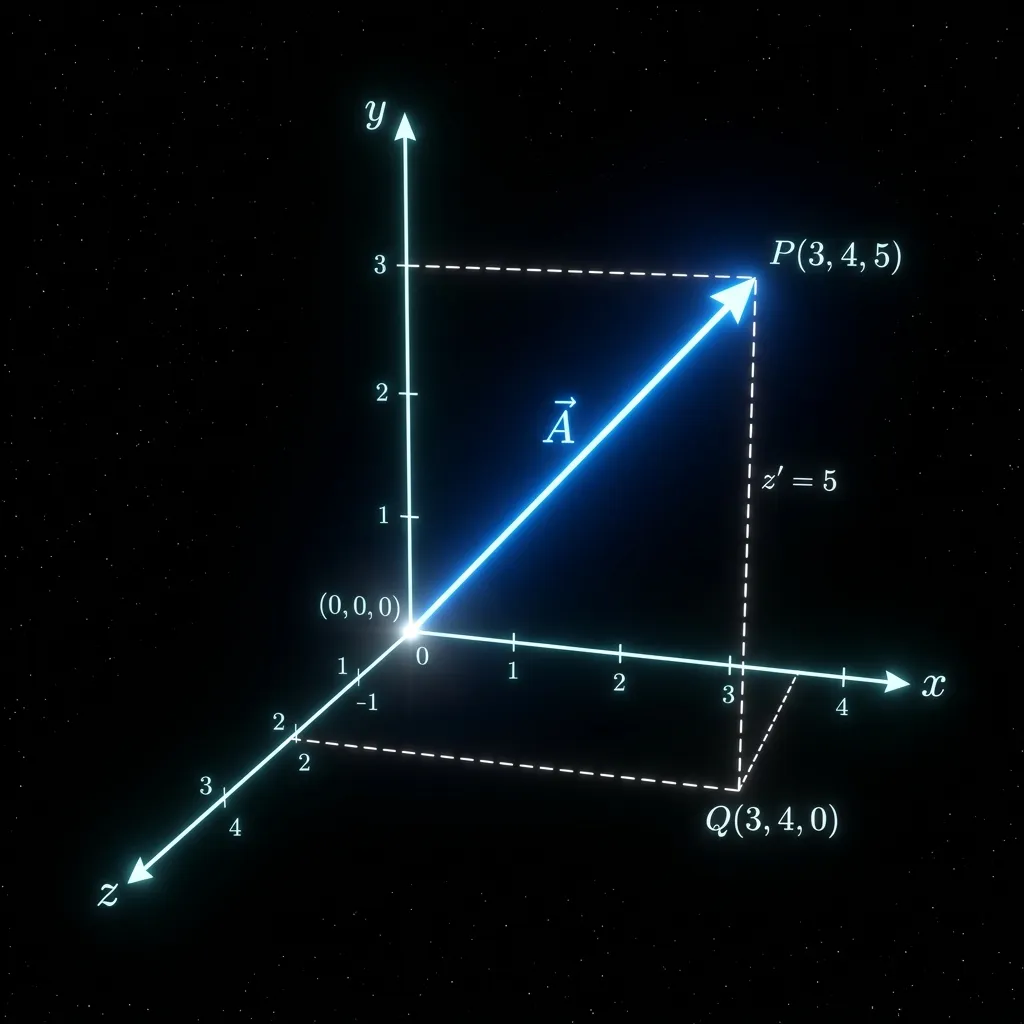
The mathematical method for computing vector magnitude is derived directly from the Pythagorean theorem extended to multi-dimensional Euclidean spaces. For any vector in Cartesian coordinates, the magnitude is defined as the square root of the sum of the squares of its orthogonal components:
OpenStax Calculus Volume 3 from Rice University explains that the magnitude or length of a three-dimensional vector v = ⟨x, y, z⟩ is defined as the square root of the sum of the squares of its components, given by |v| = √(x² + y² + z²). In geometric terms, this formula treats the vector as the spatial hypotenuse of a rectangular prism whose orthogonal edges correspond to coordinates x, y, and z. Using this vector magnitude calculator provides quick, reliable results for coursework and engineering tasks.
Worked Example 1: Standard 2D Vector (3, 4, 0)
Consider a displacement vector with components x = 3 and y = 4 in the plane (z = 0):
- Square each coordinate: 3² = 9, 4² = 16, 0² = 0.
- Sum the squared values: 9 + 16 + 0 = 25.
- Take the principal square root: √25 = 5.0000.
- Calculate unit vector components: û_x = 3/5 = 0.6000, û_y = 4/5 = 0.8000, û_z = 0.0000.
Result: The total vector magnitude is exactly 5 units, with directional unit vector (0.6000, 0.8000, 0.0000).
Worked Example 2: Spatial 3D Vector (2, 3, 6)
Consider a three-dimensional velocity vector with components x = 2, y = 3, and z = 6:
- Square each coordinate: 2² = 4, 3² = 9, 6² = 36.
- Sum the squares: 4 + 9 + 36 = 49.
- Evaluate the square root: √49 = 7.0000.
- Compute unit vector components: û_x = 2/7 ≈ 0.2857, û_y = 3/7 ≈ 0.4286, û_z = 6/7 ≈ 0.8571.
Result: The vector has a spatial length of 7.0000 units from the coordinate origin.
Worked Example 3: Negative Coordinate Vector (-1, -2, 2)
Consider a force vector acting in opposite quadrants with components x = -1, y = -2, and z = 2:
- Square each coordinate: (-1)² = 1, (-2)² = 4, 2² = 4.
- Sum the squares: 1 + 4 + 4 = 9.
- Evaluate the square root: √9 = 3.0000.
- Compute unit vector: û_x = -1/3 ≈ -0.3333, û_y = -2/3 ≈ -0.6667, û_z = 2/3 ≈ 0.6667.
Result: The magnitude is 3.0000 units, demonstrating that negative coordinates produce positive magnitudes.
In multi-variable calculus and linear algebra, vector magnitude represents the standard L2 norm within an inner product space. The dot product of any vector with itself equals the square of its magnitude (v · v = |v|²). To evaluate algebraic relationships between pairs of vectors, explore our Dot Product Calculator and Cross Product Calculator.
Unit Vector Normalization Principles
A unit vector is a specialized vector whose total magnitude equals exactly one. In mathematical notation, unit vectors are indicated with a circumflex "hat" symbol, such as û or v̂. Normalizing a vector isolates its pure spatial direction from its scale, allowing mathematicians and software algorithms to manipulate orientations without modifying force or distance magnitudes.
The process of normalization consists of dividing each individual Cartesian coordinate component by the vector overall magnitude:
Squaring the components of the resulting unit vector always sums to exactly 1: (x/|v|)² + (y/|v|)² + (z/|v|)² = (x² + y² + z²) / |v|² = |v|² / |v|² = 1. This property ensures unit vectors serve as ideal directional bases in physics coordinate systems, 3D graphics rendering engines, and aerospace navigational algorithms.
Key Concepts in Vector Analysis
Mastering vector calculations requires familiarity with fundamental geometric and algebraic principles that govern vector spaces and Euclidean metrics.
1. Euclidean Norm (L2 Norm)
The Euclidean norm represents the ordinary straight-line distance from the coordinate origin (0, 0, 0) to the coordinate point (x, y, z). It is the most common metric used in Euclidean geometry and physics simulations.
2. Triangle Inequality Theorem
For any two vectors u and v, the magnitude of their sum is always less than or equal to the sum of their individual magnitudes: |u + v| ≤ |u| + |v|. Equality holds only when the two vectors are collinear and point in the identical direction.
3. Scalar Multiplication & Scaling
Multiplying a vector by a real scalar k scales its magnitude by the absolute value of k: |k · v| = |k| · |v|. If k is negative, the magnitude remains positive while the vector directional sense reverses by 180 degrees.
4. Orthogonal Decomposition
Resolving a vector into independent perpendicular components simplifies spatial calculations. Because orthogonal axes share zero cross-correlation, individual component projections can be analyzed separately.
Wolfram MathWorld documents that a vector norm is a strictly positive mapping that satisfies triangle inequality, absolute scalability, and positive definiteness, with the Euclidean L2 norm serving as the standard geometric metric across linear spaces.
To calculate straight-line distances between arbitrary pairs of spatial points rather than vectors rooted at the origin, check our Euclidean Distance Calculator.
How to Use the Vector Magnitude Calculator
Follow these straightforward steps to calculate vector magnitude and normalized unit components:
You may enter positive numbers, negative numbers, or decimal floating-point values. Click the Reset button at any time to clear the form and restore default sample values.
Factors & Engineering Considerations
When applying vector calculations in engineering, aerospace, and computer science projects, keep these critical technical considerations in mind:
Coordinate Reference Frame:
Vector coordinates depend on the reference frame origin. While rotating coordinate axes modifies individual component values, the total scalar magnitude |v| remains invariant.
Measurement Unit Consistency:
All coordinate components must share identical units of measurement (e.g. meters or newtons) before calculating magnitude to maintain physical dimensional integrity.
Zero Vector Boundary:
The zero vector (0, 0, 0) has a magnitude of exactly 0.0000, but its unit vector is mathematically undefined because division by zero is not permissible.
Floating-Point Precision:
Extremely large or microscopic coordinate numbers can lead to numerical rounding errors during intermediate squaring operations without proper 64-bit precision.
NIST Special Publication 811 emphasizes that physical vector calculations require strict unit homogeneity across all orthogonal components to ensure valid scalar norm evaluations in scientific analysis.
For projecting vector forces along specific structural lines or axes, explore our Vector Projection Calculator.
Frequently Asked Questions
Q: How do you calculate the magnitude of a 2D or 3D vector?
A: To calculate the magnitude of a 2D or 3D vector, square each individual coordinate component (x, y, and z), add those squared numbers together, and then compute the principal square root of the resulting sum: |v| = √(x² + y² + z²).
Q: Can the magnitude of a vector ever be negative?
A: No. The magnitude of a vector represents geometric length or distance from the origin and is always a non-negative real number (|v| ≥ 0). Because squaring any real coordinate produces a positive value and the principal square root is non-negative, magnitude can never be negative.
Q: What is the difference between vector magnitude and vector direction?
A: Vector magnitude is a scalar quantity that specifies how large, intense, or long the vector is, whereas vector direction specifies the spatial orientation or angle along which the vector acts. Together, magnitude and direction completely define a vector.
Q: How do you normalize a vector into a unit vector?
A: To normalize a vector into a unit vector, divide each coordinate component by the total magnitude of the vector: û = (x/|v|, y/|v|, z/|v|). The resulting unit vector points in the exact same direction but has a length of precisely 1.
Q: How does the Pythagorean theorem relate to vector magnitude?
A: The vector magnitude formula is a direct extension of the Pythagorean theorem. In 2D space, the x and y components form the perpendicular legs of a right triangle, making the vector length the hypotenuse: c = √(a² + b²). In 3D space, this theorem is applied twice across orthogonal planes.
Q: What is the physical significance of vector magnitude in physics and mechanics?
A: In physics, vector magnitude represents the actual scalar measurement of a physical quantity, such as speed (magnitude of velocity), net force (magnitude of force vectors), electric field strength, or total spatial displacement.