Betrand Paradox Calculator - Random Chord Probability
Use this betrand paradox calculator to compare endpoint, radial-midpoint, and disk-midpoint chord probabilities for classic or custom thresholds.
Betrand Paradox Calculator
Results
What Is the Betrand Paradox?
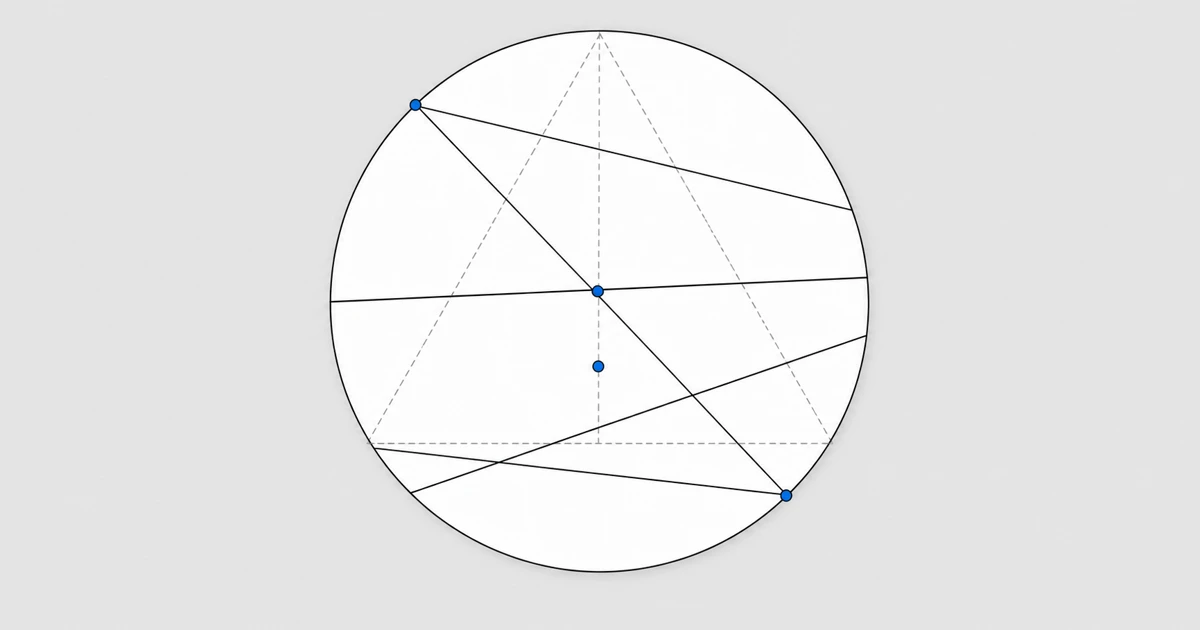
A betrand paradox calculator compares three ways to choose a random chord in a circle and shows why they do not give the same probability. The target Omni slug uses the misspelling "Betrand," but the probability problem is Bertrand's paradox: a chord is drawn in a circle, and we ask whether it is longer than a side of the equilateral triangle inscribed in that circle. The surprise is not that one formula is hard. The surprise is that the phrase random chord is incomplete until you say how the chord is generated.
- • Probability class demonstrations: Show students that changing the sample space can change the answer, even when the geometric picture looks unchanged.
- • Random simulation planning: Compare expected long-chord counts before writing a simulation that generates endpoints, midpoints, or radial distances.
- • Geometry-probability checks: Convert a circle radius into the classic triangle-side threshold and see how each model treats that same length.
- • Custom chord cutoffs: Use a threshold other than the triangle side, such as a chord at least as long as the radius, to cross-check references.
This betrand paradox calculator reports all three common answers side by side: random endpoints on the circumference, a midpoint chosen uniformly along a radius, and a midpoint chosen uniformly over the disk. The highlighted model controls the large result and the expected count, while the other two remain visible for comparison.
Use the result as a model-selection warning. If a homework problem, simulation, or article says only random chord, ask which random process is meant before treating the probability as settled.
For a single event probability after the sample space is already defined, the Probability Calculator handles the direct event-and-complement workflow.
How the Betrand Paradox Calculator Works
This betrand paradox calculator first sets the chord-length threshold L, then evaluates the same condition under three random-chord models. In classic mode, L = sqrt(3)R, the side length of an equilateral triangle inscribed in a circle of radius R. In custom mode, you enter L directly, and the calculator verifies that it is no longer than the diameter 2R.
- R: Circle radius. Any positive unit works because the probabilities depend on the ratio L/(2R).
- L: Chord-length threshold. The calculator counts chords longer than this value.
- q: Half-threshold ratio L/(2R). It ranges from just above 0 to 1.
- P_endpoints: Probability when two endpoints are chosen randomly on the circumference.
- P_radial: Probability when the midpoint distance from the center is chosen uniformly along a radius.
- P_disk: Probability when the midpoint is chosen uniformly over the circle's area.
For the endpoint model, chord length is 2R sin(theta/2), where theta is the smaller central angle between the two endpoints. A chord exceeds L when theta is large enough, which gives 1 - (2/pi)asin(L/(2R)).
For midpoint models, a chord with midpoint distance d has length 2 sqrt(R^2 - d^2). The chord is longer than L when d is less than sqrt(R^2 - (L/2)^2). If d is uniform along a radius, that distance ratio gives the square-root formula. If the midpoint is uniform over area, the circular area ratio gives 1 - q^2.
Classic triangle-side threshold
Radius R = 10, classic mode, sample count = 3000.
L = sqrt(3) * 10 = 17.3205, so q = 17.3205 / 20 = 0.8660.
Endpoint model = 33.33%, radial-midpoint model = 50.00%, disk-midpoint model = 25.00%. With endpoint sampling, 3000 chords gives an expected count of 1000 long chords.
The same circle and same threshold produce three answers because each model assigns probability to a different set of chords.
Custom threshold equal to the radius
Radius R = 5, custom threshold L = 5, sample count = 1000.
q = 5 / 10 = 0.5.
Endpoint model = 66.67%, radial-midpoint model = 86.60%, disk-midpoint model = 75.00%.
This custom setup is useful for checking the generalized formulas against references that use a radius-length cutoff rather than the triangle side.
According to Statistics LibreTexts, Bertrand's problem asks whether a random chord is longer than a side of an inscribed equilateral triangle, and different uniform model variables give probabilities of 1/2, 1/3, and 1/4.
According to Wolfram MathWorld, Bertrand's problem gives different probabilities under different chord-generation rules; for a chord at least as long as the radius, random endpoints give 2/3 while a uniformly chosen radial midpoint gives sqrt(3)/2.
When you want to express one of these model probabilities as a simplified classroom fraction, the Probability Fraction Calculator converts counted outcomes into fraction, decimal, percent, and odds forms.
Key Concepts Explained
Four ideas make the paradox easier to read before you trust any numerical answer.
Random chord
A chord is a line segment whose endpoints lie on a circle. Random chord is not a complete sampling rule because there are many ways to choose such a segment. Bertrand's paradox exists because those choices are not equivalent.
Endpoint sampling
This model chooses two points on the circumference. It gives more weight to chords by the angle they subtend at the center, and for the classic triangle-side threshold the probability is 1/3.
Radial midpoint sampling
This model fixes a radius direction and chooses the chord midpoint uniformly along that radius. It creates the 1/2 classic answer because the midpoint only has to land inside the inner half-radius.
Disk midpoint sampling
This model chooses the chord midpoint uniformly over the circular area. The favorable midpoint region is a smaller concentric disk, so the classic probability is an area ratio: (R/2)^2 divided by R^2, or 1/4.
The three models are internally consistent. The contradiction appears only when the problem statement hides the model and asks for one answer anyway. The calculator keeps each model visible so you can name the assumption in your notes.
For a probability problem where the random experiment is already well defined by independent heads-or-tails trials, the Coin Flip Probability Calculator provides a useful contrast to Bertrand's ambiguous setup.
How to Use This Calculator
Use the betrand paradox calculator to set the circle size, choose the threshold, pick the model you want to highlight, and compare the three probabilities.
- 1 Enter the radius: Use any positive value for R. The unit cancels in the probability formulas, but the threshold length is displayed in the same radius units.
- 2 Choose the threshold mode: Leave classic mode on for the equilateral-triangle side. Switch to custom mode when a lesson or reference uses another chord length.
- 3 Enter a custom threshold if needed: In custom mode, L must be greater than zero and no more than 2R. A value equal to the diameter produces zero because no chord is longer than the diameter.
- 4 Select the highlighted model: Choose endpoint, radial-midpoint, or disk-midpoint sampling. This controls the primary probability and expected count.
- 5 Review the three model rows: Compare the three percentages and the disagreement spread. A large spread means the random-chord rule matters a lot.
For a standard classroom example, enter R = 10, use classic mode, select random endpoints, and set the sample count to 3000. The page reports 33.33% for endpoint sampling, 50.00% for radial-midpoint sampling, 25.00% for disk-midpoint sampling, and an expected endpoint count of 1000 long chords.
If you plan to build a manual simulation after comparing the formulas, the Random Number Generator can supply reproducible random values for endpoint angles or midpoint coordinates.
Benefits of Using This Calculator
The betrand paradox calculator separates the geometry, the sampling rule, and the numerical probability so the assumptions stay visible.
- • Model comparison in one view: All three probabilities are visible at the same time, so you do not have to recompute the problem under separate assumptions.
- • Classic and custom thresholds: Classic mode reproduces the triangle-side problem, while custom mode supports radius-length and other cutoff examples used in references.
- • Expected counts for simulations: The sample-count input turns a probability into an expected long-chord total, which helps check simulation output before debugging code.
- • Assumption-aware answers: The model disagreement spread makes it obvious when a problem statement is under-specified.
- • Scale-invariant geometry: Changing the radius scales the threshold length but leaves the classic probabilities unchanged, making the role of ratios easier to see.
Use the calculator before writing a proof, grading a response, or designing a simulation. If the selected model is not stated in the problem, write that limitation next to the result. That habit prevents the paradox from being mistaken for a calculation mistake.
When the expected long-chord count needs to be combined with payoffs, scores, or class-game outcomes, the Expected Value Calculator extends the same probability-times-outcome logic.
Factors That Affect Your Results
Four choices control the result more than the circle drawing itself.
Sampling model
Endpoint, radial-midpoint, and disk-midpoint sampling place probability weight on different parts of the chord set. This is the central reason the classic problem has three answers.
Threshold length
A larger L makes a long chord harder to obtain. At L = sqrt(3)R the classic answers are 1/3, 1/2, and 1/4. At L = R the three answers become 2/3, sqrt(3)/2, and 3/4.
Radius scale
The probability depends on L/(2R), not on R alone. If classic mode scales L with R, the probabilities stay the same for radius 1, 10, or 100.
Strictly longer wording
The calculator treats the event as longer than L. For continuous models, greater-than and greater-than-or-equal give the same probability because equality has probability zero, but the diameter edge still returns zero.
- • The calculator evaluates ideal mathematical chord models. A physical ruler-and-compass drawing or a small hand simulation can drift because of measurement error or uneven random choices.
- • No single output should be called the answer unless the sampling model is part of the problem statement.
- • The expected count is not a fixed outcome for a finite simulation. A run of 3000 generated chords can land above or below its expectation because random variation remains.
The practical lesson is to document the random procedure. In code, that means writing whether you generated endpoint angles, midpoint distances, or disk coordinates. In a written solution, it means naming the model before presenting the percentage.
According to Foundations of Physics, transformation-group arguments are illustrated with Bertrand's paradox and lead Jaynes to treat one physical version as well posed.
For the circle measurements behind the chord threshold, the Circle Geometry Calculator gives radius, diameter, circumference, and area relationships in a more general geometry setting.
Frequently Asked Questions
Q: What is Bertrand's paradox?
A: Bertrand's paradox is a probability problem about random chords in a circle. It asks whether a chord is longer than a side of an inscribed equilateral triangle. Different reasonable definitions of random chord give different probabilities, so the problem exposes an incomplete random model.
Q: Why are there three answers to Bertrand's paradox?
A: There are three common answers because there are three common ways to generate the chord: choose two random endpoints, choose a midpoint uniformly along a radius, or choose a midpoint uniformly over the disk. Each method weights the possible chords differently.
Q: What is the classic probability for a long random chord?
A: For the classic triangle-side threshold, the endpoint model gives 1/3, the radial-midpoint model gives 1/2, and the disk-midpoint model gives 1/4. The calculator shows all three because none is meaningful without its sampling rule.
Q: Which Bertrand paradox method is correct?
A: No method is universally correct without more context. The correct method is the one that matches how the chord is actually generated. Endpoint angles, radial midpoint distance, and disk midpoint coordinates describe different experiments, so they legitimately return different probabilities.
Q: Can I use a custom chord threshold?
A: Yes. Switch the threshold mode to custom and enter a chord length L greater than zero and no more than 2R. The calculator then applies the same endpoint, radial-midpoint, and disk-midpoint formulas to your chosen cutoff.
Q: Does changing the radius change the classic probabilities?
A: Changing the radius changes the displayed threshold length, but not the classic probabilities, because L = sqrt(3)R scales with R. The formulas depend on L/(2R), so the ratio stays fixed when the whole circle scales.