Swp Calculator - Systematic Withdrawal Plan Estimator
Use this swp calculator to project steady monthly withdrawals, final balance, total withdrawn, and net cash result from a starting corpus.
Swp Calculator
Results
What Is the Swp Calculator?
A swp calculator projects how a starting investment behaves when you take a fixed amount out every month over a chosen period. Use it when you plan a retirement income stream, test how long a mutual fund corpus can fund a steady withdrawal, or compare two withdrawal amounts side by side. The output is a scenario estimate, not a promise of fund performance.
- • Plan a retirement income stream: Enter your retirement corpus, expected return, and the monthly income you need to see how long the money may last.
- • Test corpus sustainability: Compare a larger monthly withdrawal against a smaller one to see which keeps the corpus funded through your chosen period.
- • Stress-test the return assumption: Lower the return input to see how the same monthly withdrawal behaves when markets are weaker than expected.
- • Compare two withdrawal schedules: Run the calculator twice with different monthly amounts to decide which schedule fits your cash-flow needs.
An SWP, or systematic withdrawal plan, is the mirror image of a SIP. With a SIP you put a fixed amount in every month; with an SWP you take a fixed amount out every month. The remaining corpus keeps earning the assumed rate of return, so the question is whether the growth covers the withdrawals.
Read the result as a planning range rather than a forecast. Run a lower-return case, a base case, and a higher-return case, then decide whether the schedule still works if markets are weaker than expected.
The swp calculator is useful for mutual fund investors and retirees because it isolates one decision: the fixed monthly withdrawal. It does not choose a fund, pick an asset allocation, or model taxes; it is a scenario tool for testing a cash-flow plan.
If you want to model the monthly contribution side instead of the withdrawal side, the SIP Calculator projects how a regular monthly investment grows.
How the Swp Calculator Works
The calculation has two parts: compound the starting corpus for every month in the withdrawal period, then subtract the future value of fixed monthly withdrawals made at the beginning of each month.
- B(n): projected final balance after n months
- P: initial corpus at the start
- W: monthly withdrawal amount
- r: annual return assumption as a decimal
- t: withdrawal period in years (n = 12 x t)
Investor.gov, U.S. Securities and Exchange Commission, frames compound-growth projections around initial investment, monthly contribution, length of time, estimated interest rate, and compounding frequency. That is the same structure used here, with monthly compounding fixed because SWP withdrawals are entered monthly.
Changing only the monthly withdrawal shows how sensitive the corpus is to your income need. Changing only the starting corpus shows how much the initial lump sum buys in monthly income under the same return assumption.
The formula uses a constant monthly rate because the calculator needs one stable assumption for every period. Real portfolios do not move that way; the projection is a simplified planning model that lets you compare withdrawal choices under the same return assumption.
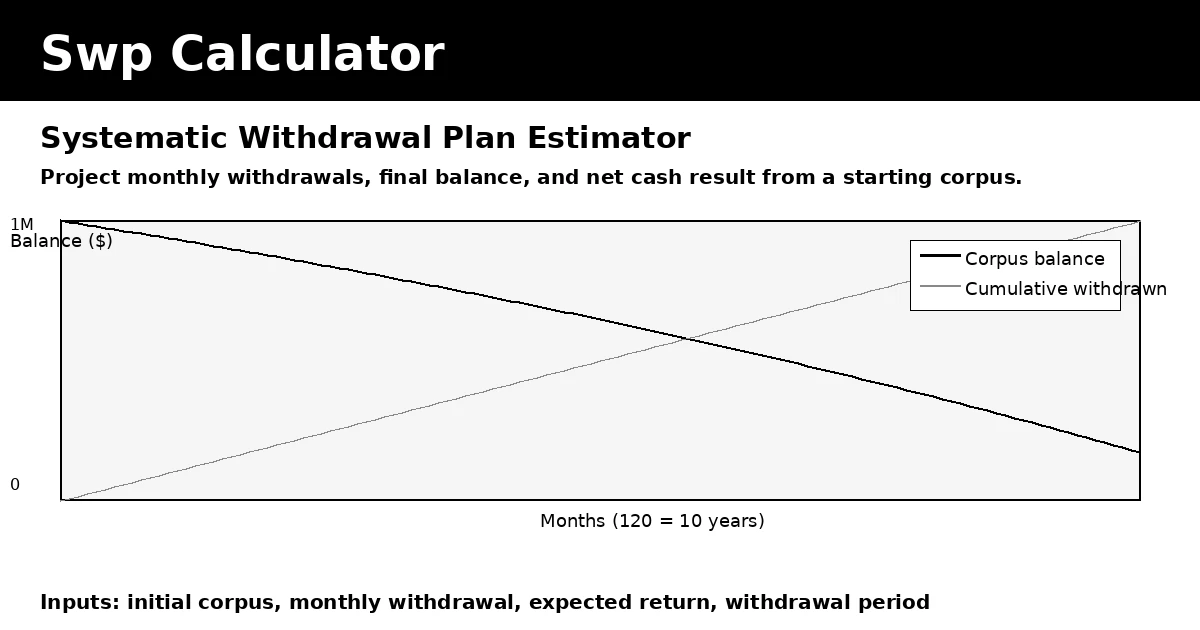
Ten-year SWP from a retirement corpus
Initial corpus 1,000,000, monthly withdrawal 10,000, annual return 6%, period 10 years.
Monthly rate is 0.5%. The corpus grows to 1,819,396.73, and the annuity value of the withdrawals is 1,638,793.46.
Final balance is 180,603.27 after 1,200,000 of total withdrawals, giving a net cash result of 380,603.27.
The withdrawal is large relative to the assumed return, so the corpus shrinks over the period but is not depleted.
To isolate the compound-growth part of the swp calculator and see what the corpus would become with no withdrawals, the Lumpsum Calculator projects the same starting amount forward.
Key Concepts Explained
The model is simple, but the interpretation depends on timing, return assumption, and whether the corpus can support the chosen withdrawal.
Beginning-of-month withdrawal
Each monthly withdrawal is treated as leaving the account at the start of the month. The corpus therefore does not earn that month's return on the withdrawn amount.
Nominal return assumption
The annual return is a planning assumption before taxes, exit loads, and fund-specific expenses unless you adjust the rate yourself.
Corpus sustainability
If the monthly withdrawal is larger than the corpus can support, the calculator flags the corpus as depleted and clamps the final balance to zero.
Net cash result
Total withdrawn plus final balance minus the initial corpus. It is the total cash value the investor ends up with from the original investment.
AMFI describes a Systematic Investment Plan as a method for investing a fixed amount in a mutual fund periodically, often monthly, and notes that rupee cost averaging does not assure profit or protect against loss in falling markets. The same caveat applies to an SWP: the calculated monthly income depends on a return assumption that may not hold in a given year.
The beginning-of-month timing convention is conservative for retirement planning. It assumes the withdrawal is taken out first, then the remaining balance earns the month's return, which is closer to how a salaried person or pension plan would actually draw the money.
A larger starting corpus and a higher assumed return both extend the period a withdrawal schedule can be sustained. A lower assumed return and a longer period both shrink the final balance, even if the same monthly withdrawal feels affordable at the start.
For a fund that mixes a one-time deposit with monthly contributions before any withdrawals begin, the Lumpsum Plus Sip Calculator shows the combined growth path.
How to Use This Calculator
Use realistic assumptions and change one input at a time so the result points to a decision rather than a single optimistic number.
- 1 Enter the starting corpus: Use the cash you have already accumulated for retirement or for an SWP strategy. Enter zero if you want to model withdrawals from zero to test a budget.
- 2 Add the monthly withdrawal: Enter the fixed amount you want to take out at the beginning of every month for the full period.
- 3 Choose the return assumption: Use a conservative nominal annual return if the result will guide a real retirement decision. Equity-heavy portfolios usually use a wider range; debt-heavy portfolios use a narrower one.
- 4 Set the withdrawal period: Match the period to the income horizon, such as 10 years for early retirement, 20 years for mid-career planning, or 30 years for a long retirement.
- 5 Read the sustainability flag: Check whether the corpus status shows the corpus lasting the full period or running out early before you commit to the schedule.
If you have 1,000,000 saved and need 10,000 per month, run the base case at 6% first. Then lower the return to 4% and see whether the corpus is still funded for 10 years. If the lower case runs out, you can lower the monthly withdrawal, lengthen the period, or build a larger starting corpus before you commit to the schedule.
After each run, ask what action the result suggests. If the corpus runs out, you can lower the monthly withdrawal, add a one-time top-up, lengthen the horizon, or build a larger starting corpus instead of simply raising the expected return.
If the projection shows a healthy final balance, that is not a reason to raise the withdrawal automatically. A large remaining balance is a cushion for weaker markets, medical costs, or a longer-than-expected retirement.
If your main decision is how long a retirement corpus can fund a specific annual income, the Retirement Withdrawal Calculator frames the same question for an annual rather than monthly schedule.
Benefits of Using This Calculator
A dedicated swp calculator separates the sustainability question from the broader retirement plan, so you can review one decision at a time.
- • Quantifies sustainability: You can see whether the corpus lasts the full period instead of guessing from a budget spreadsheet.
- • Surfaces the depletion point: The corpus status flag tells you, without extra math, when the monthly withdrawal is too large for the assumed return.
- • Connects income to return: The calculator links the monthly withdrawal to the assumed return, so you can see how much the income plan depends on market behavior.
- • Supports conservative planning: Running a lower-return case can prevent overcommitting to an income level that only works under an aggressive assumption.
- • Frames the next decision: Whether the result suggests a smaller withdrawal, a longer period, or a larger starting corpus, the outputs make the next choice explicit.
The swp calculator is also useful for comparing an SWP with a one-time lumpsum withdrawal. When the corpus is large and the withdrawal is moderate, the corpus can keep growing even while you take income out. When the withdrawal is large, the corpus can be depleted long before the chosen period ends.
The net cash result is a useful way to compare different schedules. A schedule that leaves a healthy final balance has more room to absorb weaker markets, while a schedule that depletes the corpus has no room at all.
For retirees who also need to satisfy a required minimum distribution from a traditional IRA, the RMD Calculator computes the annual amount that the IRS rule requires.
Factors That Affect Your Results
The result changes quickly when return, timing, and actual fund behavior differ from the assumptions entered.
Return volatility
The calculator applies a smooth monthly rate, while real mutual fund returns move unevenly and can be negative for long stretches, especially at the start of retirement.
Withdrawal timing
Beginning-of-month withdrawals leave the corpus slightly sooner than end-of-month withdrawals, so the same monthly amount produces a slightly smaller final balance.
Costs and taxes
Fund expenses, advisory fees, exit loads, and taxes reduce realized returns unless you lower the return input to reflect them.
Asset allocation
Equity, debt, hybrid, and other portfolios have different risk and return behavior, so one rate assumption should not fit every retirement plan.
- • The calculator assumes a constant annual return converted to monthly compounding; it does not model actual market sequence risk.
- • It assumes every withdrawal is made at the beginning of the month and does not include taxes, inflation, fund expenses, exit loads, or irregular top-ups.
- • It is for planning and comparison only, not personalized investment or tax advice.
IRS Publication 590-B explains that the general rule for non-annuity payments from an individual retirement account uses the account balance and an expected rate of return to project the annual withdrawal. The same structure applies here, with the calculator using monthly compounding and a beginning-of-month withdrawal to project a steady income stream.
For cash committed, compare the net cash result with the amount invested and the time required. A high net cash result can still demand a monthly withdrawal that is too large for the corpus to support if returns fall short of the assumption.
If you want to model the broader investment plan that funds the swp calculator, the Investment Calculator projects lump-sum and irregular contribution patterns over the same horizon.
Frequently Asked Questions
Q: How is a systematic withdrawal plan calculated?
A: The calculator compounds the starting corpus for every month in the withdrawal period, then subtracts the future value of fixed monthly withdrawals made at the beginning of each month. The result is the final balance, the total withdrawn, and the net cash position after the period.
Q: Can I use a swp calculator for retirement income planning?
A: Yes. Enter your retirement corpus, expected return, and the monthly income you need to see how long the corpus may last. The calculator is a scenario tool; it does not choose a fund, forecast market returns, or include taxes and fund-specific costs unless you adjust the return assumption.
Q: Does the calculator assume withdrawals at the start or end of the month?
A: It assumes each withdrawal leaves the account at the beginning of the month. This is a conservative annuity-due convention. If your withdrawals are taken at the end of the month, the actual final balance would be slightly higher under the same return assumption.
Q: What return rate should I enter for an SWP projection?
A: Enter a nominal annual return that fits the asset mix and risk level you are testing. For serious retirement planning, run several cases rather than one number. A lower-return case is useful because market returns do not arrive smoothly or reliably.
Q: What happens if my withdrawals are larger than the corpus can support?
A: The calculator flags the corpus as depleted and clamps the final balance to zero. It also shows the total withdrawn up to the end of the period, so you can see how much of the planned income is actually delivered before the corpus runs out.
Q: Does the swp calculator include taxes, exit load, or fund expenses?
A: No. The calculator uses the return rate you enter and does not separately deduct taxes, exit loads, expense ratios, or advisory fees. To account for costs, lower the expected return input or run a separate after-cost scenario.