Anion Gap Calculator - Serum and Albumin Corrected AG
Anion gap calculator that turns a basic metabolic panel into the serum anion gap, the albumin corrected anion gap, and a delta gap in mEq per liter, with a high, normal, or low band from the published 8 to 12 mEq per liter cut-offs.
Anion Gap Calculator
Results
What Is Anion Gap Calculator?
An anion gap calculator turns a basic metabolic panel into the serum anion gap, which is the standard first step in the workup of metabolic acidosis. The calculator takes serum sodium, chloride, and bicarbonate in mEq per liter and returns a single AG in mEq per liter paired with a high, normal, or low band from the published 8 to 12 mEq per liter cut-offs.
- • Pre-rounds chart review: enter the latest BMP values before a shift so the conversation with the clinician starts from the published AG number rather than a vague description of a metabolic acidosis.
- • Repeat scoring after a BMP: paste a fresh sodium, chloride, and bicarbonate into the form, repeat the calculation after each set of labs, and watch for movement between the reference range and the high or low AG bands.
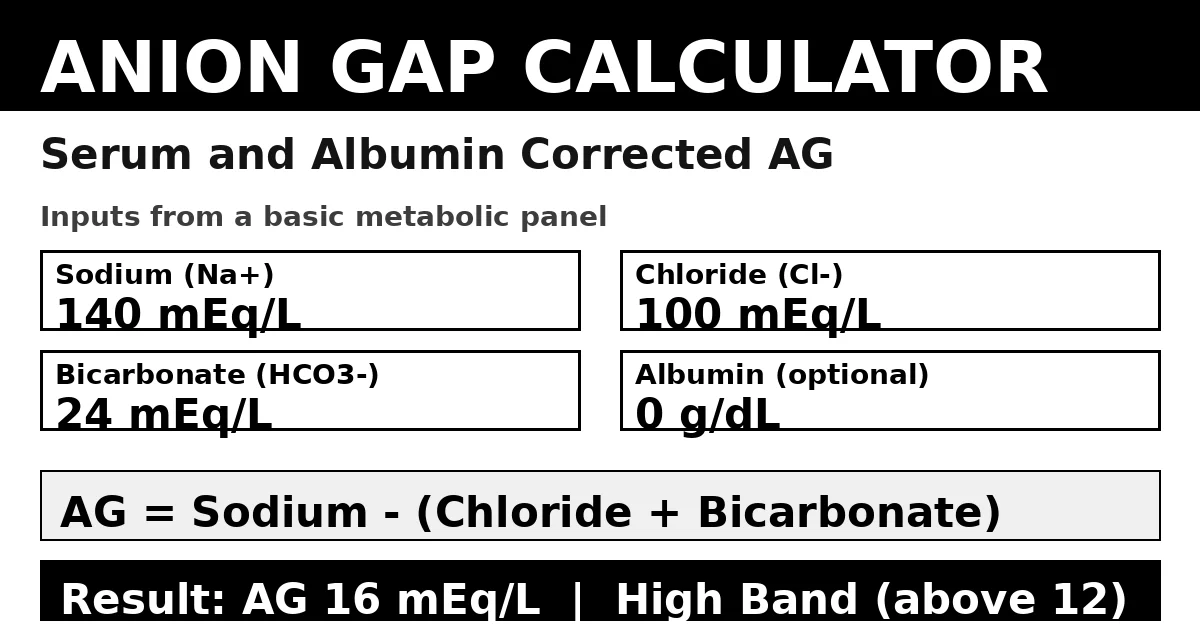
- • Walk-through of a published example: recheck the Omni Calculator worked example with sodium 140, chloride 100, and bicarbonate 24 to see how the three inputs add up to a single AG and a band.
The calculator is most useful when all three routine inputs are recent and come from the same basic metabolic panel. Mixing a sodium from one draw with a bicarbonate from another draw is a common source of error, so the result should always be read against the report date on the lab slip.
The ANC Calculator uses a similar lab-to-single-number pattern for the CBC and pairs naturally with the anion gap during a sepsis or hematology workup.
How Anion Gap Calculator Works
The anion gap calculator subtracts the sum of serum chloride and serum bicarbonate from serum sodium to get the serum anion gap in mEq per liter. When albumin is provided, the calculator also adds 2.5 times 4 minus albumin to the serum AG to produce the albumin corrected AG, which is the published Figge correction for hypoalbuminemia.
- sodium: serum sodium from the basic metabolic panel, in mEq per liter. A typical adult reference range is 135 to 145 mEq per liter.
- chloride: serum chloride from the basic metabolic panel, in mEq per liter. A typical adult reference range is 98 to 106 mEq per liter.
- bicarbonate: serum bicarbonate from the basic metabolic panel, in mEq per liter. A typical adult reference range is 22 to 28 mEq per liter.
- albumin: optional serum albumin from a hepatic or comprehensive panel, in grams per deciliter. A typical adult reference range is 3.5 to 5.0 g/dL.
- ag: serum anion gap in mEq per liter, equal to sodium minus the sum of chloride and bicarbonate.
The result is then grouped into one of three published bands: above 12 mEq per liter is high, between 8 and 12 mEq per liter is normal, and below 8 mEq per liter is low. The calculator also reports a delta gap of AG minus 12 divided by 24 minus bicarbonate, which is a published flag for a mixed acid base disorder.
Omni Calculator worked example: sodium 140, chloride 100, bicarbonate 24
Serum AG = 140 - (100 + 24) = 140 - 124 = 16 mEq per liter
Albumin corrected AG = 16 + 2.5 * (4 - 0) = 16 mEq per liter (albumin not entered)
Delta gap = (16 - 12) / (24 - 24 floored at 1) = 4 / 24 = 0.17
Serum AG 16 mEq per liter, high band
The 16 result is above the published 12 mEq per liter high AG cut-off, which is the simplest example of a high anion gap pattern. With albumin added, the corrected AG would move the same patient up by 2.5 times the albumin deficit.
According to Omni Calculator Anion Gap reference, the serum anion gap is calculated as sodium minus the sum of chloride and bicarbonate in milliequivalents per liter, and is grouped into a high band above 12 and a low band below 8 milliequivalents per liter.
According to MedlinePlus, the serum anion gap is the standard first step in the workup of metabolic acidosis, and the albumin corrected anion gap adds 2.5 times 4 minus albumin to the result to correct for hypoalbuminemia.
A second bedside kidney function review that uses the same lab panel is the GFR Calculator, which turns serum creatinine, age, and sex into a single kidney function number for the same metabolic workup.
Key Concepts Explained
Four concepts drive the result. Naming them keeps the calculator from being read as a stand alone diagnosis.
Serum Anion Gap
The difference between measured serum cations and measured serum anions, expressed in mEq per liter. The AG is the standard first step in a metabolic acidosis workup and is calculated from a single basic metabolic panel.
Albumin Correction
Serum albumin is an unmeasured anion, so a low albumin artificially lowers the AG. The published Figge correction adds 2.5 times 4 minus albumin to the serum AG so the result reflects the metabolic picture in a hypoalbuminemic patient.
AG Bands
The published stratification pairs the AG with one of three bands: above 12 high, between 8 and 12 normal, and below 8 low. The bands are triage prompts, not a diagnosis, and a high AG triggers the published MUDPILES and GOLDMARK differential.
Delta Gap
Delta gap is the change in AG from 12 divided by the change in bicarbonate from 24, and is a published flag for a mixed acid base disorder. A delta gap above 2 suggests a concurrent metabolic alkalosis, and a delta gap below 1 suggests a concurrent normal AG metabolic acidosis.
A high AG in a stable outpatient and a high AG in a febrile patient in the emergency department can sit in the same band but require very different next steps. The band is the starting point, not the conclusion.
A second clinical screening tool that uses an age aware threshold pattern similar to the AG banding is the Age-Adjusted D-Dimer Calculator, which adjusts the rule-out threshold for pulmonary embolism by patient age.
How to Use This Calculator
The form works from a small set of basic metabolic panel values. Each input should come from the most recent BMP, ideally the same draw.
- 1 Enter the serum sodium: type the sodium from the latest basic metabolic panel, in mEq per liter. Most adult reports list a reference range of 135 to 145 mEq per liter next to the result.
- 2 Enter the serum chloride: the BMP usually lists this next to sodium. A typical adult range is 98 to 106 mEq per liter. Leave the field at the default 100 if the lab slip is not at hand.
- 3 Enter the serum bicarbonate: the BMP usually lists this as CO2 or HCO3. A typical adult range is 22 to 28 mEq per liter. Bicarbonate below 22 in an acute setting is the most common trigger for an AG workup.
- 4 Enter albumin if available: add the serum albumin in grams per deciliter when the hepatic or comprehensive panel is available. Leave the field at 0 to skip the corrected AG calculation.
- 5 Read the AG and the band: the result panel shows the serum AG in mEq per liter, the albumin corrected AG when albumin is provided, the delta gap, the matching band label, and a one line clinical interpretation. Treat the band as a triage prompt.
A patient in the emergency department with a sodium of 138, a chloride of 95, a bicarbonate of 10, and an albumin of 4 enters those four numbers and gets a serum AG of 33 mEq per liter, an albumin corrected AG of 33 mEq per liter, a delta gap of 1.5, and a high band label. The result triggers the published diabetic ketoacidosis workup: insulin infusion, potassium replacement, fluid resuscitation, and a venous blood gas to confirm the pH.
The TIRADS Calculator applies a similar numeric scoring pattern to a different clinical question, and the two calculators share the same triage-band workflow.
Benefits of Using This Calculator
Using an anion gap calculator offers several practical advantages over mental math alone.
- • Standardized mEq per liter unit: the calculator returns the AG in mEq per liter, which is the unit used in every published metabolic acidosis guideline.
- • Quick bedside math: all three routine inputs come from a single basic metabolic panel, so the AG can be calculated in under a minute once the report is in hand.
- • Transparent calculation: the formula is shown in plain English, so the contribution of sodium, chloride, and bicarbonate is visible rather than hidden inside a single ratio.
- • Built-in high, normal, and low bands: the result is paired with the published 12 and 8 mEq per liter cut-offs, so the next step is implied by the same number.
- • Optional albumin correction: the corrected AG is shown whenever albumin is entered, which is the published Figge correction for hypoalbuminemia and a common source of under-call in hospitalized patients.
- • Shared language with the care team: emergency physicians, internists, intensivists, and pharmacists can all read the same number, which keeps the discussion focused on the next test rather than the calculation.
The same AG is used in emergency, inpatient, and outpatient settings, which makes it a shared language for the bedside team, the consultant, and the follow up clinic.
The Alvarado Calculator applies a published band stratification to a different clinical question, and the two calculators share the same triage-band workflow.
Factors That Affect Your Results
The output depends on the basic metabolic panel values entered and on the patient sitting in front of the calculator. Five small changes can move the AG by several mEq per liter.
Sodium Input
Serum sodium is the largest single contributor. A 5 mEq per liter rise in sodium adds 5 mEq per liter to the AG, all else equal, so a small change in sodium can move the result across a band boundary.
Chloride Input
Serum chloride is subtracted from sodium to build the AG. Hyperchloremia from saline resuscitation can mask a rising AG by widening the denominator, so the trend is more reliable than a single reading during active fluid resuscitation.
Bicarbonate Input
Serum bicarbonate is also subtracted from sodium. Bicarbonate below 22 mEq per liter is the most common trigger for an AG workup, and a falling bicarbonate over serial labs is the simplest sign of a widening gap.
Albumin Correction
Serum albumin is an unmeasured anion, so hypoalbuminemia artificially lowers the AG. Entering albumin and using the corrected AG is the published way to read the metabolic picture in a hospitalized or chronic disease patient.
Lab Variability
Electrolyte panels can be affected by sample handling, recent IV fluids, and chronic conditions, so the lab items should come from a recent draw. A result built from a sodium and a bicarbonate taken on different days is not reliable.
- • The AG is a screening tool, not a stand alone diagnosis. Blood gas, lactate, ketones, and a clinical exam are still required before any decision about insulin, bicarbonate replacement, or dialysis.
- • Children, pregnant patients, and older adults can have atypical electrolyte patterns, and the calculator can overestimate or underestimate the gap in those groups without an albumin correction.
According to the MedlinePlus medical encyclopedia chapter on metabolic acidosis, the serum anion gap is the standard first step in the workup of metabolic acidosis, and the albumin corrected AG should be reported whenever albumin is available.
According to Merck Manuals, the serum anion gap is the standard first step in the workup of metabolic acidosis, with a high gap above 12 milliequivalents per liter triggering the MUDPILES and GOLDMARK differential of methanol, uremia, diabetic ketoacidosis, propylene glycol, iron or isoniazid, lactic acidosis, ethylene glycol, and salicylates.
Frequently Asked Questions
Q: What is a normal anion gap value?
A: A normal serum anion gap is 8 to 12 mEq per liter. The Omni Calculator anion gap reference calls an AG between 8 and 12 the reference range, an AG above 12 a high anion gap, and an AG below 8 a low anion gap. Many labs also report 12 plus or minus 4 mEq per liter as the historical reference window.
Q: What does a high anion gap mean?
A: An anion gap above 12 mEq per liter is a high anion gap. It points to metabolic acidosis driven by an unmeasured acid, and the published MUDPILES and GOLDMARK mnemonics name the most common causes: methanol, uremia, diabetic ketoacidosis, propylene glycol, iron or isoniazid, lactic acidosis, ethylene glycol, and salicylates.
Q: How is the anion gap corrected for low albumin?
A: The albumin corrected anion gap adds 2.5 times 4 minus albumin to the serum AG, which is the published Figge correction. With albumin 2 g per dL and a serum AG of 16, the correction adds 5 and lifts the result to 21 mEq per liter, which is the correct reading for the metabolic picture in a hypoalbuminemic patient.
Q: What is the difference between anion gap and strong ion difference?
A: The anion gap is a simple laboratory ratio calculated as sodium minus chloride plus bicarbonate. The strong ion difference, or SID, is a Stewart based measure calculated as the sum of strong cations minus strong anions. SID is more accurate but requires more inputs, so the AG remains the standard first step in a metabolic workup.
Q: When should an anion gap be repeated after treatment?
A: Repeat the basic metabolic panel 4 to 6 hours after the first abnormal result in any acute metabolic acidosis, and then daily until the gap closes and the bicarbonate normalizes. In diabetic ketoacidosis, repeat the AG every 2 to 4 hours during insulin and fluid resuscitation so the trend toward a normal AG is visible alongside the glucose trend.
Q: What does a low anion gap value mean?
A: An anion gap below 8 mEq per liter is a low anion gap. The most common cause is hypoalbuminemia, since albumin is an unmeasured anion. Other causes include lithium or bromide exposure, multiple myeloma with cationic paraprotein, hypertriglyceridemia, and lab error, and the result should be rechecked against the same basic metabolic panel.