Acid Base Calculator - Anion Gap and ABG Reading
Use this acid base calculator to read arterial blood gas pH, PCO2, and bicarbonate, and to compute the standard and albumin-corrected anion gap.
Acid Base Calculator
Results
What Is Acid Base Calculator?
An acid base calculator is a clinical reference tool that reads an arterial blood gas panel and a basic metabolic panel side by side, then translates the numbers into plain language. It is useful for emergency clinicians triaging an ABG, residents preparing for rounds, nurses double-checking an unfamiliar lab pattern, students learning acid-base physiology, and patients who want a structured summary to bring into a follow-up visit.
- • Emergency triage review: Read an ABG result next to serum electrolytes when deciding whether the picture is respiratory, metabolic, or mixed.
- • Pre-rounds preparation: Translate a raw pH, PCO2, and bicarbonate into a one-line status before presenting a patient.
- • Anion gap review: Compute the standard and albumin-corrected anion gap to flag unmeasured anions in metabolic acidosis.
- • Patient follow-up: Bring a structured acid-base summary into a follow-up visit so the clinician can walk through the numbers.
Use the output as a clinical reference, not a diagnosis. Confirm any abnormal pattern with the treating team, a repeat blood gas when needed, and the broader clinical picture such as respiratory rate, mental status, ketones, lactate, and renal function.
Because metabolic acid-base patterns track kidney function, pair the gap reading with our Protein Creatinine Ratio Calculator to see how protein handling and filtration are moving.
How Acid Base Calculator Works
The calculator runs two short formulas on the entered values. The first formula turns pH, PCO2, and bicarbonate into a plain-language status. The second formula turns sodium, chloride, and bicarbonate into the anion gap, with an optional albumin correction for patients with low serum albumin.
- Arterial pH: Arterial pH from the ABG panel. The reference range is 7.35 to 7.45.
- PCO2: Partial pressure of carbon dioxide in arterial blood. The reference range is 35 to 45 mmHg.
- Bicarbonate: Arterial bicarbonate concentration. The reference range is 22 to 26 mEq/L. The same number is reused in the anion gap calculation.
- Sodium: Serum sodium. The reference range is 135 to 145 mEq/L. Outside this range the anion gap itself is harder to interpret.
- Chloride: Serum chloride. The reference range is 98 to 107 mEq/L.
- Albumin (optional): Serum albumin in g/dL. Leave blank to skip the corrected anion gap. Reference is 3.5 to 5.0 g/dL.
The acid-base status labels the dominant driver. If pH is low, the calculator checks whether PCO2 is high (respiratory) or bicarbonate is low (metabolic), and notes when both are moving. If pH is high, it checks the same drivers in the opposite direction. If pH sits inside the reference range but PCO2 and bicarbonate are both off, the calculator flags a compensated mixed pattern instead of calling it normal.
Worked example
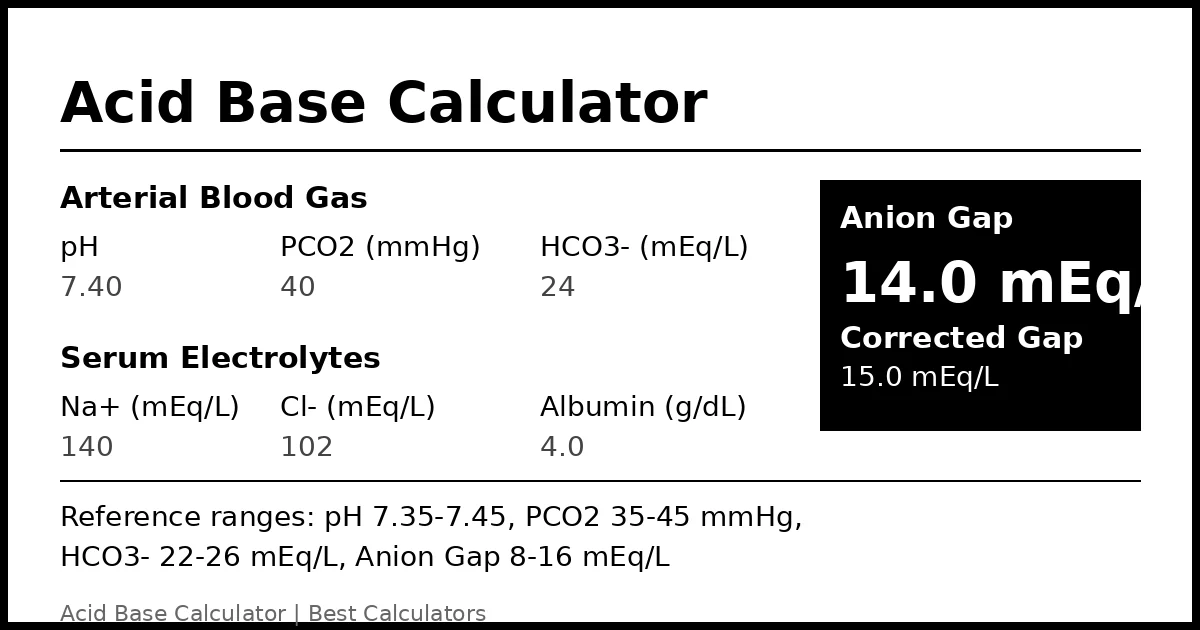
Arterial blood gas: pH 7.40, PCO2 40 mmHg, bicarbonate 24 mEq/L. Serum: sodium 140, chloride 102, albumin 4.0 g/dL.
Anion gap is 140 - (102 + 24) = 14 mEq/L. Corrected anion gap is 14 + 2.5 x (4.4 - 4.0) = 15.0 mEq/L. pH, PCO2, and bicarbonate are all inside their reference ranges.
Anion gap 14.0 mEq/L, corrected anion gap 15.0 mEq/L, status reads 'Normal acid-base balance'.
A typical adult with a normal ABG and a normal anion gap. No further workup is suggested by these numbers alone.
According to New England Journal of Medicine (Oh MS, Carroll HJ), the standard anion gap is calculated as sodium minus the sum of chloride and bicarbonate, and is corrected for low serum albumin by adding 2.5 mEq/L for every 1 g/dL that albumin falls below 4.4 g/dL.
If a metabolic acidosis is driven by distal acidification issues or chronic stone-former urine, the Kidney Stone Calculator helps check the related supersaturation picture in parallel.
Key Concepts Explained
Four concepts hold the rest of the reading together, and they show up on every ABG summary a clinician writes.
Reference ranges
pH 7.35-7.45, PCO2 35-45 mmHg, bicarbonate 22-26 mEq/L, and a standard anion gap of 8-16 mEq/L. The calculator labels anything outside these windows and leaves anything inside unlabeled.
Respiratory vs metabolic
A pH change driven by PCO2 is respiratory, because the lungs control CO2. A pH change driven by bicarbonate is metabolic, because the kidneys control bicarbonate. The two drivers can move in the same or opposite directions.
Compensation
When one driver moves, the other system tries to bring the pH back toward normal. Compensation can be partial or full, and the pH may stay inside the reference range even when the underlying pattern is not normal.
Anion gap
The anion gap is the difference between the most abundant cation (sodium) and the most abundant measured anions (chloride and bicarbonate). A high gap suggests unmeasured anions such as lactate, ketones, or toxic alcohols.
A normal anion gap does not rule out acidosis. A patient can have a normal-gap hyperchloremic metabolic acidosis, an early high-gap picture, or a mixed picture where the gap is normal but the bicarbonate and PCO2 both point to acidosis. Read the gap together with the ABG.
Severe hypertension and chronic hypoperfusion both change the metabolic picture, so review the gap reading with the Blood Pressure Calculator when perfusion is in question.
How to Use This Calculator
Use laboratory values from the most recent ABG and basic metabolic panel. The calculator is designed to read those values, not to estimate them.
- 1 Enter the ABG values: Type the arterial pH, PCO2, and bicarbonate from the most recent blood gas report.
- 2 Enter the electrolyte values: Type the serum sodium, chloride, and bicarbonate from the most recent basic metabolic panel.
- 3 Add albumin if available: Type serum albumin in g/dL to enable the corrected anion gap. Leave it blank to skip the correction.
- 4 Read the status line: Look at the acid-base status, then the compensation cue, then the gap numbers in that order.
- 5 Compare to the reference ranges: Use the reference ranges shown beside each input to see which value is driving the status.
- 6 Bring the summary to the team: Share the status line and gap values with the treating clinician or study partner before acting on the result.
A 70-year-old presents with fatigue and a bicarbonate of 18 mEq/L, a sodium of 138 mEq/L, and a chloride of 100 mEq/L. The standard anion gap is 20 mEq/L, and the ABG shows a pH of 7.32 with a PCO2 of 34 mmHg. The calculator reads 'Metabolic acidosis with respiratory compensation' and flags the elevated gap, prompting a search for unmeasured anions such as lactate or ketones.
When the ABG and gap pattern is driven by a tachyarrhythmia or a perfusion event, cross-check the heart rate with the ECG Heart Rate Calculator as you build the clinical picture.
Benefits of Using This Calculator
The result helps turn a stack of lab numbers into a short summary you can act on. Rerun the acid base calculator whenever a new ABG or metabolic panel is drawn.
- • Two readings in one place: Combines the ABG status and the standard plus corrected anion gap so the lungs and kidneys are evaluated together.
- • Plain-language status: Translates pH, PCO2, and bicarbonate into a status line such as 'Metabolic acidosis with respiratory compensation' instead of leaving the user to interpret raw numbers.
- • Compensation cues: Flags which driver is moving and whether the pH is sitting inside the reference range because of partial or full compensation.
- • Optional albumin correction: Supports the corrected anion gap when albumin is supplied and clearly shows 'not applied' when albumin is left blank.
- • Reference ranges visible: Shows the standard reference ranges next to the inputs so each value can be checked against the same scale.
Use the calculator to prepare for teaching rounds, to review a discharge summary, or to walk a patient through their own numbers. It is also a quick sanity check when an unfamiliar pattern appears on a new lab draw.
The result is not a diagnosis. The status line is meant to organize the ABG, the gap, and the compensation cue so a clinician can decide on the next test, treatment, or repeat draw.
Renal function drives the kidney side of acid-base balance, so cross-check the gap reading with the GFR Calculator when a uremic, low-GFR pattern is part of the differential.
Factors That Affect Your Results
Several lab and patient factors change how the numbers should be read, even when the inputs look reasonable.
Serum albumin
Low albumin makes the standard gap look better than the true unmeasured anion load. Always apply the correction in patients with chronic illness, malnutrition, burns, cirrhosis, nephrotic syndrome, or critical care admissions.
Sample type and timing
A venous blood gas has different reference ranges from an arterial blood gas. The pH and PCO2 from a venous sample should not be entered as if they were arterial values.
Coexisting electrolyte shifts
Severe hyponatremia, hypernatremia, hyperchloremia, or lithium toxicity change the gap itself. Read the gap together with the broader electrolyte picture.
Temperature correction
ABG analyzers report values at 37 degrees Celsius. In hypothermic patients, the true pH and PCO2 are different, which is why some teams report temperature-corrected ABG values for cardiac surgery and targeted temperature management.
- • The calculator is a clinical reference. It does not replace clinical assessment, does not compute base excess, and does not evaluate mixed acid-base disorders with full quantitative rules such as the delta gap or delta-delta method.
- • The result is only as reliable as the input values. Mislabeled units, an arterial sample entered as a venous sample, or a delayed sample can change every output on the page.
- • The status line uses simple thresholds. Patients on chronic oxygen, with chronic respiratory disease, or on renal replacement therapy need a clinician to interpret whether a normal pH is masking a compensated long-standing pattern.
An anion gap above 16 mEq/L with metabolic acidosis should prompt a search for unmeasured anions, including lactate, ketones, uremic acids, and toxic alcohols. The corrected gap matters most in patients where hypoalbuminemia is likely.
When the pH stays inside the reference range but both PCO2 and bicarbonate are off, treat the picture as compensated and ask whether the underlying driver is acute or chronic. Acute compensation is incomplete, while chronic compensation can fully normalize the pH.
According to BMC Cardiovascular Disorders, the albumin-corrected anion gap is a stronger predictor of 30-day all-cause mortality in critically ill patients than the uncorrected gap, which is why hypoalbuminemia should be factored into the calculation.
According to Merck Manual Professional Edition on metabolic acidosis, the standard clinical reference ranges are arterial pH 7.35 to 7.45, PaCO2 35 to 45 mmHg, and bicarbonate 22 to 26 mEq/L, with a standard anion gap commonly cited as 8 to 16 mEq/L when unmeasured anions such as lactate, ketones, or uremic acids are not present.
Body surface area shows up in many of the same ICU and renal dosing decisions that sit next to an ABG reading, so the Body Surface Area Calculator is a useful companion for the next clinical step.
Frequently Asked Questions
Q: What does an acid base calculator do?
A: An acid base calculator reads an arterial blood gas panel and a basic metabolic panel together. It returns a plain-language acid-base status, the standard anion gap, and an albumin-corrected anion gap when albumin is supplied.
Q: What is a normal anion gap value?
A: A standard anion gap of 8 to 16 mEq/L is considered normal for most adults. Values above 16 mEq/L suggest unmeasured anions such as lactate, ketones, or toxic alcohols, and should be reviewed by a clinician.
Q: How do I read arterial blood gas pH, PCO2, and bicarbonate?
A: Compare pH to 7.35-7.45, PCO2 to 35-45 mmHg, and bicarbonate to 22-26 mEq/L. A pH below 7.35 with a high PCO2 points to respiratory acidosis, a low pH with low bicarbonate points to metabolic acidosis, and the reverse patterns point to alkalosis.
Q: What is the formula for the corrected anion gap?
A: The corrected anion gap is the standard anion gap plus 2.5 times the difference between 4.4 g/dL and the patient's serum albumin. The formula adjusts the gap for hypoalbuminemia so unmeasured anions are not hidden by a low albumin level.
Q: What does a high anion gap mean?
A: A high anion gap usually means there are unmeasured anions in the blood, such as lactate in lactic acidosis, ketones in diabetic ketoacidosis, uremic acids in kidney failure, or toxic alcohols in poisoning. The result is a flag, not a diagnosis, and should be reviewed by a clinician.
Q: When should an acid base calculator be used?
A: Use it whenever an arterial blood gas and a basic metabolic panel are available, including emergency triage, pre-rounds preparation, study review, and structured follow-up with a clinician. The result is informational and is not a substitute for clinician assessment.