Ounce to kg Converter - Exact oz to kg
Use this ounce to kg converter to translate oz to kg, grams, milligrams, pounds, and metric tons with the exact 0.028349523125 factor and examples.
Ounce to kg Converter
Results
What Is the Ounce to kg Converter?
The ounce to kg converter changes a mass measured in avoirdupois ounces into kilograms using the exact 0.028349523125 factor. Use it when a food label, package weight, kitchen scale reading, laboratory note, or shipping record gives a value in ounces but your worksheet, label, customs form, or metric log needs kilograms.
- • Food and kitchen records: Convert a recipe weight, packaged ingredient amount, or scale reading in ounces into kilograms for nutrition logs and inventory lists.
- • Shipping and parcel weights: Translate a label or carrier weight in ounces into kilograms for international shipping forms that ask for metric mass.
- • Product specifications: Turn U.S. customary ounce weights on a product sheet into kilograms for catalogs, technical drawings, or supplier records.
- • Homework and lab notes: Check the exact ounce-to-kilogram factor and related mass units so the conversion is easy to show in written work.
The calculator keeps the task deliberately narrow. You enter an ounce value, and the result panel reports kilograms as the main answer. It also shows grams, milligrams, pounds, and metric tons because those related units help with scale checks and other-unit records without changing the source measurement.
Use the kilogram result when the final record must be metric. Use the pound row when you need a quick customary check, and use grams or milligrams for finer scientific or packaging work. The metric ton row helps when the ounce count is large enough to describe freight, batch, or agricultural mass.
When the source value may need to move from ounces into several metric and customary options, the Weight Converter gives a broader ounce-and-pillar mass workflow.
How the Ounce to kg Conversion Works
The calculation uses one fixed relationship: one avoirdupois ounce equals exactly 0.028349523125 kilogram. Every supporting output is derived from that same kilogram value.
- ounces: The entered mass in avoirdupois ounces.
- 0.028349523125: The exact number of kilograms in one avoirdupois ounce.
- kilograms: The metric mass returned by the calculation.
- supporting units: Grams equal kilograms x 1000, milligrams equal kilograms x 1,000,000, pounds equal kilograms / 0.45359237, and metric tons equal kilograms / 1000.
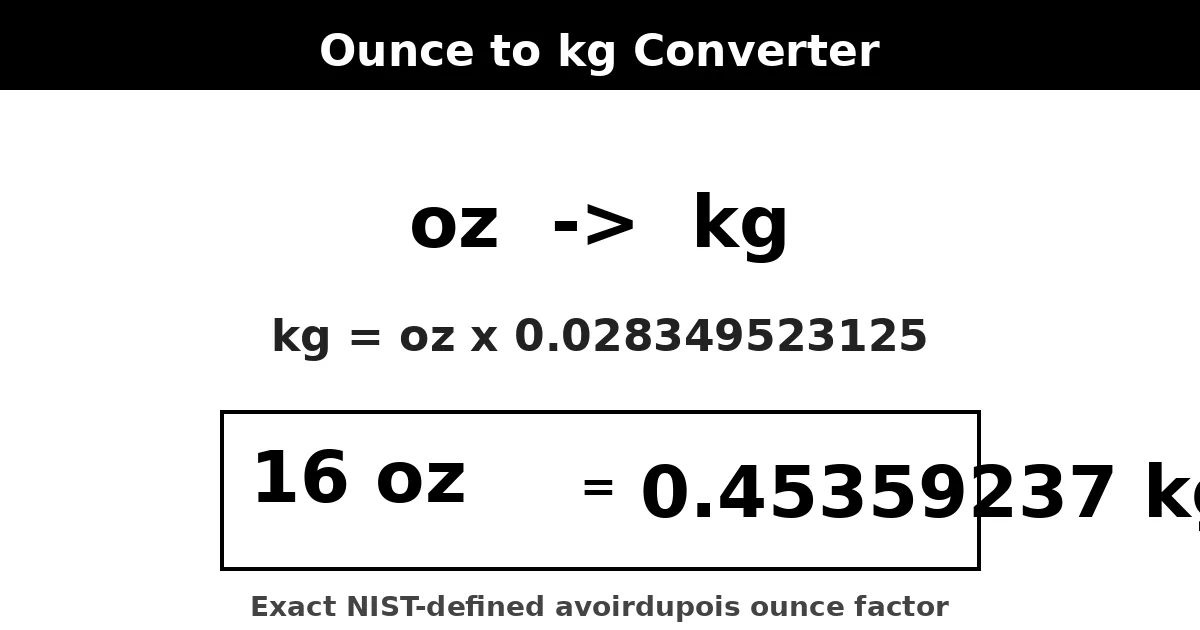
For example, 16 ounces x 0.028349523125 equals 0.45359237 kilogram. The same 16-ounce mass is 453.59237 grams, 453,592.37 milligrams, 1 pound, and 0.00045359237 metric ton. These rows describe the same mass, not separate estimates.
Because the ounce-to-kilogram factor is exact, the main uncertainty usually comes from the original measurement. A kitchen scale, parcel scale, and laboratory balance can all produce different source readings before any conversion begins.
Example: 16 ounces to kilograms
Enter 16 ounces.
16 x 0.028349523125 = 0.45359237 kilograms.
The result is 0.45359237 kg.
Sixteen avoirdupois ounces equal one pound and 0.45359237 kilogram.
According to NIST Handbook 44 Appendix C, one international avoirdupois pound equals 0.45359237 kilogram and contains 16 avoirdupois ounces.
For values already written in pounds, the Lbs to kg Converter provides the same kilogram target using the pound-first source format.
Key Concepts for oz to kg Results
These concepts help you read the result and choose the right unit for the record you are keeping.
Exact factor
The international avoirdupois ounce is tied to the kilogram by the exact factor 0.028349523125. The calculator does not use a rounded shortcut such as 0.028 unless you choose to round the final answer yourself.
Kilogram result
Kilograms are the primary output because they are the SI base unit of mass and the standard metric mass used in most international, scientific, and customs records.
Mass versus volume
An avoirdupois ounce is a unit of mass. It is not the same as a fluid ounce, which is a unit of volume. A fluid ounce to kilogram conversion needs a density assumption and a different calculator.
Rounding discipline
More decimal places do not make the original measurement more precise. If you measured a package to the nearest ounce, quoting six kilogram decimals may imply more certainty than the source scale supports.
For mental math, one ounce is just under 30 grams. Multiplying by 0.028349523125 gives the exact conversion, while multiplying by 0.03 gives only a rough classroom estimate.
If you are comparing two masses, convert both into the same unit before subtracting or averaging. Mixing ounces and kilograms in one equation is a common source of avoidable mistakes.
For records that already list grams and need the matching ounce value, the g to Oz reverses this calculation without changing the avoirdupois factor.
How to Use This Calculator
Use this ounce to kg converter when you need a direct ounce-to-kilogram answer and a few related mass outputs in one place.
- 1 Enter the ounce value: Type the mass as a nonnegative number. Decimals are fine, such as 0.5 oz for a small ingredient or 12.25 oz for a packaged item.
- 2 Calculate the result: Submit the form to convert the ounce value with the exact 0.028349523125 kilogram factor.
- 3 Read kilograms first: Use the kilogram line as the main answer for metric records, customs forms, or nutrition logs.
- 4 Check supporting units: Review grams, milligrams, pounds, and metric tons when the context calls for a finer, larger, or customary reference.
- 5 Round for the audience: Keep more decimals for technical notes and fewer decimals for labels, kitchen logs, or spoken explanations.
If a parcel label says 24 ounces, the ounce to kg converter returns 0.680388555 kilogram. You might record 0.68 kg for a customs form, while keeping the original 24 oz on the shipping label.
When a downstream form is written in pounds rather than kilograms, the kg to Lbs Converter carries the converted mass into the customary direction.
Benefits of Using This Calculator
A focused converter prevents small mass-unit mistakes from spreading through a record, label, or worksheet.
- • Keeps the exact factor visible: The page shows the oz to kg relationship, so the answer is easier to audit than a copied table value.
- • Handles ordinary and decimal ounces: Whole-ounce kitchen weights and decimal laboratory readings use the same calculation path.
- • Supports metric follow-up work: Grams, milligrams, and metric tons make it easier to move from the conversion into a customs form, label, or laboratory record.
- • Provides a customary cross-check: The pound row catches many entry mistakes because 16 ounces should always produce exactly 1 pound.
- • Improves written explanations: The formula and worked example help you show the conversion method instead of giving only a final number.
The calculator is most useful when the conversion is one step in a larger task. A cook may need metric weights for an international recipe, a shipper may need kilograms for a customs form, and a student may need a formula line for a homework answer.
It is also useful for checking estimates made by eye. If the converted value seems too large or too small, confirm that the original number was entered in ounces rather than fluid ounces or pounds.
Because the pound row should always be exactly 0.0625 times the entered ounce value, it gives a quick sanity check before the kilogram answer is copied into a spreadsheet, label, or customs form.
For mixed ounce-and-pound notations, the Pounds Ounces Calculator keeps both units visible without forcing a single kilogram output.
Factors That Affect Your Results
The formula is fixed, but the usefulness of the final number depends on the source measurement and the unit you actually entered.
Source precision
A parcel scale, kitchen scale, and laboratory balance can produce different source readings before any conversion begins. The kilogram result inherits that measurement quality.
Mass versus volume entry
Ounces and fluid ounces are different units. A fluid ounce needs a density assumption and a different calculator to reach kilograms.
Rounding choice
Rounding 0.45359237 kg to 0.45 kg may be acceptable for a kitchen note, but it can be too coarse for a customs declaration or laboratory record.
Unit label clarity
Ounces, pounds, and kilograms are all mass units, but they are not interchangeable. Label copied results clearly before sharing them.
- • The calculator converts mass only. It does not convert fluid ounces, troy ounces, or any volume-based ounce reading.
- • The displayed decimals should not imply that the original measurement was taken with that level of precision.
- • Historical or specialty ounce measures (troy, apothecaries) use different factors and need a separate tool.
For most everyday, kitchen, and shipping uses, the international avoirdupois ounce is the right assumption. The main decision is how many digits to keep after the conversion, and whether the source value really was a mass and not a volume.
When you use the result in a table, keep the original ounce value nearby. That makes later reviews easier, especially when someone needs to check whether the source measurement or the conversion factor caused a discrepancy.
According to BIPM SI Base Unit Kilogram, the kilogram is the SI base unit of mass, fixed in terms of the Planck constant since 2019.
According to NIST Special Publication 811, the avoirdupois ounce is defined as exactly 28.349523125 grams, which equals 0.028349523125 kilogram.
If the recorded value was actually a fluid ounce or milliliter reading, the mL to Lbs Calculator handles the density-based path that this mass-only calculator cannot.
Frequently Asked Questions
Q: How many kilograms are in one ounce?
A: One avoirdupois ounce equals exactly 0.028349523125 kilogram. The calculator uses that exact factor in the background, so the displayed kilogram result is rounded only at the end for readability.
Q: What is the formula to convert ounces to kg?
A: Multiply the number of ounces by 0.028349523125. For example, 32 oz x 0.028349523125 equals 0.90718474 kg. Grams come from kilograms x 1000, and pounds come from kilograms / 0.45359237.
Q: Is 8 oz the same as 0.25 kg?
A: Eight ounces equals 0.226796185 kilogram, so 0.25 kg is a rough estimate but not the exact result. The difference matters for shipping forms and laboratory records but is small for many kitchen tasks.
Q: What is 32 oz in kg?
A: Thirty-two ounces equals 0.90718474 kilogram. The calculation is 32 x 0.028349523125 = 0.90718474. That same 32-ounce mass is 907.18474 grams, 907,184.74 milligrams, and 2 pounds.
Q: Can I use this converter for shipping and package weight?
A: Yes, for mass-only records. Enter the parcel weight in ounces and read the kilogram value for customs forms, carrier labels, or warehouse logs. Verify with the carrier or weighing device that the source value was a mass, not a volume or dimensional weight.
Q: Does this convert fluid ounces (fl oz) too?
A: No. A fluid ounce is a unit of volume, not mass, and converting fluid ounces to kilograms requires a material density. Use a density-based calculator for fluid ounce conversions to avoid a wrong answer.