PSI to ATM Conversion Calculator - psi to atm in One Step
Use this psi to atm conversion tool to translate psi readings into standard atmospheres (atm) with a kPa, Pa, and bar cross-check in one entry.
PSI to ATM Conversion Calculator
Results
What Is PSI to ATM Conversion?
A PSI to ATM conversion turns a pressure reading in pounds per square inch (psi) into standard atmospheres (atm), and back, in a single step. It uses the fixed relationship that 1 atm equals exactly 101,325 pascals and 1 psi equals exactly 6,894.757293168 pascals, so 1 psi equals 0.06804595777 atm and 1 atm equals 14.69594878 psi. This covers tire gauges, SCUBA tank ratings, vacuum gauge readouts, and engineering datasheets without retyping a constant.
- • Tire pressure and road gauges: Move between psi on North American tire placards and the atm value used in vacuum and altitude references for 32 psi car tires, 35–45 psi truck tires, and 80–130 psi bicycle and motorcycle tires.
- • SCUBA and compressed-gas cylinders: Translate a 3,000 psi or 4,500 psi fill pressure into the atm value printed on a regulator or compressor spec sheet.
- • Vacuum gauges and altitude references: Convert an under-1 atm vacuum reading (for example 0.5 atm at 18,000 ft) or an over-1 atm gauge reading into the matching psi or absolute atm value the rest of the workflow expects.
- • Gas-law and engineering textbook problems: Replace textbook atm values with the equivalent psi figure for ideal-gas, van der Waals, and Henry's-law calculations when the rest of the workflow expects psi.
The standard atmosphere is a pressure unit fixed by the BIPM SI Brochure at exactly 101,325 pascals, and the psi is fixed by NIST at 6,894.757293168 pascals, so the psi to atm ratio is exact at 0.06804595777.
When the source value is in bar rather than psi, the Bar to ATM Conversion Calculator applies the same 0.9869232667 atm/bar factor in the same result panel.
How the Conversion Works
The conversion is a single exact ratio. The standard atmosphere is fixed at 101,325 pascals and the pound per square inch at 6,894.757293168 pascals, so multiplying a psi value by 0.06804595777 gives the atm value, and dividing an atm value by 0.06804595777 (or multiplying by 14.69594878) gives the psi value.
- p(psi): Pressure in pounds per square inch (psi) that you want to convert to standard atmospheres
- p(atm): Pressure in standard atmospheres (atm) that you want to convert to psi
- direction: Toggle that picks psi → atm or atm → psi so the same tool handles both directions
When the direction toggle is set to psi → atm, the calculator multiplies the input by 0.06804595777 and reports the answer in atm. The same psi value then drives the pascal, kilopascal, and bar cross-check rows, so every output reads from a single underlying number.
Worked example: 1 atm in psi
Start with the standard atmosphere reference value of 1 atm
Multiply by the 14.69594878 psi/atm factor: 1 × 14.69594878 = 14.69594878 psi
1 atm = 14.69594878 psi = 101,325 Pa = 101.325 kPa = 1.01325 bar
Use this result whenever a gauge, datasheet, or textbook quotes a pressure in atm and the rest of the workflow expects psi or pounds per square inch.
According to NIST SP 811 (Guide for the Use of SI), 1 atm equals exactly 101,325 pascals and 1 psi equals exactly 6,894.757293168 pascals, which makes the psi to atm ratio 6,894.757293168 ÷ 101,325 = 0.06804595777 atm/psi
For the pascal-side panel that also covers atm, kPa, mbar, and bar, the ATM to Pascals Conversion reads the same number against the full SI prefix ladder.
Key Concepts Explained
Four ideas shape this conversion: a BIPM-fixed pascal value for the standard atmosphere, a NIST-fixed pascal value for the psi, the small magnitude of the psi to atm ratio (0.068×), and the way Pa, kPa, and bar sit on the same physical scale.
The standard atmosphere as an exact 101,325 Pa unit
The BIPM SI Brochure (9th edition) defines 1 atm as exactly 101,325 pascals, the historical average atmospheric pressure at mean sea level. That fixed pascal value is the anchor for every other pressure unit and the source of the 14.696 psi/atm relationship.
The psi as an exact 6,894.757293168 Pa unit
NIST SP 811 defines 1 psi as exactly 6,894.757293168 pascals, derived from the pound-force and the square inch, so the psi to atm ratio carries eleven significant figures and stays exact for any calculation.
The 0.068× magnitude of the psi to atm ratio
1 psi is roughly 1/14.7 of an atmosphere, so 14.7 psi equals about 1 atm. A 32 psi car tire reads about 2.18 atm, and a 4,500 psi SCUBA tank reads about 306 atm. Mixing psi and atm is the most common manual conversion error in vacuum and pressure work.
Pa, kPa, and bar on the same physical scale
1 Pa is the SI base unit, 1 kPa is exactly 1,000 Pa, and 1 bar is exactly 100,000 Pa. Vacuum science uses Pa, weather maps use kPa, and European hydraulics use bar, so the same psi value reads cleanly across all three cross-check rows.
When the workflow needs to read atm against Pa, kPa, bar, psi, and torr in a single entry, the ATM Conversion Calculator sits next to the psi to atm conversion as the broader atm overview.
How to Use This Calculator
The psi to atm conversion calculator has a value field and a direction toggle. Pick the direction, type the number, and read the converted pressure plus the pascal, kilopascal, and bar cross-check rows in the same result panel.
- 1 Pick the conversion direction: Use the dropdown to switch between Pound per square inch (psi) to Standard atmosphere (atm) and Standard atmosphere (atm) to Pound per square inch (psi). The default is psi → atm for the most common tire, SCUBA, and vacuum workflow.
- 2 Type the pressure value: Enter the value in the unit set by the direction toggle. Try 14.696 for a quick 1 atm sanity check, 32 for a typical car tire, 0.5 for an altitude-equivalent vacuum, or 4,500 for a high-pressure SCUBA tank.
- 3 Read the converted pressure: The black box at the top of the result panel shows the answer in the target unit. For 14.696 psi, the answer is about 1.0000 atm; for 1 atm, the answer is 14.69594878 psi. The unit label switches with the direction toggle.
- 4 Cross-check the Pa, kPa, and bar rows: The result panel also shows the same pressure in pascals, kilopascals, and bar. Compare against a published chart or a separate calculator to confirm the factor is being applied correctly.
- 5 Switch direction for the reverse: Toggle the direction dropdown to flip between psi → atm and atm → psi. The same value and cross-check rows are kept, so a round trip takes two clicks and never loses precision.
A US tire placard lists 32 psi. Toggle the direction to psi → atm and type 32. The calculator returns 2.1774708 atm alongside 220,632.2334 Pa, 220.6322 kPa, and 2.206322 bar. Toggle to atm → psi and the same value rounds back to 32 psi.
For a quick check on the same psi unit when the source is a metric bar value, the Bar to PSI Conversion reads the bar input against the matching psi row.
Benefits of the Conversion
The advantage of a single, factor-driven psi to atm conversion is that the result is exact and the cross-check rows make it self-validating, removing the rounding error and misplaced-decimal mistakes that creep in when each conversion is done by hand.
- • Exact NIST/BIPM factor: The 1 psi = 0.06804595777 atm ratio is fixed by the NIST pascal definition and the BIPM standard atmosphere definition, so the calculator returns the same value at any precision with no empirical calibration needed.
- • Bidirectional in one tool: Switch the direction toggle to flip between psi → atm and atm → psi. The same input and cross-check rows stay in place, so a round-trip never loses precision.
- • Three cross-check rows: Every result includes the equivalent pressure in pascals, kilopascals, and bar, catching transcription errors early when a psi value was rounded to 1 or 2 significant figures.
- • Worked tire and SCUBA examples: The 1 atm reference, the 32 psi car tire, and the 4,500 psi SCUBA tank are built into the explanation, covering tire placards, regulator specs, and high-pressure cylinder work.
For a broader psi-side panel that also covers kPa, bar, atm, and MPa, the PSI Conversion Calculator applies the same NIST pascal definitions to the full psi family.
Factors That Affect Results
The psi to atm conversion is exact, but the usefulness of any specific number depends on what the input represents, on the precision of the original record, and on whether the rest of the workflow is using the same pressure reference.
Source precision
Converted values should not imply more precision than the original measurement. A 32 psi tire placard cannot give a 2.1774708 atm answer more accurately than the placard itself supports, so round to the placard precision before quoting the atm value.
Direction of conversion
The factor is × 0.06804595777 when going from psi to atm and × 14.69594878 when going the other way. Mixing up the direction is the most common source of a 14.7× error in manual conversion, so check the direction toggle before reading the result.
Gauge versus absolute pressure
Standard atmosphere is an absolute pressure reference, so it pairs naturally with psia and bara. When the source uses psig or barg, the atm value is also a gauge reading relative to 1 atm, not an absolute reading. Add or subtract 1 atm explicitly when the workflow needs to switch between gauge and absolute frames: 32 psig becomes about 3.177 atm absolute, while 32 psia is about 2.177 atm. Mixing gauge and absolute references is the second most common manual conversion error.
- • The standard atmosphere is a fixed unit but it is not the SI pressure unit. The SI unit is the pascal, and the bar is the most common non-SI replacement. Engineering datasheets that quote bar, kPa, or MPa will not match the atm result without an extra conversion step.
- • The conversion factor is exact, but the real pressure being measured is not. A tire pressure of 32 psi is a single cold-inflation snapshot, and the actual pressure rises by roughly 3 psi when the tire is at operating temperature.
Atmospheric pressure is a useful benchmark. At 1.01325 bar, the atmosphere reads 14.69594878 psi, anchoring US weather reports, altimeter settings, and SCUBA tank ratings.
According to BIPM SI Brochure (9th edition), the standard atmosphere is defined as exactly 101,325 pascals, the value the psi to atm conversion chain uses
For weather and altimeter work where the natural unit is the millibar or hectopascal rather than the atm, the Barometric Pressure Conversion Calculator applies the same 1 atm sea-level standard against mmHg and inHg.
Frequently Asked Questions
Q: How do you convert psi to atm?
A: Multiply the psi value by 0.06804595777 to get atm. So 14.696 psi × 0.06804595777 ≈ 1.0000 atm, and 32 psi × 0.06804595777 ≈ 2.1775 atm. The factor is exact, so the result is exact at any precision you choose to display.
Q: How many atm are in 1 psi?
A: There are exactly 0.06804595777 atm in 1 psi, because 1 atm equals 101,325 pascals and 1 psi equals 6,894.757293168 pascals. The same 1 psi reading also equals 6,894.757293168 Pa, 6.894757293168 kPa, or 0.06894757293 bar.
Q: What is the formula to convert psi to atm?
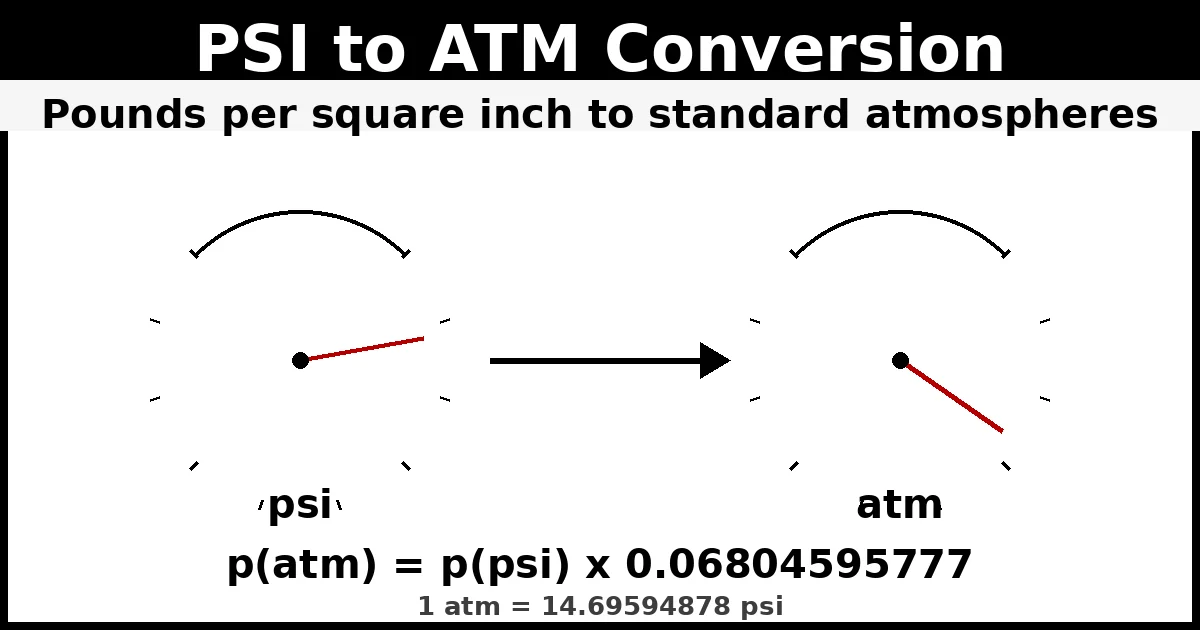
A: The formula is p(atm) = p(psi) × 0.06804595777. The reverse conversion is p(psi) = p(atm) × 14.69594878. The factor 0.06804595777 atm/psi is fixed by the NIST and BIPM pascal definitions, so the formula is exact.
Q: Why is 1 atm equal to 14.69594878 psi?
A: Because 1 atm is defined by the BIPM SI Brochure as exactly 101,325 pascals and 1 psi is defined by NIST as exactly 6,894.757293168 pascals, dividing 101,325 by 6,894.757293168 gives the 14.69594878 factor that the calculator uses for every conversion.
Q: Is psi to atm conversion exact?
A: Yes. Both 1 atm = 101,325 Pa and 1 psi = 6,894.757293168 Pa are exact definitions, so the psi to atm ratio is a fixed exact fraction. The only rounding is in the decimal places you choose to display the result, not in the factor itself.
Q: How do you convert atm back to psi?
A: Multiply the atm value by 14.69594878. So 1 atm gives 14.69594878 psi, 2 atm gives 29.39189756 psi, and 0.5 atm gives 7.34797439 psi. The same factor works for tire placards, SCUBA tank ratings, and vacuum gauge readouts because the atm is defined as exactly 101,325 pascals.