Square Meter Converter - Common Area Units
Convert a known area through square meters, square feet, square yards, hectares, acres, and square kilometers with adjustable rounding.
Square Meter Converter
Results
What This Calculator Does
A square meter converter changes a known area into another area unit while keeping the underlying surface size unchanged. The square meter is the base reference in this calculator, so every entered value is first normalized to m² and then expressed as the selected target unit. That approach supports room plans, site summaries, product sheets, land records, classroom examples, and reports that mix metric and customary area units.
The main result follows the selected target unit. Supporting rows show square meters, square feet, square yards, hectares, acres, and the side length of a square with the same area. Those related outputs help a reviewer see whether a result belongs at room scale, building scale, parcel scale, or map scale before copying it into another document.
The converter is most useful when the source area is already known. It does not measure a wall, floor, field, or boundary from dimensions. A floor plan, survey, GIS export, takeoff sheet, or product specification must still supply the starting area. After that source area exists, the calculator keeps unit changes consistent and prevents common mistakes such as treating square feet like linear feet.
The tool also separates conversion from interpretation. A room reported as 18.5 m² can be converted to square feet for a lease exhibit, but the converted value does not decide whether closets, shafts, common areas, or exterior walls were included in the original measurement. A parcel reported as 2,400 m² can be converted to hectares or acres, but title boundaries, setbacks, and easements still come from the governing documents.
That distinction matters because area numbers often move through several hands. Architects, real estate teams, facilities managers, students, estimators, and land analysts may all use the same area in different unit systems. A consistent conversion step keeps the numeric handoff clean before professional judgment or local reporting rules are applied.
For broader area-unit checks that start outside square meters, Area Converter covers the same general problem across many common units.
How the Calculator Works
The calculation has two stages. First, the entered value is multiplied by the source unit factor to produce square meters. Second, that square-meter value is divided by the target unit factor. A factor is the number of square meters in one source or target unit. For example, one square foot equals 0.09290304 square meters, so square meters convert to square feet by division.
The NIST Guide to the SI, Appendix B.8 publishes conversion factors for square foot, square inch, square mile, and square yard relative to square meters. The calculator uses those relationships as the basis for customary-area outputs and keeps the square-meter value as the calculation hub.
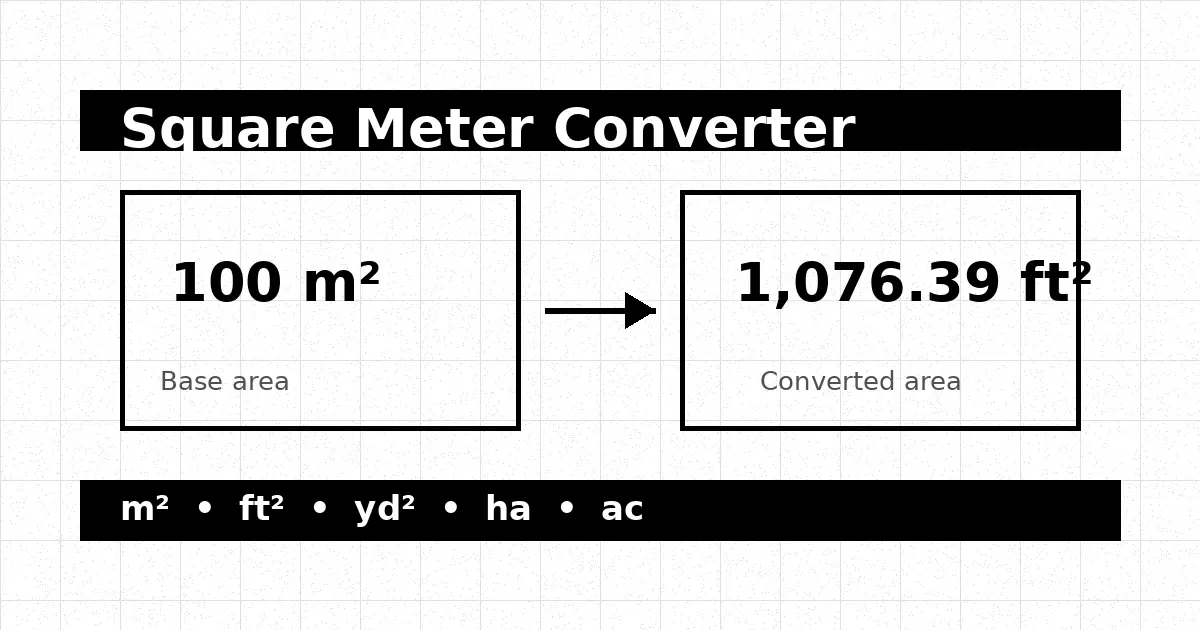
A 100 m² input converted to square feet gives 100 / 0.09290304, or about 1,076.39104167 ft². The same 100 m² input converted to square yards gives 100 / 0.83612736, or about 119.599 yd². Rounding is applied after the conversion so the displayed rows remain consistent with the same unrounded base value.
When the source unit is not square meters, the same structure works in reverse. A 500 ft² input is multiplied by 0.09290304 to produce 46.45152 m². If the target unit is hectares, that base value is divided by 10,000, producing 0.004645152 ha. The intermediate square-meter value is what keeps each output row connected to the same original area.
The square-side row is calculated with the square root of the square-meter value. It gives a scale reference in meters, not a shape description. A 100 m² area has the same area as a 10 m by 10 m square, but the actual surface could be a long corridor, an irregular lot, or a collection of several rooms.
When a result also needs a land-area check, Hectares to Acres Converter handles the metric-to-customary land comparison in the opposite direction.
Key Concepts Explained
Area units are squared units, not length units. A square meter is the area of a square one meter on each side. A square foot is the area of a square one foot on each side. Because both dimensions are involved, length factors must be squared before they become area factors. That is why one foot equals 0.3048 meter, but one square foot equals 0.09290304 square meter.
The NIST SI Units area reference explains area as a two-dimensional surface measured in square units and identifies the square meter as the SI area unit. It also places the hectare in the same metric sequence as 10,000 square meters, which is why hectares appear naturally beside larger square-meter values.
Unit symbols need the same care as the numbers. The symbols m², ft², yd², ha, and ac should stay attached to their values in tables and notes. Without a symbol, a converted result can be misread as another unit, especially when square feet and square yards appear in the same project. The calculator displays each symbol beside the numeric output for that reason.
Square meter
The metric area reference used as the calculator's internal base.
Square foot
A customary area unit common in floor plans, building summaries, and material coverage.
Hectare
A metric land-area unit equal to 10,000 square meters.
Acre
A customary land-area unit often used in property and agricultural records.
For circular surfaces where the area must be calculated before conversion, Square Footage Circle Calculator derives the area from radius, diameter, or circumference before showing metric context.
Real-World Examples
A 72 m² apartment converted to square feet equals about 775.00 ft². That result helps compare a metric floor area with a listing, insurance form, or furniture plan that uses square feet. The value should still be treated as total floor area, not as a promise that every room has the same usable shape or ceiling height.
A 1,500 m² site converted to hectares equals 0.15 ha, while the same site converted to acres equals about 0.3707 ac. Those two rows help a land table move between metric planning language and customary property language. If the source number came from a GIS polygon, the coordinate system and survey basis still matter before the area is treated as legal acreage.
A 35 yd² material quote converted to square meters equals about 29.26 m². That conversion can support flooring, fabric, landscaping, or surface treatment estimates when supplier coverage and project drawings use different units. The quantity order should still include waste factors, cuts, overlap, and product-specific installation rules from the supplier.
A classroom example can show why area factors differ from length factors. A rectangle measuring 5 m by 4 m has an area of 20 m². Converting each side to feet and multiplying gives approximately the same area in square feet as converting the final 20 m² result directly. The direct method is usually cleaner once the area is already known.
A facilities spreadsheet may list one floor as 3,200 m² and another as 28,000 ft². Converting both to square meters before comparison prevents the larger-looking number from being mistaken for the larger area. After normalization, the 28,000 ft² floor is about 2,601.29 m², so the 3,200 m² floor is larger.
How to Use This Calculator
Enter the known area value from the source document, plan, specification, or measurement worksheet.
Select the unit attached to that starting value. The selected source unit controls the conversion factor used to create square meters.
Select the desired target unit for the highlighted result. Supporting rows remain visible for context.
Choose display precision. More decimals can help with small areas; fewer decimals can make large land summaries easier to read.
Read the primary result first, then compare the square-meter, square-foot, hectare, acre, and square-side rows before recording the value.
A conversion should keep its unit label wherever it is copied. A number such as 250 means very different things as m², ft², yd², or acres. Clear labels also make later review easier when a project crosses between drawings, permits, product data, and land records.
The selected decimal places should match the decision being made. Two decimals are often enough for room-scale square meters and square feet. Four or six decimals may be useful when a small area is converted to hectares or acres, because those units are much larger than a square meter and can otherwise round to 0.00.
If a source table already contains rounded values, the converted result should be treated as an approximate continuation of that source. The calculator cannot recover precision that was removed before entry. Keeping the original source value beside the converted value helps later reviewers understand the level of precision available.
For parcel summaries that begin with acreage rather than square meters, Acres to Square Feet Converter Calculator gives a direct customary land-area breakdown.
Benefits and When to Use It
The calculator reduces unit drift in mixed-unit work. A designer may receive a room area in square meters, a product coverage rate in square feet, and a site reference in hectares. Normalizing through square meters keeps those values connected instead of relying on separate rough estimates.
It is also useful for checking whether a value has been copied with the wrong unit. A site described as 10,000 m² should read as 1 ha, not 10,000 ha. A floor described as 100 m² should read near 1,076 ft², not 100 ft². Large mismatches like those usually signal a label, column, or import problem rather than a small rounding issue.
- - Building review: floor areas can move between metric and customary reporting formats.
- - Material planning: coverage data can be compared when products list ft², yd², or m².
- - Land summaries: square meters can be translated into hectares and acres for parcel-scale context.
- - Data cleanup: suspicious unit mismatches can be checked before a table is reused.
- - Education: squared-unit relationships can be shown with one consistent base value.
The NIST Unit Conversion guidance points readers to SP 811 Appendix B when exact conversion factors are needed. That source supports using official factors rather than rounded memory aids when a value will be reused in project records.
The tool is less appropriate when the area itself is uncertain. If a room was paced off casually, if a parcel outline is approximate, or if a product coverage rate depends heavily on waste and substrate condition, a precise unit conversion can still sit on top of an imprecise source. The converted number should not imply more certainty than the source measurement deserves.
For reports that need acreage and hectare values side by side, Acres to Hectares Converter Calculator focuses on that specific land-area handoff.
Factors That Affect Results
The biggest factor is the source unit. A value of 100 entered as square meters is about 1,076.39 ft², but 100 entered as square feet is only 9.290304 m². The number alone is incomplete until the unit is known. That is why the source-unit selector should match the label on the source record exactly.
Rounding is another factor. A report that rounds 9.290304 m² to 9.29 m² loses a small amount of detail. That loss may be harmless for a single room summary, but repeated rounding can matter across many parcels, rooms, or material rows. The calculator therefore performs conversions before rounding visible outputs.
The source measurement method can affect interpretation even when the unit conversion is correct. A floor plan may include interior floor area, gross floor area, rentable area, or coverage area. A land record may describe surveyed area, mapped area, or taxable area. The converter does not decide which definition is appropriate; it only changes units for the supplied area.
The choice between international and survey-based customary units can also matter in specialized land work. This calculator uses the common international-foot relationships used by modern square-foot, square-yard, and square-mile factors. Historic survey-foot records may require separate treatment when a legal or engineering record specifically depends on that basis.
Finally, the direction of conversion affects how results are checked. Converting from square meters to square feet makes the number larger because a square foot is smaller than a square meter. Converting from square meters to hectares makes the number smaller because a hectare is much larger than a square meter. Directional sense checks catch many data-entry errors before a value is reused.
For volume work where square-area values become part of a depth or height calculation, Cubic Meter Calculator handles the next dimensional step.
Frequently Asked Questions
How are square meters converted to square feet?
Square meters convert to square feet by dividing by 0.09290304, or by multiplying by about 10.7639104167. The calculator keeps the full factor internally, then rounds only the displayed result.
How many square meters are in one hectare?
One hectare contains 10,000 square meters. The hectare row is useful for land records because it turns a large square-meter result into a shorter metric land-area value.
How many square meters are in one acre?
One international acre contains 4,046.8564224 square meters. The acre output is therefore the square-meter total divided by 4,046.8564224.
Does rounding change the underlying area?
Rounding changes only the displayed number. The calculator converts through the full square-meter base value first, so related outputs stay tied to the same source area before display precision is applied.
Can this converter measure a room or property boundary?
No. The converter changes a known area from one unit to another. It does not measure boundaries, confirm a floor plan, replace a site survey, or decide which portions of land are usable.
Why does the calculator show a square-side value?
The square-side value gives the side length of a perfect square with the same area. It is only a scale reference and does not imply that the actual room, parcel, or surface is square.