Area Oblique Triangle Calculator - SAS Area From Two Sides
Use this area oblique triangle calculator to get area, height, and perimeter from two sides and the included angle, with an optional Heron's formula cross-check.
Area Oblique Triangle Calculator
Results
What Is Area Oblique Triangle Calculator?
The area oblique triangle calculator finds the area of any triangle without a right angle using two sides and the angle between them. Use it when you already know two adjacent side lengths and the angle that connects them, and need a quick area, height, perimeter, or a Heron's formula cross-check from a third side.
- • Classroom geometry: Verify SAS homework by reading area, height, and third side from the same two-side and angle input set.
- • Land and roof plots: Estimate the footprint of an irregular plot or roof face from two measured sides and the angle between them.
An oblique triangle is any triangle that does not contain a 90-degree angle. The simple right-triangle shortcut (0.5 * base * height) does not apply because the two sides usually do not meet at a right angle.
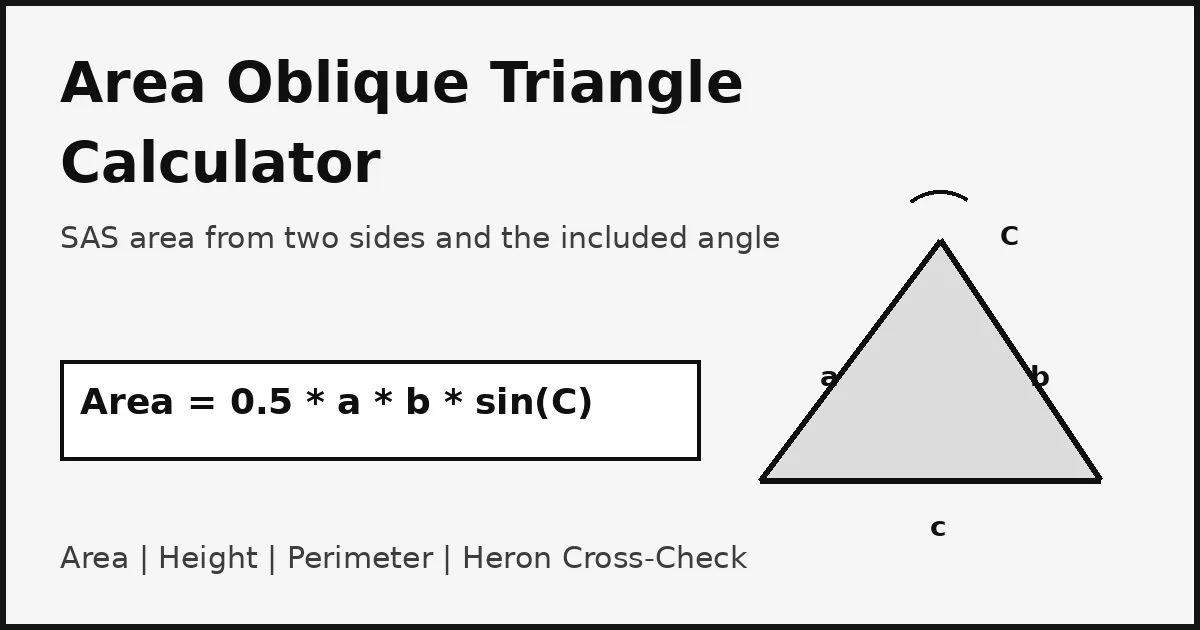
The most direct area formula for that situation is the SAS area formula: 0.5 * a * b * sin(C). It uses two adjacent sides and the angle between them, then drops a perpendicular through the sine of that angle to recover the height.
The result is an area, so the output is in square units of the input length unit. Use the same length unit for both side inputs.
When you have a mix of side, angle, or three-side inputs and want one tool that picks the right method automatically, the Triangle Calculator handles SSS, SAS, and base-height cases in a single page.
How Area Oblique Triangle Calculator Works
The calculator multiplies the two known sides together, takes the sine of the included angle, and divides by two. The same result can be cross-checked with Heron's formula when the third side is known.
- a: length of one side of the oblique triangle
- b: length of the other side that meets side a at the included angle
- C: included angle between side a and side b, in degrees
- sin(C): sine of the included angle, expressed as the ratio of the perpendicular height to side b
- third side c: computed from the law of cosines when side c is not provided, or used as input for the Heron's formula cross-check
The SAS area formula is the easiest way to handle an oblique triangle because the only trigonometric function in play is the sine of one angle. The calculator converts degrees to radians internally, computes the sine, and returns the area, the perpendicular height against side a, and the third side from the law of cosines.
If you also enter side c and the three values satisfy the triangle inequality, the calculator adds a Heron's formula row that usually agrees to within a few hundredths of a square unit.
Example with sides 7 and 9 at 60 degrees
Enter a = 7, b = 9, included angle C = 60 degrees, and leave side c at 0.
Area = 0.5 * 7 * 9 * sin(60 degrees) = 0.5 * 7 * 9 * 0.8660 = 27.28 square units. Height against side a = 9 * sin(60 degrees) = 7.79 units. Third side c = sqrt(7 squared + 9 squared - 2 * 7 * 9 * cos(60 degrees)) = sqrt(67) = 8.19 units.
Area = 27.28 square units, height = 7.79 units, third side = 8.19 units, perimeter = 24.19 units.
The 60-degree included angle keeps the area close to one half of the side product, while the law of cosines shows the triangle is almost equilateral.
According to Wolfram MathWorld, the area of a triangle is one half of the base multiplied by the perpendicular height, which generalizes to 0.5 * a * b * sin(C).
For triangles that do contain a 90-degree angle, the same two-side and one-angle problem collapses to the Pythagorean theorem and the dedicated Right Triangle Calculator can be used to cross-check the right-angle case.
Key Concepts Explained
These four ideas decide whether the SAS area formula gives the answer you actually need.
Oblique vs. Right Triangle
An oblique triangle has no 90-degree angle. The two adjacent sides that meet at the included angle are not perpendicular, so the right-triangle shortcut 0.5 * a * b does not apply unless C is exactly 90.
Included Angle
The included angle is the angle between the two sides you entered. The sine of that angle converts side b into a perpendicular height against side a, which is why only one trigonometric function is needed.
Heron's Formula Fallback
Heron's formula gives the area from the three side lengths using area = sqrt(s * (s - a) * (s - b) * (s - c)) with s as the semi-perimeter. The calculator shows it as a cross-check when the optional side c is filled in.
Law of Cosines Connection
The third side c comes from the law of cosines: c = sqrt(a squared + b squared - 2ab * cos(C)). The same cosine term appears in the law of cosines, which is why the SAS area formula and Heron's formula are consistent for the same triangle.
The key insight is that the perpendicular height h needed for 0.5 * a * h can be recovered from side b and the included angle: h = b * sin(C). Once you see that step, the SAS area formula becomes a direct application of the standard triangle area definition, not a special case.
If the angle you measured is not the angle between the two known sides, the formula still works as long as you relabel the sides so the angle really is the one between them. Use the law of cosines first to find that included angle.
If the figure is more than three sides and the oblique triangle is only one panel inside a larger shape, the Polygon Area Calculator handles regular and irregular polygon outlines with the same square-unit outputs.
How to Use This Calculator
Use the area oblique triangle calculator with matching length units and the included angle measured in degrees, then read the area result in square units.
- 1 Enter side a: Use the length of one side of the oblique triangle.
- 2 Enter side b: Use the length of the other side that meets side a at the included angle. Do not use the third side or the perimeter.
- 3 Enter the included angle C: Use the angle in degrees between side a and side b. For a quick right-triangle check, set it to 90.
- 4 Optionally enter side c: Add the third side if you have it. The calculator shows a Heron's formula cross-check when the three sides satisfy the triangle inequality.
- 5 Read the area: Use the SAS area as the primary result. The unit is square units of your length input.
Suppose a roof face has two measured edges of 7 feet and 9 feet meeting at 60 degrees. Enter a = 7, b = 9, included angle = 60, and leave side c at 0. The calculator returns 27.28 square feet of area, a height of 7.79 feet against side a, a third side of 8.19 feet, and a perimeter of 24.19 feet.
When the same worksheet also needs a flat area for a rectangle, circle, or sector, the Area Calculator covers the common 2D shapes alongside this oblique triangle page.
Benefits of Using This Calculator
The SAS area formula plus an optional Heron's check gives you a single tool for the most common oblique triangle scenarios.
- • Two inputs do the work: Two side lengths and the included angle are enough for the primary area result. There is no need to derive the third side first.
- • Height and third side included: The perpendicular height against side a and the law-of-cosines third side come back with the area, so you do not need a second calculator.
- • Heron's formula cross-check: When the third side is known, the calculator shows a Heron's formula area row. The two values normally agree to within a few hundredths of a square unit.
- • Decimal and large values: Decimal sides, decimal angles, and large site-scale values all work, so the same calculator handles textbook and field inputs.
- • Right-triangle special case: Setting the included angle to 90 degrees recovers the right-triangle area formula 0.5 * a * b, which makes this calculator a useful cross-check for the dedicated right-triangle page.
Because the calculator returns the area, height, third side, and perimeter together, you can decide which value belongs in the next step. A takeoff sheet may only need area. A diagram may only need height. A class worksheet may need every intermediate value to show the work.
After reading the area in square inches, square feet, or square meters, the Area Converter can convert the finished result into another square unit without redoing the calculation.
Factors That Affect Your Results
The SAS area formula is compact, but a few measurement choices decide whether the calculator returns the right value.
Which angle is the included angle
The included angle must be the angle between the two sides you entered. The angle at any other vertex gives a wrong height and a wrong area.
Units on the two sides
Both sides must be in the same length unit. The area is in square units of that length, so mixed units silently produce a wrong area.
Optional side c and the triangle inequality
The Heron's formula cross-check only appears when side c is positive and the three sides satisfy the triangle inequality. If they do not, the row stays at 0 and only the SAS area is shown.
Right angle as a special case
Setting the included angle to 90 degrees collapses the formula to 0.5 * a * b. The result should match a right-triangle calculation and can be used to sanity-check inputs.
- • The calculator does not solve for the included angle when only the three sides are known. Use the law of cosines first to recover the angle.
- • Rounded output can differ by a few hundredths of a square unit from a hand calculation that rounds after each intermediate step.
- • The result is the geometric area only. Real material takeoffs may need extra allowance for seams, overlap, offcut, or surface texture.
Heron's formula works for any triangle as long as the three sides form a valid triangle. That is why the calculator can use it as an independent cross-check against the SAS area, even though the two formulas look very different.
According to Wolfram MathWorld, Heron's formula gives the area of any triangle from its three side lengths and works for oblique triangles as well as right triangles.
According to Wolfram MathWorld, the law of cosines gives the third side of any triangle from two sides and the included angle, which is why the same cosine term appears in the oblique triangle area workflow.
Frequently Asked Questions
Q: What is the formula for the area of an oblique triangle?
A: The headline formula is Area = 0.5 * a * b * sin(C), where a and b are two adjacent sides and C is the included angle between them. The same triangle also satisfies Heron's formula when the third side is known.
Q: How do you find the area of an oblique triangle with two sides and an included angle?
A: Multiply the two sides, multiply by the sine of the included angle, and divide by two. The result is the area in square units of the length unit you used on the sides.
Q: What is the difference between an oblique triangle and a right triangle?
A: An oblique triangle has no 90-degree angle, so the two sides you choose usually do not meet at a right angle. A right triangle has a 90-degree angle, and the two legs are already perpendicular, so area is just 0.5 * a * b.
Q: Can Heron's formula be used to find the area of an oblique triangle?
A: Yes. Heron's formula works for any triangle, including oblique ones, as long as the three side lengths form a valid triangle. The calculator shows it as a cross-check when you also enter side c.
Q: What units are returned by the area of an oblique triangle calculator?
A: Use one length unit for both side inputs. The area comes back in square units of that length, so inches in gives square inches out, and meters in gives square meters out. Do not mix length units in the same calculation.
Q: Why does the sine of the included angle appear in the oblique triangle area formula?
A: Sine turns side b into a perpendicular height against side a through the right triangle that drops from the included angle. That step replaces the height in the standard 0.5 * base * height formula, which is why the SAS area formula is 0.5 * a * b * sin(C).