Cube Volume Calculator - a^3, Diagonal & Surface Area
Use this cube volume calculator to find a cube's volume, surface area, and diagonals from its side length, face diagonal, or space diagonal.
Cube Volume Calculator
Results
What Is a Cube Volume Calculator?
A cube volume calculator solves for the three-dimensional space enclosed inside a cube from a single known measurement, then reports the matching side length, face diagonal, space diagonal, and total surface area in one pass. Enter the edge length, face diagonal, space diagonal, total surface area, or volume and the calculator returns V = a^3 instantly, with metric and imperial units handled automatically.
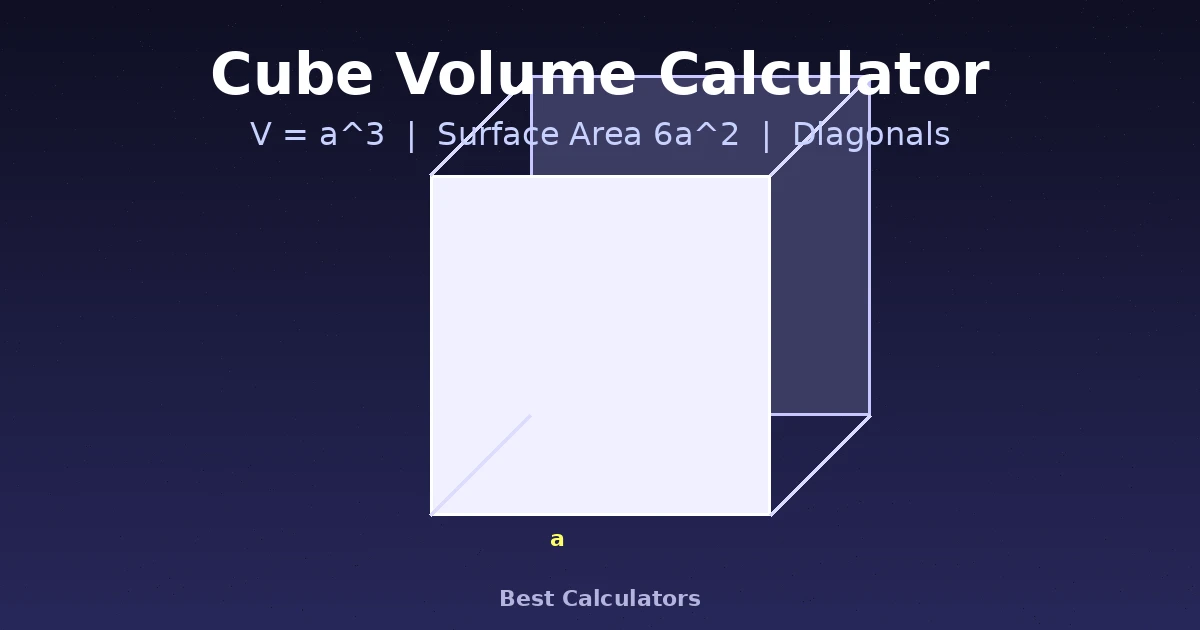
The cube is the simplest Platonic solid, with six congruent square faces, twelve equal edges, and eight vertices, which is why every measurement of a cube can be derived from one edge length. That single-fact geometry makes the cube a popular starting point for teaching volume, surface area, and spatial reasoning in middle school math, and it also shows up constantly in real life: storage containers, dice, planter boxes, dice trays, and most kitchen canisters are practical cube examples.
Common use cases include estimating the interior capacity of a cubic storage bin, packing crate, kitchen container, or moving box before loading it; calculating the volume of a cubic footing, planter, or concrete block so you can order the right amount of material; sizing a cube-shaped aquarium or terrarium in liters and US gallons before stocking it; and checking geometry homework, classroom demonstrations, and competition math problems that involve cubes and their diagonals.
For general 3D solid volume work across spheres, cones, cylinders, and pyramids, our volume calculator covers the full family of shapes in a single tool.
How the Cube Volume Calculator Works
The cube volume calculator solves for the edge length a in meters from whichever value you supply, then computes volume, surface area, and the two diagonals from that single recovered edge length. This avoids the need to enter every measurement by hand and keeps the geometry internally consistent.
Surface Area = 6a^2
Face Diagonal = a * sqrt(2)
Space Diagonal = a * sqrt(3)
Where a is the recovered edge length in meters, V is the volume in cubic meters (or your selected display unit), the face diagonal crosses one square face, and the space diagonal cuts through the interior from one vertex to the opposite vertex.
Worked example: a 1 m cube. Step 1: Volume V = a^3 = 1^3 = 1 m^3. Step 2: Surface area A = 6 * a^2 = 6 * 1 = 6 m^2. Step 3: Face diagonal d_f = a * sqrt(2) = 1.4142 m. Step 4: Space diagonal d_s = a * sqrt(3) = 1.7321 m. A cube with a 1 m side holds exactly 1 cubic meter of space, has 6 square meters of outer surface, and the longest inside-the-cube distance is about 1.73 m, which is the value you can sanity-check with a tape measure from one back corner to the opposite front corner.
If you only know the face diagonal of a cube, divide that measurement by sqrt(2) to recover the side, and if you only know the space diagonal, divide by sqrt(3). When you only have the surface area, take the square root of surface area divided by 6, and when you have the volume, take the cube root. According to Wolfram MathWorld, a cube has volume V = a^3, surface area A = 6a^2, face diagonal a*sqrt(2), and space diagonal a*sqrt(3), which is exactly the chain of relationships this calculator evaluates. As published by Encyclopaedia Britannica, the volume of a cube equals the cube of its edge length, a relationship that has been part of Euclidean geometry since antiquity.
For imperial cubic-foot and cubic-yard work, our cubic feet calculator uses the same V = a^3 idea but skips the unit-conversion step.
Key Concepts Explained
A cube has only one independent length, but four useful measurements, so it helps to know exactly what each one describes.
Edge Length (a)
The length of one of the twelve equal edges. Every other cube measurement is derived from this single number.
Volume (V = a^3)
The amount of three-dimensional space enclosed by the cube, equal to the edge cubed. Doubling the edge multiplies the volume by eight.
Surface Area (6a^2)
The total area of all six square faces. Doubling the edge multiplies the surface area by four, not by eight.
Face and Space Diagonals
A face diagonal runs across one square face (a*sqrt(2)), and the space diagonal cuts through the interior (a*sqrt(3)). They grow faster than the edge.
These four quantities are the only measurements most cube problems ever need. Once you have a, you can produce V, A, d_f, and d_s with nothing more than a calculator and the unit conversions above. For a side-by-side look at how cube volume compares with cylindrical, spherical, and conical volumes, our cylinder volume calculator is a useful reference for the cylinder family of solids.
How to Use This Calculator
Use the cube volume calculator in five short steps, switching measurement modes without re-entering data.
Select the Known Value
Pick side length, face diagonal, space diagonal, surface area, or volume from the first dropdown.
Enter the Measurement
Type the numeric value of the measurement you already have in the value box.
Choose the Length Unit
Pick the unit that matches the value you entered. Millimeters, centimeters, meters, inches, feet, and yards are all supported.
Pick a Volume Display Unit
Choose cubic meters, liters, US gallons, or US cups to control how the final volume is reported.
Read the Full Cube Profile
Watch the side length, volume, surface area, and both diagonals update in real time without pressing a button.
Practical example: If you measure a cubic planter at 50 cm per side, switch the length unit to centimeters, enter 50, and select liters for the volume display. The calculator reports V = 125 L, surface area = 1.5 m^2, face diagonal = 70.71 cm, and space diagonal = 86.60 cm, which is enough information to order soil, liner fabric, and sealant in the correct quantities. To translate that 125 L into a more familiar kitchen measurement such as cups, open the volume converter and select liters to US cups for a direct comparison.
Benefits of Using This Calculator
A cube volume calculator saves time and removes the algebra from four tightly related calculations.
- • One Input, Four Outputs: Enter one measurement and the calculator returns side length, volume, surface area, and both diagonals at the same time.
- • Flexible Starting Points: You can start from side length, face diagonal, space diagonal, surface area, or volume without redoing the math by hand.
- • Metric and Imperial in One Place: Switch the length input between millimeters, centimeters, meters, inches, feet, and yards, and switch the volume output between m^3, L, US gal, and US cups.
- • Eliminates Algebra Mistakes: The diagonal and surface-area inverses (divide by sqrt(2), divide by sqrt(3), sqrt(divide by 6), cbrt) are easy to mix up, but the calculator handles them automatically.
These benefits make the cube volume calculator useful for both quick planning and rigorous school or work problems. To estimate the volume of related 3D shapes like a sphere or a rectangular tank, you can use the same workflow with the sphere volume calculator, which is set up for radius, diameter, and circumference inputs.
Factors That Affect Your Results
Three measurable factors control the precision of your cube volume result, and two practical limits apply to any volume-of-a-cube estimate.
Unit Conversion Precision
The meter, inch, and foot factors used to convert your input are exact in this calculator, so length and volume conversions do not introduce error.
US Gallon and Cup Definition
The US gallon and US cup are defined relative to the cubic inch, so a 1 m cube converts to a clean 264.172052 US gallons but a slightly less clean liter total of 1,000 L. According to NIST, one US gallon equals 3.785411784 liters and one liter equals 0.001 cubic meters, which underpins the volume unit conversions in this calculator.
Rounding and Display Precision
Results are stored at full JavaScript precision and rounded to four decimal places on the page, so small cubes (under 1 cm) may show the same rounded value at multiple edge sizes.
Square and Space Diagonal Use
The face diagonal divides by sqrt(2) and the space diagonal divides by sqrt(3); entering one value when you meant the other is a common input error that immediately changes the recovered edge length.
Limitations: The calculator assumes a perfect cube. Real-world objects with slightly rounded edges, manufacturing tolerances, or non-square faces will have a true volume lower than the calculator's V = a^3 result. The page rounds display values to four decimal places, so for very small cubes (under 1 mm per side) or very large cubes (over 1 km per side), switch the length or volume unit to keep the displayed number readable.
For a more involved look at how surface area and volume scale with each other across a range of solid shapes, the surface area calculator walks through the full comparison for cubes, prisms, and pyramids.
Frequently Asked Questions (FAQ)
Q: What is the formula for the volume of a cube?
A: The volume of a cube is V = a^3, where a is the length of one edge. Doubling the edge length multiplies the volume by eight, and halving the edge length reduces it to one eighth of the original.
Q: How do you calculate the volume of a cube with a side length?
A: Take the side length in any linear unit, cube it, and apply the matching cubic unit. A 1 m cube has a volume of 1 m^3, a 10 cm cube has a volume of 1,000 cm^3, and a 2 ft cube has a volume of 8 ft^3.
Q: How do you find the volume of a cube from its diagonal?
A: Divide the face diagonal by sqrt(2) to recover the side, or divide the space diagonal by sqrt(3). Then cube the side length to obtain the volume. This calculator performs both steps automatically when you select the diagonal input mode.
Q: How do you convert the volume of a cube to gallons or liters?
A: Convert the side length to meters, cube it to get the volume in cubic meters, and multiply by 1,000 to obtain liters or by 264.172052 to obtain US gallons. The calculator does this conversion when you change the volume display unit.
Q: What is the difference between the surface area and the volume of a cube?
A: Surface area is the two-dimensional measurement of the outside of the cube and is calculated as 6a^2 in square units. Volume is the three-dimensional measurement of the space inside the cube and is calculated as a^3 in cubic units. Doubling the edge multiplies surface area by four and volume by eight.
Q: Is a cube a rectangular prism?
A: Yes. A cube is a special case of a rectangular prism in which all three edge lengths are equal and all six faces are squares. Any formula that works for a rectangular prism, like V = length x width x height, also works for a cube.