mg to mL Calculator for Liquid Concentration
Convert a milligram amount and mg/mL concentration into liquid volume, with reverse amount checks and density context.
mg to mL Calculator
Results
What This Calculator Does
This tool converts a quantity stated in milligrams into a liquid volume stated in milliliters. It is built for cases where the source information gives an amount of substance, active ingredient, or dissolved material, while the measuring tool or container is marked by volume. It also works in reverse, converting a milliliter volume into milligrams when the same concentration is known.
The conversion depends on concentration or density. Milligrams describe mass or amount, and milliliters describe volume. No universal factor turns mg into mL for every liquid because one milliliter can contain different milligram amounts. A dilute solution, a concentrated medication, water, milk, cooking oil, and syrup all produce different results from the same milligram entry.
This page treats the bridge value as milligrams per milliliter. For a medication label, that value may appear directly as mg/mL or indirectly as mg per 5 mL. For a general liquid, density can be entered in the same field. Water-like density is commonly approximated as 1000 mg/mL, but that shortcut should remain visible rather than hidden inside the answer.
The result is arithmetic support, not a dosing recommendation. Medication directions, treatment decisions, rounding rules, and measuring-device choices belong with a clinician, pharmacist, veterinarian, or product authority. The conversion is most useful after the intended milligram amount and the correct concentration have already been established.
That boundary is important because the same formula appears in science labs, kitchens, workshops, and medicine labels. The clinical question is broader than the unit conversion, so the arithmetic should stay separate from decisions about administration.
The output also helps expose when two records are describing different things. A package may list net contents by volume, a formulation may list active ingredient by milligrams, and a storage log may list total product weight. Those values cannot be compared until the relevant concentration, density, or formulation basis is known.
For broader medicine arithmetic that also includes body-weight inputs, the Dosage Calculator keeps dose, strength, and liquid volume together in a separate clinical-math workflow.
How the Calculator Works
Forward mode uses one direct equation. Milliliters equal the entered milligrams divided by concentration in milligrams per milliliter.
For example, 250 mg at 80 mg/mL equals 250 divided by 80, or 3.125 mL before display rounding. Reverse mode rearranges the same relationship as milligrams = milliliters x concentration. A 5 mL amount at 20 mg/mL therefore contains 100 mg.
The unit structure follows metric prefixes. According to the BIPM SI prefixes, milli represents 10^-3, so one milligram is one-thousandth of a gram and one milliliter is one-thousandth of a liter. The equation keeps those two milli-units separate until concentration connects them.
When density is the source value, the same field still works if density is expressed as mg/mL. A density of 1 g/mL is 1000 mg/mL. A density of 0.92 g/mL is 920 mg/mL. Converting density into mg/mL first lets the calculator use one equation for liquids, mixtures, and labeled solutions.
The supporting rows are calculated from the same inputs rather than from separate rounded answers. Grams are milligrams divided by 1000, liters are milliliters divided by 1000, and the formula row repeats the exact operation selected by the conversion direction. This prevents a common audit problem where a rounded volume result is reused to calculate grams or liters, adding avoidable rounding drift to a simple record.
In reverse mode, the concentration still carries the meaning of milligrams per one milliliter. A 2 mL entry at 80 mg/mL gives 160 mg because each milliliter contributes 80 mg. The calculator does not infer whether that amount is large, small, correct, or safe; it only reports the amount implied by the concentration and measured volume.
When the bridge value must be calculated from measured mass and volume, the Density Calculator can solve that missing concentration-like value before the mg-to-mL conversion is performed.
Key Concepts Explained
The important concept is that amount and volume are not interchangeable on their own. Concentration tells how much milligram content is present inside each milliliter. Once that bridge is known, the arithmetic is simple and auditable.
Milligrams
Milligrams describe mass or active amount. A small mass can require a large or small volume depending on concentration.
Milliliters
Milliliters describe volume. Syringes, cups, lab cylinders, bottle marks, and small containers commonly use mL markings.
Concentration
Concentration in mg/mL states how many milligrams are contained in one milliliter of liquid.
Density
Density can be used for general liquids when the mg value represents total material mass rather than active ingredient.
The NIST SP 330 accepted units table lists the liter as a non-SI unit accepted for use with the International System and identifies it as 10^-3 cubic meter. That reference supports the metric volume side of the calculation while the mg/mL value supplies the material-specific relationship.
Concentration labels can be written several ways. A label of 400 mg/5 mL is equivalent to 80 mg/mL because 400 is divided by 5. A label of 12.5 mg/5 mL is equivalent to 2.5 mg/mL. The form provides common presets and a custom field so that the displayed formula uses the normalized mg/mL value.
For nearby metric mass conversions after the milligram amount is known, the mg to Lbs Calculator converts milligrams into pounds without adding a liquid-volume step.
Reference Values and Source Notes
The calculation does not contain a changing legal rate or health threshold. Its fixed references are metric relationships and user-selected concentration values. The metric relationships are stable: milli means one-thousandth, 1000 milligrams equal one gram, and 1000 milliliters equal one liter.
The presets are examples that help the form start with familiar values. Water-style density is set at 1000 mg/mL. Milk-style density is set at 1030 mg/mL, cooking oil at 920 mg/mL, diphenhydramine oral liquid at 2.5 mg/mL, ibuprofen oral liquid at 20 mg/mL, and amoxicillin suspension at 80 mg/mL. Actual products may differ, so the label or official product information should control any real record.
For medication package language, the U.S. Food and Drug Administration maintains the Drugs@FDA database, where approved labels and product details can be reviewed for many U.S. medicines. This page does not fetch product labels; it only provides the arithmetic after a concentration has been entered.
Concentration should be copied carefully because a small notation change can create a large volume error. A product written as 100 mg/5 mL is 20 mg/mL, not 100 mg/mL. A product written as 50 mg/mL is already normalized and should not be divided by 5 again.
The preset values should also be treated as examples rather than a promise about every bottle or batch. Formulations can change by country, manufacturer, package size, dilution, compounding process, or concentration after reconstitution.
For volume-only work after a milliliter value is calculated, the Volume Converter can compare milliliters with liters, cups, fluid ounces, and other capacity units.
How to Use This Calculator
- Choose the conversion direction. Select mg to mL for a milligram amount that needs liquid volume, or mL to mg for a volume that needs amount.
- Enter the known amount. In forward mode the amount is milligrams. In reverse mode the amount is milliliters.
- Select a preset or custom concentration. A preset fills the concentration field, while the custom option allows any positive mg/mL value.
- Check the concentration field. If a label gives mg per 5 mL, divide by 5 before treating it as mg/mL.
- Review the result rows. The primary answer shows the requested conversion, while supporting rows show grams, liters, concentration, and formula detail.
The quick amount menu fills common milligram examples in forward mode. It is disabled in reverse mode because the amount then represents milliliters instead of milligrams. Reset returns the form to 250 mg at 80 mg/mL, which produces 3.125 mL before rounding.
For careful records, the concentration source should be stored beside the result. A calculation that says 3.13 mL is incomplete unless it also shows that the source concentration was 80 mg/mL. This is especially important when two products share the same active ingredient but have different strengths.
For household-scale volume breakdowns after mL is known, the Cups to Tbsp, Tsp, Oz, mL Converter provides spoon and cup equivalents.
Benefits and When to Use It
The main benefit is transparency. The calculator displays the concentration used, the formula, and supporting metric units, so the result can be checked instead of copied as an unexplained number. That is valuable whenever a source switches between amount language and volume language.
- Label interpretation: A strength such as 400 mg/5 mL can be normalized into 80 mg/mL before volume is calculated.
- Liquid planning: A known milligram target can be translated into a fill volume when concentration is fixed.
- Density examples: Water-like or oil-like materials can be converted when density is expressed in mg/mL.
- Reverse checks: A measured mL amount can be converted back into contained milligrams.
- Audit support: Formula text makes entry mistakes easier to spot before a value moves into another record.
The conversion should not be used to choose a medication dose, decide whether a medicine is appropriate, or override a written label. It also should not be used when the label is unclear, the concentration has changed after dilution, or the material is not uniformly mixed.
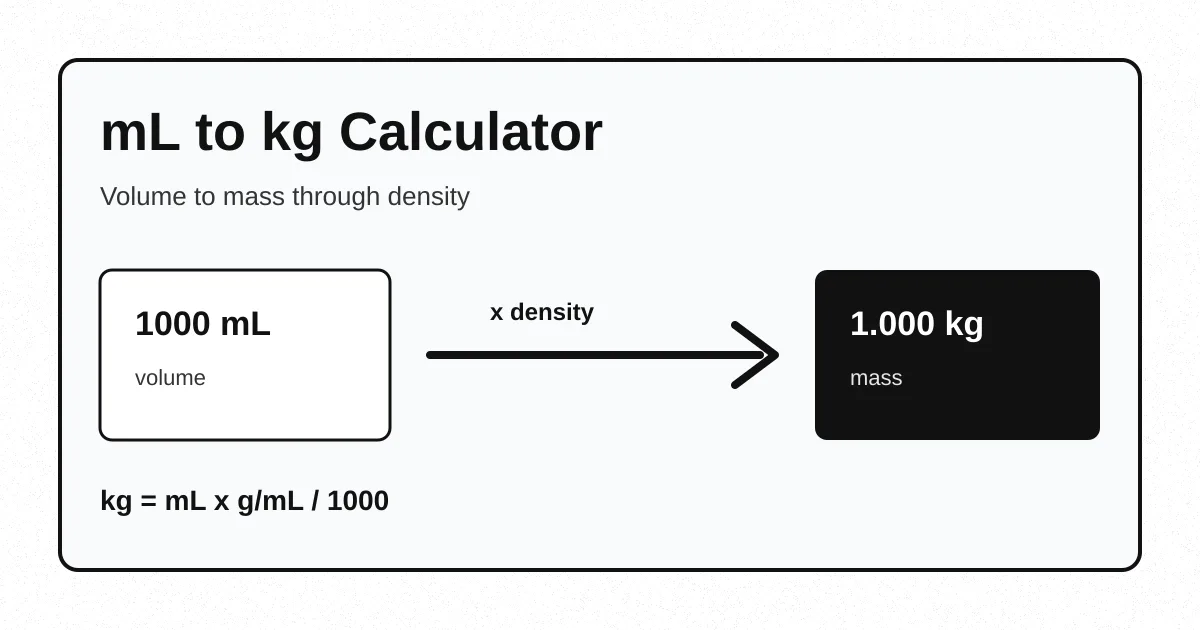
For liquid volume converted into weight rather than active amount, the mL to Grams Calculator follows a density-based path from milliliters to grams.
Factors That Affect Results
The chosen concentration has the largest effect. At 20 mg/mL, a 100 mg amount requires 5 mL. At 80 mg/mL, the same amount requires 1.25 mL. The milligram amount is unchanged, but the liquid strength changes the volume.
Label wording is another major factor. A strength printed as mg per 5 mL must be divided by 5 before entry unless a preset already performed that normalization. A strength printed as mg/mL can be entered directly. A strength printed as percent, ratio, or units per mL needs separate interpretation outside this calculator.
Mixture uniformity matters. Suspensions may need proper shaking, concentrated liquids may need dilution, and some materials may settle or separate. The calculator assumes the entered concentration applies evenly throughout the measured volume.
Rounding should match the measuring tool. A displayed result of 3.13 mL may be too precise for a cup marked every 1 mL, while it may be reasonable for a calibrated oral syringe with smaller graduations. The decimal control changes display precision, not the underlying calculation.
When the final volume must be restated with kitchen spoons for non-medication work, the Cooking Measurement Converter compares milliliters with teaspoons, tablespoons, cups, and other recipe units.
Real-World Examples
Water-style density: A 1000 mg water-like amount at 1000 mg/mL equals 1 mL. The same relationship explains why 5000 mg is about 5 mL for a water-density liquid.
Amoxicillin-style label: A 400 mg/5 mL suspension is 80 mg/mL. A 250 mg amount at that concentration equals 3.125 mL. The calculator displays the rounded mL value and keeps the formula visible.
Ibuprofen-style label: A 100 mg/5 mL liquid is 20 mg/mL. A 100 mg amount equals 5 mL, while 200 mg equals 10 mL. A different product strength would change those volumes.
Oil-density example: A 920 mg/mL oil-like material needs about 1.087 mL to contain 1000 mg of material. Treating it as water would understate the volume slightly.
Reverse check: A measured 2.5 mL amount at 80 mg/mL contains 200 mg. This reverse path is helpful when a volume is known and the contained amount needs review.
Custom concentration example: A lab preparation listed at 12 mg/mL and a target amount of 30 mg gives 2.5 mL. If the preparation is later diluted to 6 mg/mL, the same 30 mg target becomes 5 mL. The doubled volume shows why concentration belongs beside every converted result.
Frequently Asked Questions
Q: How does an mg to mL calculator work?
An mg to mL calculator divides the milligram amount by concentration in mg per mL. The same equation can be reversed by multiplying milliliters by concentration to calculate milligrams.
Q: Is 1000 mg always equal to 1 mL?
1000 mg equals 1 mL only when the liquid concentration or density is 1000 mg per mL. Water is often approximated that way, but medications, oils, syrups, and mixtures need their own concentration or density.
Q: What formula converts mg to mL?
The formula is milliliters = milligrams / concentration in mg per mL. For example, 250 mg at 50 mg/mL equals 5 mL.
Q: Why does concentration matter for mg to mL?
Concentration matters because milligrams measure amount of substance and milliliters measure volume. A stronger liquid contains more milligrams in each milliliter, so the required volume is smaller.
Q: Can this calculator convert mL back to mg?
Yes. In reverse mode, the calculator multiplies milliliters by the entered concentration to report milligrams, grams, liters, and formula detail.